Wednesday, August 12, 2020

Xavier Lopez Performance #11B: On The Edge: Latinx Performance Art Festival --Teaching A Hare to Tell Time. 2016


"Dream of the Soft Cyborg (Performance Art) : "Explaining the world to a Hare," Pioneer Square, Seattle, WA . La Cocina. Rumor has it that this was the first night of all Latinx non-solo Performance Art in Seattle history--but who knows for certain. 2016.


This performance, like the earlier Spaniard performance at Anne Bonney in Seattle and a lost performance that I did at UCDavis all owed significantly to the performances of Joseph Beuys, whether I was aware of it or not.  His mythology and mine overlapped in some very significant ways.


If I was somehow given the opportunity, I would love to work on a performance with Joseph Beuys--of all the artists throughout history--his is the one that I seem to come back to the most--visually, we share some striking similarities--which is odd--because for both of us the performance work is extremely personal, autobiographical and anecdotal. I'm sure that Beuys himself would say it has something to do with a kind of post-Jungian--artistic collective mind--but all of that is just a little too new agey for me--though I love Beuys for being so out there and for being so willing to go out on a limb for what he believed--no matter what!


As a child, before I even knew what art was, I would watch my father paint murals in the Los Angeles Chicano Art Movement as I would tag along to the Mechicano Art Center on Whittier Blvd mentally devouring the exciting scenes of Latino artists expressing what it meant to be Chicano back then! Days passed as I watched my father paint his expressionist, politically charged murals, day-dreaming of my own future. Every month my parents would take us to the LA Museums and galleries, where we saw Warhol's “Brillo Boxes,” conceptual sculptures and the films of Joseph Beuys and Gilbert and George. Later, in college, at the University of Nevada Reno and Uc Davis, my mind would be blown by the work of Marcel Duchamp and Dada, who influenced my now, mixed media performances. 


It was during this time that I began to perceived an unspoken difference between how my heroes made art and how I--as a young Latino artist--was expected to. Let me tell you a story. As a young artist, I searched everywhere, for successful Chicano artists for a sense that my work had a place. When Duchamp or Beuys made their work it was about ideas, their ideas, it reflected their view of the world. No one asked Marcel Duchamp to make work that was solely about his heritage—and he did not have to make artwork for the annual Halloween exhibition, knowing that that was the only time he would be able to show his work. I desperately wanted to make art that had meaning beyond other's expectations—art that reflected my life!  But I had no models, no history to fall back on. I decided that I would have to make my own. 


Ultimately, At UCDavis, critical theory, personal history and personal artifacts began to infuse my work opening it up to incorporate queer, feminist and other identity discourses. I created two theoretical treatises, "The Soft Cyborg," a variation on Haraway's "Cyborg" and "Putoh"--melding Japanese Butoh and Latino identity performance. 

Today, issues of gender, race and identity permeate my work and it is through performance that I seek to push the boundaries of how we perceive the essence of ethnic/cultural/Latinx performance, to give voice to underrepresented groups and, moreover, to expand the language of marginalized performance and even to broaden access through guerrilla and drop-in performances. . As a Latino Artist who works with many materials that have been pared down to their core elements, minimalized and purified so to speak--creating fiercely personal narratives--I have been forced to deal with oversimplified views of who can make what and what art can be made. 


I am part of a new breed of Latinx artists intent on expanding the themes and expectations available to minority artists--making art that is individual--defying traditional expectations of collective identity. I choose personal, everyday materials, a collage of sheets, candy, fake flowers, tin foil and personal items in order to tell my stories. This is an important conceptual, performative and material shift that cannot be overstated. It is a stance of liberation, which pushes the boundaries of expectations and dares to say that individual lives of color matter; which, in itself, is powerful and revolutionary, problematizing racial, masculine, cultural and identity essentialism in an intellectual investigation which is in no way post-race. 


Saturday, August 8, 2020

Xavier Lopez Performance #11A: Cacophany Anodyne and Hamlet's Ghost Introduction.


In 2016, there were only a handful of us, each of us taking the stage one after the other. From spoken word poetry and more traditionally Latino performance. I was the last one that hot, August night and as a cacophony of layers and layers of looped recordings of the tune "Theme From A Summer Place" played while I, dressed as a ghost handed out flowers into the audience, later I painted in chocolate and strawberry syrup, and dressed as a giant teddy bear--none of us had any idea that we were the first ones to put together a festival of Performance Art that was brave enough to claim the term Latinx. We had no idea that this was the first all-Latinx performance art festival--in all of its difficult to classify, irreverent, problematic, transient glory. The night itself was wonderful; then we became part of university curricula across the globe when Marvin Carlson claimed us in Routledge's textbook "Performance: A Critical Introduction."

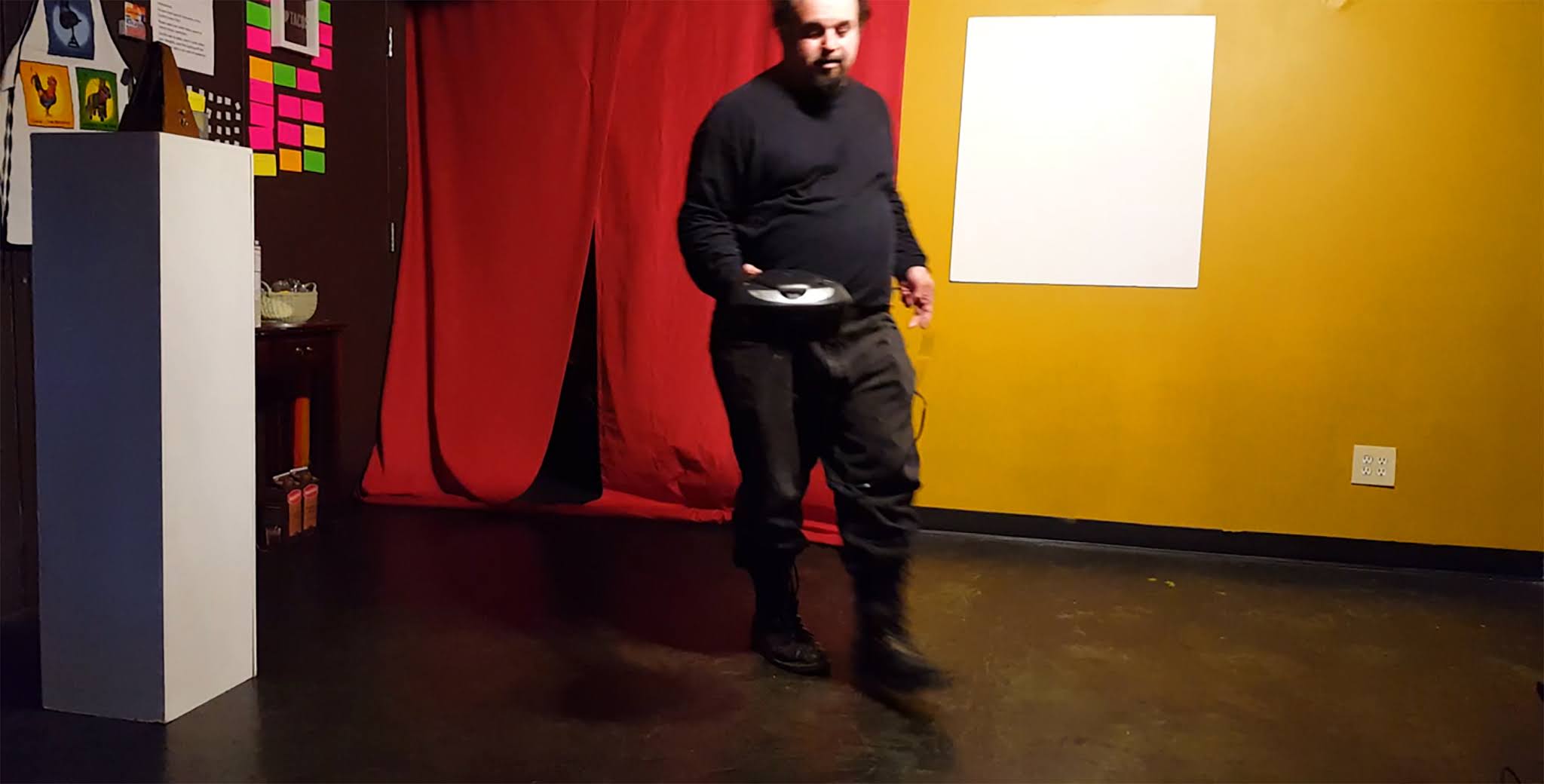
The first performance of the night began with me placing multiple "boom boxes" out throughout the room all playing the same track in a kind of staggered "row row row your boat"sort of way. Then I came out as a ghost and handed flowers to the audience.


For the last twenty years I have been working with Sheet Ghost installations, performances and sculpture. Beginning first with my performance art in 1993, wherein I first used the "sheet ghost" in a significant way--I have found the ghost to be an amazingly expressive means of dealing with many issues ranging from the extremely personal to themes of isolation and even more abstract ideas as was the case in the most recent installation I did for the Seattle Office Arts & Culture's "Dialogues in Art" series, wherein I dealt with issues of homelessness. In Hope/Home, the first installation with multiple figures, the sheet ghosts became stand-ins for my family as we dealt with a period of homelessness that we experienced when I was still very young. Over the course of several installations I have seen my process become increasingly narrative and more and more theatrical.


Wednesday, August 5, 2020

Xavier Lopez Performance #11: Overview - On the Edge: First International Latinx Performance Art Festival.


In 2016, I, alongside La Sala/La Cocina, with organizational assistance from Lauren Davis, created "On the Edge: Latinx Performance Art," the first all-Latinx performance art festival in Seattle. We came to understand how profoundly new this concept was-worldwide, when Marvin Carlson named our event in Routledge's textbook "Performance: A Critical Introduction" becoming part of university curricula across the globe. We are working toward creating the second biennial event in 2021--moved forward due to the current pandemic.

“La Cocina” was a series of summer events using the notion of ‘cooking’ as a creative metaphor for the development of new artistic work. Headlined by a month-long pop-up salon in Pioneer Square’s new “Good Arts” building, a cohort of curators (a multi-disciplinary group of professional Latino arts leaders and artists in visual, dance, theatrical, music, and literary arts) programmed each week with events and exhibitions mixing ‘ingredients’ from the diversity of Latino/a/x history and cultures. Coinciding with the Seattle Art Fair for visibility, the new visual and performing works created for “La Cocina” blended technology with heritage, as well as local and international flavors of ‘Latino Futurism’ and performance art to audiences and participants.

The first On the Edge Festival was a one-night event, small but expansive, dedicated to serving Seattle and the Seattle Latinx community, giving voice to local Latinx Artists presenting work that is rarely seen in our communities.


Xavier Lopez is a contemporary, Latinx/o conceptual, mixed media and performance artist. Lopez received his MFA from the University of California, Davis, where he created the theoretical/artistic thesis of the "Soft Cyborg." He is part of a young group of artists who are seeking to move beyond contemporary mainstream art ideas, becoming post-genre, mixing sculpture, performance art, theory, painting and anything else they can get their hands on to create something exciting and new. 

"In 2016, I was asked to program an evening of performance art for La Sala Latinx Artists Network’s ‘La Cocina’ in Pioneer Square, which exceeded all our hopes."  


Xavier Lopez and Lauren Davis put together the very first Latinx Performance Art Festival. (They are currently planning more in the series.) Then in 2017, Xavier Lopez alongside Vicente Montanez were cited in the Routledge critical theoretical textbook "Performance: A Critical Introduction"--by Marvin Carlson in the third edition of his seminal work, as leading figures in the Latinx Performance Art movement, something for which they are extremely proud.

"As a Latinx performance artist, I knew our 2016 event was unique and vital to the Seattle community, showcasing Latina/x/o artists' identity and genre-expanding work. But none of us could imagine that our event would become part of worldwide university curricula inspiring a new generation of Latina/x/o artists. Academic Marvin Carlson wrote in Routledge's textbook "Performance: A Critical Introduction,” “There is a growing body of...artists who specifically identify themselves as Latinx, headed by...Xavier Lopez...featured in the first festival of Latinx performance, held at the Good Arts center...in Seattle... Latinx represents an important orientation in modern performance... concern(ed) with developing more inclusive and flexible attitudes toward designations of gender, race, and ethnicity...addressing this major reorientation of the field." --original wording about our event, which was later updated to include the creation of Putoh. 


This, then is the final wording for the book "Performance: A Critical Introduction" straight from the pen of Marvin Carlson: 

"The First Latinx performance venue was established in 2013, the Teatro Publico de Cleveland, and there is a growing body of theatre artists who specifically identify themselves as Latinx, headed by Xavier Lopez Jr. and Vicente Montanez. Lopez created the first festival of Latinx performance, held at the Good Arts center for experimental theatre in Seattle in 2016, in which Montanez performed. Lopez is also co-creator, with performance artist Katherine Adamenko of New York City, of Putoh performance, a melding of Chicano performance art and contemporary art inspired by Butoh." 

Lopez is part of a new breed of Latinx artists for whom art-making, while still personal and autobiographical in the broadest sense, eschews the obvious tropes of masculinity, hegemony and race.  As an Hispanic artist, it has become clear to Lopez over the course of his thirty-plus year career that his work has focused on a more personal kind of conceptualism, centering on autobiography and his own set of obsessions, hopes and fears.


Vicente Montanez at the first Latinx Performance from On The Edge: Latinx Performance Art Festival: This image spotlights Vicente Montanez performance from our first festival in 2016. The evening of August 5, 2016. On the Edge: Latinx Performance Art featured experimental performance art by contemporary Latino/a/x artists, featuring Xavier Lopez, Jr. and Vicente Montanez and coincided with the 2016 Seattle Art Fair and was part of the programming for the exhibit La Sala presents La Cocina.


"On the Edge" is aptly named as it is all about the cutting edge, it is about intersections and breaking the bounds and definitions of history. Latinx is, perhaps, the first movement of the twenty-first century and may, in fact be the first redefinition of the post-postmodern era. Latinx is a true reinvention and reinvesting of what it means to be Latino, through performance, through our work, I and other contemporary Latinx artists are defining a term that is defined by complexity, criticality and biographical and theoretical strength creating a "Latinoism" based on alliances that owes more of its form to the Queer and Feminist programs that lead the way for identity movements than to an essentialized Latino-ness. This festival seeks to engender, enlarge and expand the conversation of what Latina/x/o art is and what it can be. We live at a time in which definitions of race, masculinity, gender and art are changing, and "On the Edge" seeks to be a leading voice in this change.


Xavier Lopez Performance #10: Hamlet's Ghost: On the Edge: Latinx Performance Art Festival


The day before On The Edge Latinx Performance Art Festival, Lauren Davis and I did a test performance of the Ghost from the Introductory section of the Dream of the Cyborg.  While the audience was small, this was an important performance that reintroduces a character not seen since my third performance. 


Third Performance: Honest as Hell: The Poltergeist. 1992.  


It's important to note that these are sheet ghosts, in the sculptures they are empty figures using strings to hold their shape. In "Hamlet's Ghost," an installation that I am proposed later, I intended to try my first truly theatrical installation by recreating the climactic scene from Shakespeare's Hamlet--moments before so many of the characters become actual ghosts within the narrative of the play. It was a kind of sequel to this performance.

From a conceptual point of view the piece dealt with the infinite iterability of a text/language like Shakespeare's--which in my work always stands metonymically for language or the concept of the idea of the text. The piece, itself also acts itself as a Synechdochic element referring to the Shakespearean whole, moreover, the installation an performance was meant to be a visually arresting and beautiful visual experience.          


The idea of the Sheet Ghost comes from the idea of pareidolia. Pareidolia (/pærɪˈdoʊliə/ parr-i-DOH-lee-ə) is the tendency for incorrect perception of a stimulus as an object, pattern or meaning known to the observer, such as seeing shapes in clouds, seeing faces in inanimate objects or abstract patterns, or hearing hidden messages in music.  For me, this goes back to the Pinnocchio moment in fiction and even in biology where life comes from lifelessness.  This moment plays through in a lot of my work. 


Edited versions of Hamlet's Ghost performance. 


Monday, August 3, 2020

Xavier Lopez Performance #9: Cacophany Anodine 1+2 - Greenwood Collective, La Cocina First Latinx Performance Art Festival


Cacophany Anodyne has so far been performed twice, once at the Greenwood Collective, where it had its innaugural performance in, I believe 2015 and later in August of 2016 as part of the opening performance at On the Edge: (First) Latinx Performance Festival.  The idea behind this performance began from a simple drawing and was called either Easy Listening or Uneasy Listening--but later evolved in Cacophany Anodyne, for some reason, I'm not sure.  The idea was simple--I had always wanted to fill a room with sound--a cacophany made out of something completely inoccuous, something pretty and banal turned into something loud and rauccous--even overwhelming, like when a band prepares for a concert. 


My work had always had an element of sound, such as in one of the first Dum Dum Boy Art Exhibitions, where I deconstructed the sounds from a Kate Bush Album, "Running Up That Hill,"  focusing on the track entitled "Waking the Witch."  


 Another sound piece, this time sculptural was titled "Antigone and Creon: Angels and Beasts"  and dealt with the impossibility of communication and how when the truth is spoken sometimes it is impossible for humans to understand as it is spoken in the language of angels and animals. 


Cacophany Anodyne was part of the opening to my piece for the Latinx Performance Art Festival 2016, part of both La Sala's La Cocina Pop Up and that Year's Art Fair.  


Xavier Lopez Performance #8: Bloodtelling. Faire Gallery Cafe!


Xavier Lopez Performance #8: Bloodtelling. Faire Gallery Cafe!  This performance took place in the rain with the audience in front of the Faire Gallery Cafe in 2007.  In this performance, aided by Rebecca Dallin,  Bloodstains came from within my hospital gown. 


Sunday, August 2, 2020

Xavier Lopez Performance #7: Tales of the Soft Cyborg: The Spaniard.


Xavier Lopez Performance #7:  Tales of the Soft Cyborg: The Spaniard. 

After several years, after having lived in Europe, after having been married and gone to graduate school, I was single and ready to return to doing performance art, this time in Seattle, WA.  After a devastating divorce that had left me demolished; I took a year off from everything and had just begun showing work again, especially sculpture and painting.  At this time, as well, I began to write for the local online newspaper, the Post Intelligencer and became fast friends with local artist Ryan "Henry" Ward and a particular band of Street Artists.  The "Soft Cyborg" had moved into the world of sculpture, including ghost sculptures and moving, flexible, latex sculptures.


Soft Cyborg: Ghost Story: A mixed media audio/visual sculpture including the video Soft Cyborg: Brothers, which was played below the ghost forcing the viewer to look under the skirted folds of the ghost's sheet.  


Video of Soft Cyborg: Brothers from underneath the Ghost sheets.


This is the video projection part of an installation I did at the Faire Gallery Cafe in Seattle Washington as part of the Soft Cyborg series.


During my time at the University of California, Davis, I had been working with latex and plaster making large sculptures with them.


It was a logical next step for latex to find its way into the performance. 


The actual performance took place at the Anne Bonney, an antique shop that was next door to the Faire Gallery and Cafe, at which I often showed art.   The Spaniard, the creature/protagonist/antagonist in this performance was very loosely based on the infamous shaving scene from the Melville tale, "Benito Cereno."  More for the feeling than in any concrete way. but also possibly in the way that the scene depicts the consummate definition of an unreliable narrator.  


In fact, this entire performance is about telling stories, whether real or imagined, truth or lies.  The performance begins with the Spaniard either speaking through or speaking to a stuffed monkey and ends with the Spaniard wearing a sailor's cap playing records telling war stories and painting pictures. 


Saturday, August 1, 2020

Xavier Lopez Performance 6. Nightmare: Re:Construction, Retitled "The Utter Impossibility of Truly Understanding the Position of the Other."


Photograph taken during performance of “Nightmare: Re: construction,” (Later, retitled–“The Utter Impossibility of Truly Understanding the Position of the Other.”) (Full Title.) 2001. Katherine Adamenko's Closeted Salon. 

The performance "The Impossibility of Truly Understanding the Other;" exemplifies my process. The process began with a theoretical, pro-feminist idea, influenced by Judith Butler and other feminist writers, then moving into a more personal tone centering around everything my mother gave up as a Latina woman. My work is multi-vocal and Latinx, refusing essentialist identity, as Marvin Carlson describes in "Performance: A Critical Introduction," "There is a growing body of...artists who specifically identify themselves as Latinx, headed by...Xavier Lopez...These and others were featured in the first festival of Latinx performance, held at the Good Arts center...in Seattle... Latinx represents an important orientation in modern performance...concern(ed) with developing more inclusive and flexible attitudes toward designations of gender, race, and ethnicity."

I seek to engender, enlarge and expand the conversation of what Latina/x/o art is and what it can be. We live at a time in which definitions of race, masculinity, gender and art are changing, and through my performance I seek to be a voice in this change and to translate this mission into a body of work that is consistent with these goals.

"What I am saying is that those like me–that we exist, write perform and theorize from a position that has already always been post-modern—post identity, post singularity. We know, inherently, what it means to walk through several spaces at the same time; we know what it means to wear many contradictory masks, to speak many strange accents and in multiple languages. We do not emulate a white, male desire to reconstitute identity–because it is not part of our history. We do not call for society to attempt to recreate a space of modernity—to lie to ourselves so that we can move on. Instead we claim a new, shifting, mobile space of many, even antagonistic identities—which we deploy when needed. Trust me when I say that the future will engender a new kind of multiculturalism, we will not be manipulated by those that cry “cultural appropriation” in an inauthentic, ignoble attempt to keep us in place–but we will celebrate diversity, interdisciplinarity and shared, overlapping identities and the differences that come from individual lives lived to the fullest–each of us engendering a multiplicity of identities–individual and shared with the knowledge that no one is lessened by celebrating difference–a space in which no one is “othered”–because we have seen through the current ploys to divide us draped in the wolves’ clothing of a language that we have been speaking for too long, one which the enemy has learned to use against us. We are instead, reclaiming something that we have already always known, something that was never a shock to our multi-national, multi-ethnic, multi-vocal selves–we all are very different–just as we are all the same and we must celebrate it all–individual Lives Of Color–matter. That is to say that every moment, every dream, every hope and failure of every individual life in color–matters."


I do suppose if you were told for millennia that your identity was fixed, that history was fixed, that you could drop your life into a construct made up out of generation upon generation of others who looked exactly like you, where civilization was coursing in a predictably positive way, whereupon each generation could applaud itself and ignore the bumps and fissures and massacres of others that did not fit into your cozy, neat narrative, which only included lives that you could pronounce, name and claim –that this loss would be pretty startling. But it is not, cannot be, if you never had those expectations in the first place.


In the performance-“Nightmare: Re: construction,” (Later, retitled–“The Utter Impossibility of Truly Understanding the Position of the Other.”) I have come to some answers and many more questions. Some of these include: “what does it mean and why is it of utmost importance, now, for a male to recognize and reconsecrate his connection to feminism?” “Why do I feel that feminism is the most important critical, theoretic and performative movement undertaken by women and men?” These questions have been brewing in my heart and mind for ages, but have come full-force to the surface over the last three quarters in which I enrolled in three separate feminist courses, one of which was ironically entitled “Masculinities.” This has been a time for me in which I have re-upped and re-recognized my inherent connections to feminism–especially as a performance artist.


I have stated in the past, in this class that I do not feel alien to the tendencies and practices of feminism. I do not feel as though they are not about me, perhaps this is queer, it certainly seems anti-masculinist, both of which I stand by gladly. It just seems as though my issues, issues of race, identity, gender all began as feminist issues. If one is honest, s/he will note that none of the spaces that we recognize now, none of the voices that we hear now could be recognized without feminism.


One of the most important achievements of feminism has been to open up spaces and to allow those that had not been able to speak to hear their own voices and to share their dialogue with others. To a certain extent all of the authors have spoken about the history of silence, the silencing of voices and finally the reclaiming of those voices, certainly Hipple, hooks and others have pointed to the need for as many voices to be heard as possible. Hipple, especially, by taking words and feelings and making them into artwork, something tangible and beautiful stands as a model for me. The ability to speak and to be heard is something which all of us, me as a queer little boy, me as a young Hispanic male, me as a comic book fan and victim of the eighties, me as a melancholy lover of sad poems and British television-owes to feminism; the ability to share with pride even the most unique aspect of myself. Feminism has opened up the queerest spaces and like the speculum that Haraway theorizes it allows us to look inside and see the blossoming complexities within each of us.


Today, I still wince, when I see my soft, fat body on a television screen, when I see myself revealed and naked for others to grade and gauge me in comparison to whatever models of the human body they have in mind. I still wince when I see a misstep in my performance, but perhaps a bit less often, now as I become accustomed to the shape and substance of my message.


"Now, in the present tense, at least one thing has been seen to be true–the form of a Latinx criticism is shaping up and it will be a far cry from what has come before. It will not be inflected by the crap of “magic realism,” or a masculinist parentage–but it will “come out” from the borders, for it is ultimately a criticism from outside the margins (in all of its myriad meanings: paper, maps, personalities, etc.) it will be a raucous, hearty, alien form of criticism patently outside of any of the historically “coded” binary positions, it will be neither black nor white, but at times it will be both, it will be both male and female–and at times it will be neither, it is queer and straight–though it is more queer and de-centered than many dare to realize–it does, definitely owe a great deal to Fusco and Gomez-Peńa’s borderlands, but it is ultimately less essentialist and less interiorizing–it is a forward moving, active and ironic stance that replicates itself endlessly–and it is, ultimately, the future—all of our futures." --Happy Holidays–The Author Goes Back in Time to a Simpler Age and Graduate Paper’s Past! By xavier_lopez_jr on December 17, 2017 at 1:45 AM


Even in 2001, blocks away from the UCDavis campus, shaving my legs in front of an audience until they streamed blood in the pro-feminist, anti-gender-essentialist performance: "The Impossibility of Truly Understanding the Other;" it was clear that the seeds were already growing for a genre-breaking, anti-essentialist movement, as Marvin Carlson described it in "Performance: A Critical Introduction," "There is a growing body of...artists who specifically identify themselves as Latinx, headed by...Xavier Lopez...These and others were featured in the first festival of Latinx performance, held at the Good Arts center...in Seattle... Latinx represents an important orientation in modern performance, clearly anticipated by artists like Fusco and Gómez-Peña... concern(ed) with developing more inclusive and flexible attitudes toward designations of gender, race, and ethnicity,...Latinx will doubtless be joined in the future by other...terms addressing this major reorientation of the field."

Friday, July 31, 2020

Xavier Lopez Performance #5D: The Tryx Rabbit. Katherine Adamenko's Salons. 2001.


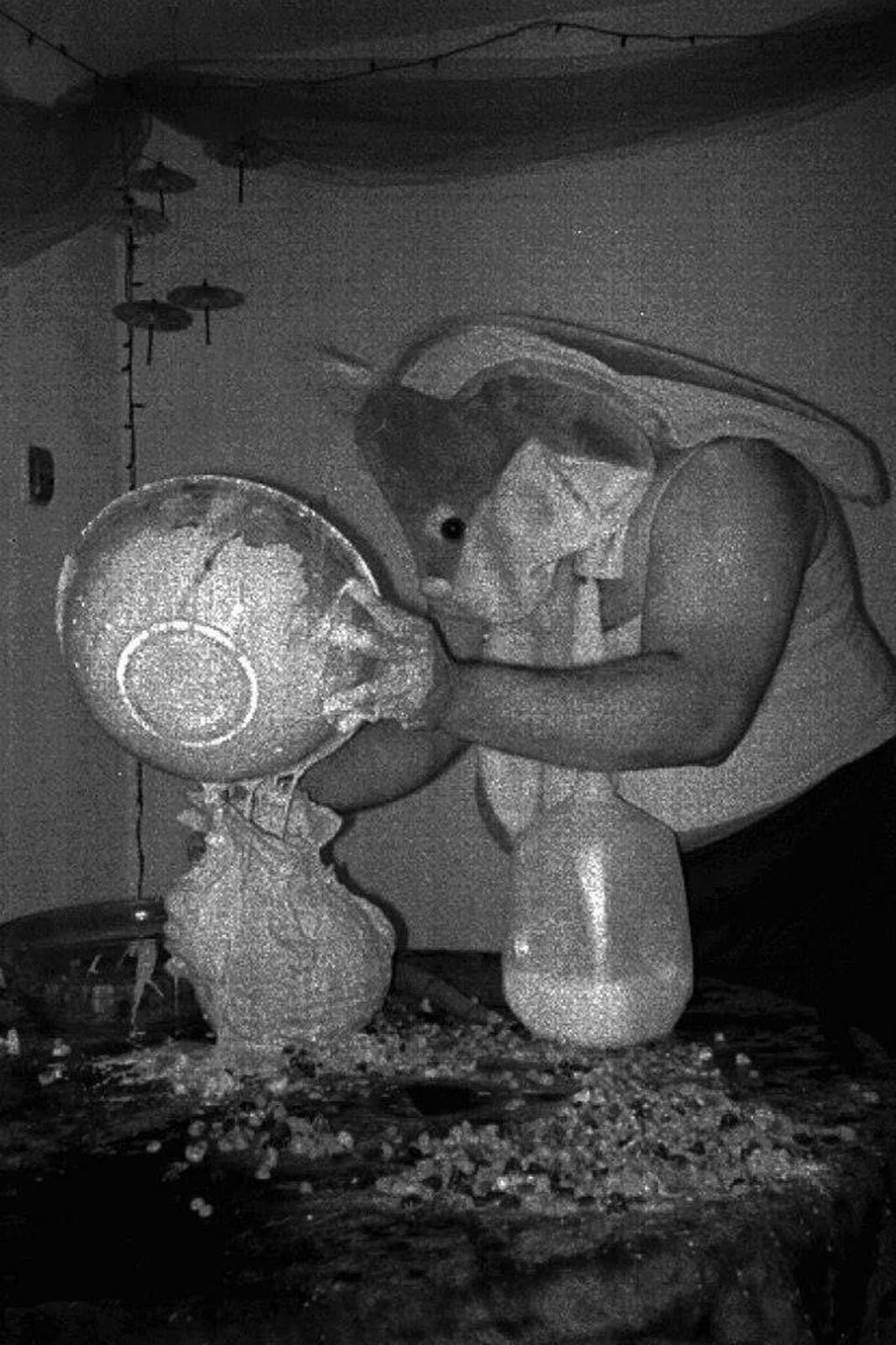
Xavier Lopez Performance #5C: The Tryx Rabbit. Katherine Adamenko's Saons. 2001. While the last performance of the night was the return of the bear, the last one that we are covering is the Rabbit, also known as the Trix or Tryx Rabbit, which continues the adventures of the Soft Cyborg as the ultimate consumer/emcee creature.  In this performance, donning the head of a stuffed bunny and wearing a tank top, I proceeded to mix plaster and the fruitloops from the earlier Krazy Cat performance in a failed attempt at making art--plaster will not set with regular milk! An important lesson in art!


As emcees, by selling their animated souls to monopolies and mega-corporations they have become larger, longer lasting, stronger, more powerful than the men that have created them.  They no longer die, when their creators die.  They simply acquire a strange voice, a new stance, shadowing and continue on.  They have become demi-hegemonic, that is, they continue as long as the product they speak for continues to sell.  This sell/cel/cellular aspect of the soft-cyborg is fascinating and puts our mortal bodies to shame.

Roger Rabbit, who made those first tentative steps into our world in the thirties, only to find that he missed the comfort of his own world, we can find a system that has begun to inverse itself.  One in which it is humans who are attempting to enter the world of these cartoon characters, to trade in their flesh and blood for the promise of immortality. 

We Are Soft Cyborg

I have said before that our bodies have become soft, infiltrated and injected with a creamy filling.  We have been asked to close our eyes as our systems have become more plastic, more additive. 


Pliant, suppliant
metal against flesh
We are Twinkies in that we are ingesting, and here I am talking about a real scientific evolution—us becoming addicted at a cellular level to the products of our desire. 
The value of course is that it may be both our inevitable end and our survival skill, if we imagine a world like the one in Max Headroom—a program that was simply too honest to last long on television-we can imagine a world that is owned part and parcel by large corporations-these corporations are viruses, in that they seek to live for as long as they can using the resources of their host body till the host is destroyed and empty.  They are the viruses that we have created, hard edged and machinelike they kill us with their cyborg bodies and hegemonic minds.


                If we are to survive, we must become like Roger Rabbit, we must become like Road Runner and Wile E. Coyote, our flesh must be pliant and perfect—we must become the plastic and rubber that bounces back after being dropped from the top of the Empire State Building.  We must discover the nirvana that occurs in those few moments when we are suspended in mid-air before we drop.  Our skin must stretch like Plastic-man and allow the machine to pass through us effortlessly.  We must never bleed and instead we must ooze.   We must see through the wild, white lidless eyes that see all, but know the rules of the mystery.  If not, the Terminator will necessarily destroy us.  In essence we must evolve, grow and become what we were always meant to be.  Soft.  


That is the message of the Soft Cyborg.