Showing posts with label UCDavis. Show all posts

Friday, August 28, 2020

Xavier Lopez Performance # 17: Performance: A Critical Introduction (Inclusion + Putoh, Katherine Adamenko) 2017.


As a Latinx performance artist, I knew our 2016 event was unique and vital to the Seattle community, showcasing Latina/x/o artists' identity and genre-expanding work. But none of us could imagine that our event would become part of worldwide university curricula inspiring a new generation of Latina/x/o artists. Academic performance historian Marvin Carlson wrote in Routledge's textbook "Performance: A Critical Introduction,” “There is a growing body of...artists who specifically identify themselves as Latinx, headed by...Xavier Lopez...featured in the first festival of Latinx performance, held at the Good Arts center...in Seattle... Latinx represents an important orientation in modern performance... concern(ed) with developing more inclusive and flexible attitudes toward designations of gender, race, and ethnicity...addressing this major reorientation of the field."

This entry was later updated to:


This is the final wording for the book until then, straight from the pen of Marvin Carlson "...and there is a growing body of theatre artists who specifically identify themselves as Latinx, headed by Xavier Lopez Jr. and Vicente Montanez. Lopez created the first festival of Latinx performance, held at the Good Arts center for experimental theatre in Seattle in 2016, in which Montanez performed. Lopez is also co-creator, with performance artist Katherine Adamenko of New York City, of Putoh performance, a melding of Chicano performance art and contemporary art inspired by Butoh."


As a child, before I even knew what art was, I would watch my father paint murals as part of the Los Angeles Chicano Art Movement, where I would tag along to the Mechicano Art Center on Whittier Blvd mentally devouring the exciting scenes of Latino artists expressing what it meant to be Chicano back then! Days passed as I watched my father paint his expressionist, politically charged murals, day-dreaming of my own future. Every month my parents would take us to the LA Museums and galleries, where we would see Warhol's “Brillo Boxes,” conceptual sculptures and the films of Joseph Beuys and Gilbert and George. 

Later, in college, at the University of Nevada Reno and UCDavis, my mind was blown away by the work of Marcel Duchamp and the Dadas, who influenced my now, mixed media performances. 

It was also during this time that I began to perceived an unspoken difference between how my heroes made art and how I--as a young Latino artist--was expected to. 

Let me tell you a story. As a young artist, I searched everywhere for successful Chicano artists for a sense that my work had a place. When Duchamp or Beuys made their work it was about lives, their ideas, it reflected their view of the world. No one asked Marcel Duchamp to make work solely about his heritage—and he did not have to make artwork for the annual Halloween exhibition. I desperately wanted to make art that had meaning beyond other's expectations—art that reflected my own life and how I saw things? But I had no models, no history to fall back on. Because of this I did the only thing that I could, I decided that I would have to be my own model. 

Ultimately, At UCDavis, critical theory, personal history and personal artifacts began to infuse themselves into my work opening it up to incorporate queer, feminist and other identity discourses. I created two theoretical treatises, "The Soft Cyborg," a variation on Haraway's "Cyborg" and "Putoh"--melding Japanese Butoh and Latino identity performance. In 2016, I co-curated "On the Edge: Latinx Performance Art Festival" the first all-Latinx performance art festival--apparantly--ever.  I did this with Lauren Davis, La Sala Collective member and Assistant Director at Art Exchange Gallery. This led to me becoming part of university curricula across the globe when Marvin Carlson mentioned our event in Routledge's textbook "Performance: A Critical Introduction." 

Today, Issues of gender, race and identity permeate my work and it is through performance that I seek to push the boundaries of how we perceive the essence of ethnic/cultural/Latinx performance, to give voice to underrepresented groups and, moreover, to expand the language of marginalized performance and even to broaden access through guerrilla and drop-in performances. As a conceptual artist, I am confronted with the sense that "Conceptual Art" is often considered to be an elitist, hegemonic realm.  It has become visibly and conceptually associated with purity, intellectualism, masculinity and hegemony. As a Latino Artist who works with many materials that have been pared down to their core elements, minimalized and purified so to speak--creating fiercely personal narratives--I have been forced to deal with oversimplified views of who can make what and what art can be made. 

I am part of a new breed of Latinx artists intent on expanding the themes and expectations available to minority artists--making art that is individual--defying traditional expectations of collective identity. I choose personal, everyday materials, a collage of sheets, candy, fake flowers, tin foil and personal items in order to tell my stories. This is an important conceptual, performative and material shift that cannot be overstated. It is a stance of liberation, which pushes the boundaries of expectations and dares to say that individual lives of color matter; which, in itself, is powerful and revolutionary, problematizing racial, masculine, cultural and identity essentialism in an intellectual investigation which is in no way post-race. 

Perhaps the greatest engine that keeps me going is my over-developed desire to correct social injustices and my love for constant creation. Building community has always been one of my primary concerns; I have taught courses at UC Davis, UNR, Europe and art classes here in Seattle. I understand firsthand, the power of art to change a person and give their lives new meaning. Beginning at UNR, I have been in many art exhibitions, community events, auctions and live painting activities. In the last five years, I have been part of 8 teaching and artistic workshops with the Seattle Art Museum. In 2016, I was asked to put my dreams into action by programming an evening of performance art for La Sala Latinx Artists Network’s ‘La Cocina’ in Pioneer Square. This collaborative project entitled "On The Edge: Latinx Performance Art Festival," was the first all Latinx night of performance art. Up to that point, apparently, there had never been an all Latinx night of performance art in the Pacific Northwest. I had been wanting to get back into that part of my oeuvre. Not performances--that happens all the time--performance art--in all of its difficult to classify, irreverent, problematic, transient, impossible to document glory. In less than a month, we put everything together from scratch. I worked very closely with Lauren Davis of ArtXchange Gallery and Miguel GuillĂ©n as well as the rest of the folks at La Sala and La Cocina and the other performers. The night itself was not just historic; it was an amazing success! This magical event exceeded all our hopes. The first On the Edge Festival was a one-night event, small but expansive, dedicated to serving Seattle and the Seattle Latinx community, giving voice to local Latinx Artists presenting work that is rarely seen in our communities. What we created with On the Edge is a sense of freedom and inclusion that I have always searched for in my journey as a performer exploring themes of Latino/x identity, gender and class privilege. We had a very nice crowd and at least once, I heard a very audible gasp as I was on stage. There is something very real and very magical about doing something as visceral and honest as performance art in front of a live audience--it is an amazing feeling for the audience as well as the performer. Our night of performance had something for everyone and at the same time, the whole event was fundamentally individual and Latina/o/x, and is part of a larger conversation working not only to continue and preserve a set of cultural traditions, but seeking to redefine the nature of these traditions moving forward as we live at a time in which definitions of race, masculinity, gender and art are in flux

Sunday, August 16, 2020

Xavier Lopez Performance #14A: Gus Was a Singing Ghost. When the Body Speaks. Performance Art. InArtsNW. Seattle, WA. 2017.


Gus Was a Singing Ghost.  

Gus Was a singing Ghost. When the Body Speaks. Performance Art. InArtsNW. Seattle, WA. 2017. When the Body Speaks. A Night of Performance Art by Xavier Lopez. Cast: Xavier Lopez, Grace Larenard, Basil Mayan, Girlgoth and Kaz. Supported by Artists Up - Grant Lab Award from Seattle Office of Arts & Culture, 4 Culture and Artist Trust. Music changed to adhere to copyright laws. Performance Art. InArtsNW. Seattle, WA. 2017.  Documented by Loren Herrera. 


The performance of myself dressed as a ghost and singing in front of a live audience, actually started as many of my performances do, by picking up the pieces of "discarded" performances--or more specifically, performances that I haven't gotten around to yet and which have morphed and mutated in the time since their first imagining.

In this case, Gus is a mixing of my continuing "Sheet Ghost" series of performances and a performance that I still intend to do some day, wherein I am dressed as the English band Depeche Mode's singer and Songwriter Martin L. Gore, standing outside Seattle's Pike's Public Market or some similar spot lipsynching to Depeche Mode songs for cash.  


The Sculptural Installation, "A Recreation of My Teen-Age Bedroom," Showing how autobiography plays throughout my entire oeuvre of artworks.


"Day-Dream Believer," Installation. Seattle, Ethnic Heritage Art Gallery, an installation, which like the recreation of my bedroom is made up of personal, autobiographical artifacts.


In this performance, I sang in front a live audience for the very first time, a song entitled "When The Body Speaks," A Grabbing Hands Sonnet.


Gus the Ghost is a continuing character throughout my sculpture and performance art.  When we were children we had three "ghost" imaginary friends.  


I had been working with the ideas of ghosts ever since I was an undergraduate at the University of Nevada, Reno in 1990, where I did a performance titled: Poltergeist. This was part of a solo exhibition I did at the Faire Gallery Cafe. The piece included sound and a looping video that can be accessed here: 


Soft Cyborg Video: Ghost Story


When the Body Speaks...All else is Hollow.  


What is beneath the sheet?


In the end, after the song, I pulled off the sheet, thus beginning the second act.


Gus the singing Ghost. When the Body Speaks. Performance Art. InArtsNW. Seattle, WA. 2017. A Night of Performance Art by Xavier Lopez. Cast: Xavier Lopez, Grace Larenard, Basil Mayan, Girlgoth and Kaz. Supported by Artists Up - Grant Lab Award from Seattle Office of Arts & Culture, 4 Culture and Artist Trust. Music changed to adhere to copyright laws. Performance Art. InArtsNW. Seattle, WA. 2017. Filmed by Loren Herrera.

Friday, July 31, 2020

Xavier Lopez Performance #5D: The Tryx Rabbit. Katherine Adamenko's Salons. 2001.


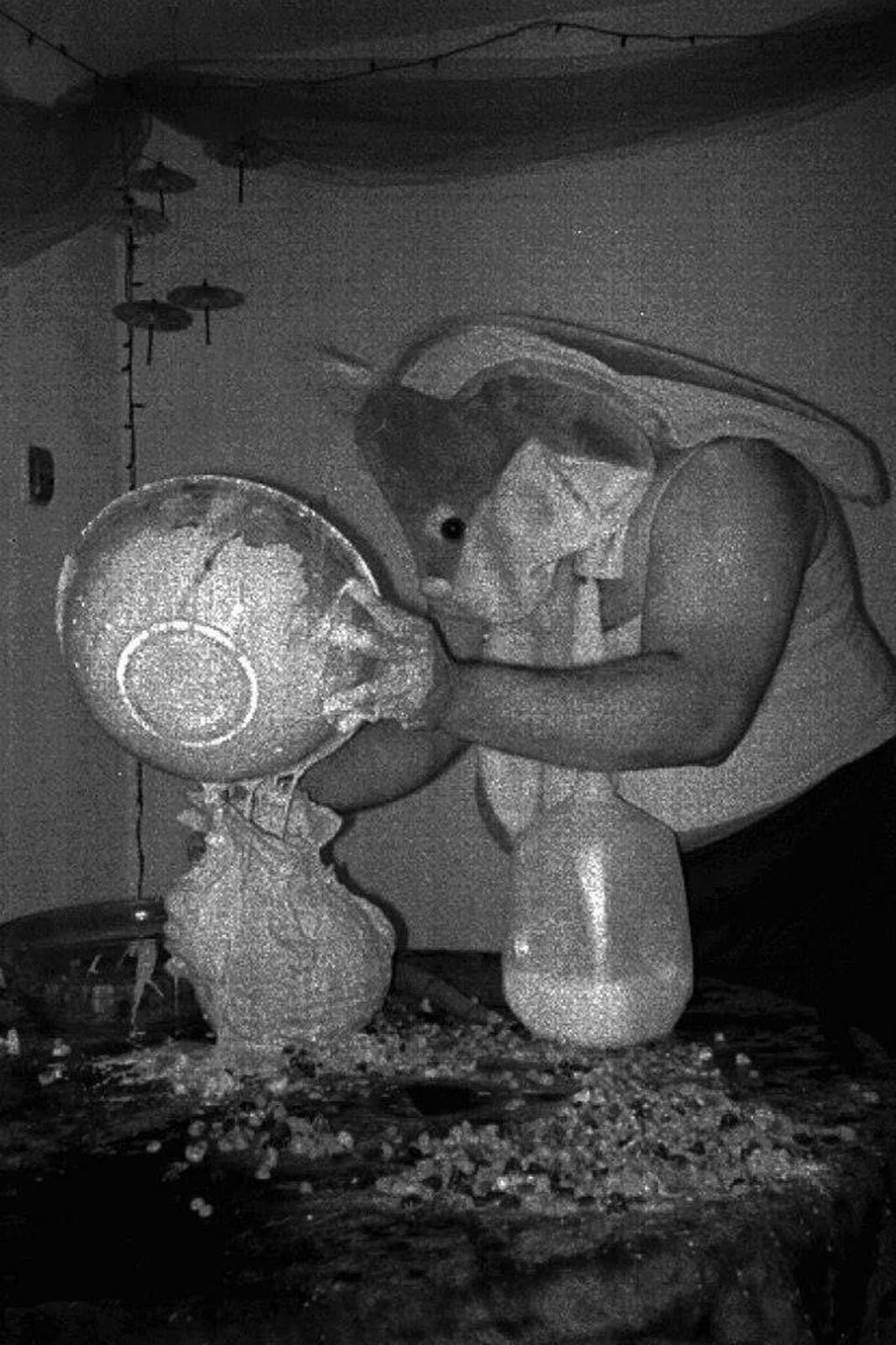
Xavier Lopez Performance #5C: The Tryx Rabbit. Katherine Adamenko's Saons. 2001. While the last performance of the night was the return of the bear, the last one that we are covering is the Rabbit, also known as the Trix or Tryx Rabbit, which continues the adventures of the Soft Cyborg as the ultimate consumer/emcee creature.  In this performance, donning the head of a stuffed bunny and wearing a tank top, I proceeded to mix plaster and the fruitloops from the earlier Krazy Cat performance in a failed attempt at making art--plaster will not set with regular milk! An important lesson in art!


As emcees, by selling their animated souls to monopolies and mega-corporations they have become larger, longer lasting, stronger, more powerful than the men that have created them.  They no longer die, when their creators die.  They simply acquire a strange voice, a new stance, shadowing and continue on.  They have become demi-hegemonic, that is, they continue as long as the product they speak for continues to sell.  This sell/cel/cellular aspect of the soft-cyborg is fascinating and puts our mortal bodies to shame.

Roger Rabbit, who made those first tentative steps into our world in the thirties, only to find that he missed the comfort of his own world, we can find a system that has begun to inverse itself.  One in which it is humans who are attempting to enter the world of these cartoon characters, to trade in their flesh and blood for the promise of immortality. 

We Are Soft Cyborg

I have said before that our bodies have become soft, infiltrated and injected with a creamy filling.  We have been asked to close our eyes as our systems have become more plastic, more additive. 


Pliant, suppliant
metal against flesh
We are Twinkies in that we are ingesting, and here I am talking about a real scientific evolution—us becoming addicted at a cellular level to the products of our desire. 
The value of course is that it may be both our inevitable end and our survival skill, if we imagine a world like the one in Max Headroom—a program that was simply too honest to last long on television-we can imagine a world that is owned part and parcel by large corporations-these corporations are viruses, in that they seek to live for as long as they can using the resources of their host body till the host is destroyed and empty.  They are the viruses that we have created, hard edged and machinelike they kill us with their cyborg bodies and hegemonic minds.


                If we are to survive, we must become like Roger Rabbit, we must become like Road Runner and Wile E. Coyote, our flesh must be pliant and perfect—we must become the plastic and rubber that bounces back after being dropped from the top of the Empire State Building.  We must discover the nirvana that occurs in those few moments when we are suspended in mid-air before we drop.  Our skin must stretch like Plastic-man and allow the machine to pass through us effortlessly.  We must never bleed and instead we must ooze.   We must see through the wild, white lidless eyes that see all, but know the rules of the mystery.  If not, the Terminator will necessarily destroy us.  In essence we must evolve, grow and become what we were always meant to be.  Soft.  


That is the message of the Soft Cyborg. 


Thursday, July 30, 2020

Xavier Lopez Performance #5B. The Soft Cyborg: Super Sugar Bear.


At the same performance of the Soft Cyborg, The Super Sugar Bear is an exemplification of the Soft Cyborg and how this manifesto was turned into performance.  In this performance, I dressed up in a giant grey teddy bear, from which I had taken out all the stuffing.  The name taken from a friend of my father's when I was growing up, who was part of the Chicano Art movement in California, he was called "Sugar Bear," and if I remember correctly, he might even have been my godfather!  I actually remember asking my parents what this meant and being worried that he was going to take me away! 


In the actual performance, I dressed as a cute bear, who mugged for the camera and elicited many awes, much like a real teddy bear would.  The bear then reached into an opening in the "bottom" of his bear suit and mirroring the first art act for many of us, reaches in and pulls out chocolate icing and draws a big flower for the audience.  This act of creation is part of most of my performances and the flower has been abstract as in "Tales of the Soft Cyborg: The Spaniard," and "Teaching a Hare to Tell Time,"  to a flower that blooms into a nuclear explosion in "The Magician" segment of  "When the Body Speaks."


Wednesday, July 29, 2020

Xavier Lopez Performance #5A. The Soft Cyborg: The Ghost Host


"The Ghost Host" Introduced the very first Soft Cyborg performances at Katherine Adamenko's Salons.  These performances were filmed by Scott Hilton, but have currently been misplaced, for now these images are all that we have of these performances, but hopefully that will change in the future.  The Host came out, myself dressed in a clown mask found at a garage sale, gloves from Goodwill and medical gown, laughed a goofy laugh and introduced each performance section, A Big Bear painting a flower, The Krazy Kat who loved cereal and the Trix Rabbit who made a sculpture.


While "The Ghost Host" was named after the disembodied voice at the Haunted Mansion at Disneyland, the character and his behavior was completely different than the Paul Frees voice-track, except, perhaps in that they both took their participants on a kind of voyage. 

The effect, I believe was more comedy than horror, but there has always been an underlying tension between the Real and reality in my work that reads as horror.  Similarly, as influential painter Lisa Yuskavage describes her work in a way that is applicable to some of this menagerie of creatures that I have created for my performances: 


"I like to think of my characters as “The Brood”… have you seen that movie? It is by Cronenberg. It is about a woman who is the main suspect in a series of brutal murders, but her perfect alibi is that she is locked up in a mental hospital, so (she) couldn’t have done the deeds… Then you find out that her...therapy is producing these creatures, which are manifestations or personifications of her different neurosis… They then go out and “heal” her by killing the responsible parties.  Cool, huh?[14]" While I don't like to think of my own work in such simple terms, nor as a kind of therapy, the idea that I am creating these characters, half-beings, mutations--all broken--seems to me to be a fertile space that may gain power as I move into the next phase in my work, most likely mixing my ghosts with pantomime.  As I do move forward, I would not be surprised if many of my characters might often be presented to us as armless, leg-less, blind or otherwise unwhole--especially as I grow older, I think and it becomes clear that one cannot always count on the body to do what it is supposed to. 


Monday, July 27, 2020

Xavier Lopez Performance Art #5 Overview-- Soft Cyborg: Katherine Adamenko, The Salons and the birth of Putoh.


Katherine Adamenko at one of the Salons

Following our presentation at the UCDavis Interdisciplinary Graduate Symposium was a set of performances at Katherine Adamenko's Apartment about four blocks away from the campus in a set of very houselike apartments.  The Soft Cyborg and the Dada Dialectic wer concepts that easily gave birth to many characters and continues to do so to this very day in my current performances.  These performances came directly from my own theories and, which like Putoh, also created during this time were directly resultant from classes and discussions that folks like Scott Hilton, Katherine Adamenko and myself were having at UCDavis while taking art history and performative classes there.   


Katherine's amazingly exciting and in-your-face feminist performances layed the groundwork for a group of artists, sculptors, photographers and performance artists to come together and experiment with their ideas for performance, without judgement and backed by their studies, they began to set their sights on the future of performance and its intrinsic connections to theory and identity and especially the theories of identity.  This would also be the perfect petri dish for Xavier Lopez and Katherine Adamenko, through their many conversations, to create the pre-latinx, latinx discourse Putoh! 


What exactly is "Putoh?"


The Salons in 2001, between February and June--were the most exciting of times, the "Salons" at Katherine Adamenko's Apartment in 2001 included the first performances of the "Soft Cyborg," as well as the creation of "Putoh," which was/is an ahead of its time mixing of Japanese "Butoh" and a Latinx sensibility with a personal irreverence holding it all together.  Adamenko created a safe space for experimentation and for "post-avant garde" performance. It was, as they say-- the best of times!

With "Putoh" and the search for a Dada Dialectic and the Soft Cyborg Manifesto my performances took a turn for the theoretical when I went to Graduate School at UCDavis. 

Fellow student Katherine Adamenko and I met, if I remember correctly, either at a Butoh training in which we were asked to go through the life cycle of a flower or it was in a Performative Theory course in which we studied the work of Guillermo Gomez Pena, who I had met a few years earlier, as an undergraduate, either in one of Joanna Frueh's courses or Peter Goin's filmmaking class.

We quickly hit it off and invented "Putoh" together. Putoh is an irreverant mix of a Punk Chicano aesthetic and philosophy and the far more sedate, methodical and expressive Japanese Butoh.

But, What exactly is "Putoh?" 

"Putoh" is a hybrid in every sense of the word. Putoh celebrates individuality and intersectionality. Invented in the year 2000 at the University of California Davis, it is a portmanteau of ideas, vision and philosophies. Linguistically, the term "Putoh" is a fusion of two languages and two words.
Of course there is the Japanese Butoh, meaning, literally "Dance."  Mesh that with the Spanish-in this case-Mexican, gutter word "Puto."  Which has many harsh and vulgar meanings, but which has a very similar etymological history to the word "Punk" and it is in that spirit that the two words were married.

The performance form itself was created by two very different, yet very similar people, one Chicano--the other Cubana, pre-Latino, pre-Latinx, both feminists, both performance artists, both graduate students at the university of California, Davis.  Katherine Adamenko and Xavier Lopez came from very different backgrounds Xavier, a California, Mexican-American, complete with a Valley girl brogue and Katherine Adamenko a New York City, Jewish and Cuban/Spanish feminist, performance artist with a huge personality, were destined to create something that the world was not prepared for--something that refused to be categorized and which meshes many forms and many cultures, genders, philosophies and which will make more sense as we exit this age of atavistic essentialism and collective intellectual ethnocentrism.


Katherine as La Guapa Gorging Geisha in Tango with my fridge 1


Link to Katherine's website: 


Sunday, July 26, 2020

Xavier Lopez Performance Art #4: Soft Cyborg Presentation at UCDavis Interdisciplinary Graduate Symposium.


Xavier Lopez presenting: "Toward a Dada Dialectic and the Soft Cyborg," at UCDavis
GSA Interdisciplinary Graduate Symposium.

In 2001, I was in graduate school, working toward my MFA in Studio Art: Sculpture, with a specialization in critical theory.  I was a member of the UCDavis, Graduate Student Association and was working on a side project that had been influence by several of my feminist classes, by the work of Donna Haraway and especially by the concept of taking ideas and turning them into performance.  I was also highly influenced by the courses that I was taking outside the art department and especially the classes on Critical and Linguitic theory and the theater courses on Peformativity.  It was during this period and perhaps in one of these classes in which I met the Jewish/Cuban, feminist, Butoh performance artist Katherine Adamenko, who would prove to be fundamental to the course of my progress--but we will talk more about her in the next section. 

The Soft Cyborg.


The Soft Cyborg began as a paper that I knew I could never turn in for a grade because it was just too far out there for any of my art classes--too strange for art history and too literate for Studio/Fine Art.  My only hope was to get it accepted to a conference as I had for two other papers, "Depeche Mode Ate My Balls," and "Longing For Reconcilliation In The DC Comics Multi-Verse," which were both outside of the box.  Soft Cyborg's main premise, or goal was a tongue-in-cheek attempt to find or create a dialectic for a movement that eschewed language and art as having any true, actual or cohesive meaning--so that was a programme that was meant for failure from the very beginning.  But strangely, the saritical vehicle for this, which was never meant to be taken seriously, ended up making more sense and being a generative, not-so-liminal space that tied to Donna Haraway, Mikhail Bakhtin, the idea of the "Carnival," Mickey Mouse, Twinkie the Kid, cartoon emcees, Furries art and even politics in a way that fit very well with the performances that I had been doing up to then. 

The Lost performance. 

Prior to the performances at Katherine Adamenko's "Salons," my performances had mostly taken place at the University of Nevada, Reno, but during the second year of graduate school at UCDavis, during one of our studio visits, I decided to put on a performance for our graduate group.  I don't remember the details so much, except that it was very loosely a precurser to Tales of "The Soft Cyborg: The Spaniard," which in turn owed a great deal to the work of Joseph Beuys.  In this production, I walked up to my sculptures and berated them in German.  The class clearly had no idea what to do with this, and as usual Lucy Puls was clearly unimpressed. 

As for me, that night was important in that it excercised some long unused muscles and definitely reawakened the desire whithin me to do some more performance art.   


_____________________________________________________


Soft Cyborg paper Presentation and Putoh at UCDavis. Putoh, co-created by Xavier Lopez and Katherine Adamenko. 2001. Musical composition "Song of the Cyborg" by me.


Xavier Lopez Performance Art: Performance #3 - Honest as Hell: Poltergeist.


University of Nevada, Reno. Version 2. "Night of Performance," "Honest as Hell II: Poltergeist." University of Nevada, Reno. A group show of solo performances with five others. Poltergeist was a performance mixing sound and action before an audience. 1993.


In 1993, I was asked to be a part a night of performance, which was, I believe made up of a bunch of us that had been in Joanna Freuh's first seminal performance art course at the University of Nevada, Reno. Influenced by ideas of ephemera and especially the "Happenings" of Alan Kaprow, Dick Higgens, George Brecht and The New School, which brought a kind of individualistic, "Mannerist" approach to performance art, it's narrative, symbology and approach.

  
This was also the first of my art pieces, aside from a few drawings and any preliminary sketches, that dealt with the idea of the sheet ghost/ghost. Ghosts, at this point were one of the few, truly biographical objects that I allowed myself at the time, though, I still believed in the Rauchenberg/Johnsian ideal of denying the artist's presence in their own work. This is something that I continue to back and forth with, never settling on a single position of comfort. Though, it's interesting to note that the drawing I ever turned in for an art class at UNR, was entitled ,"The Fan/Fanatic" Something that I would come back to once I was at UCDavis, several years later and which would lead me to far more autobiographical work. I suppose that, if I'm honest with myself--the work is fairly autobiographical and always has been.


Saturday, July 25, 2020

Xavier Lopez Jr.: Performance Art #2 - Exquisite Corpse


"Exquisite Corpse." Performance Art. Originally performed in Joanna Freuh's Performance Art Course. This reconstruction documents my second performance. 1992. Images and photography by Krista Lee Wolfe. Music by Haunted Me -- Pleasure.

Beads of sweat were pouring down my forehead onto my ears and down the sides of my face. With my eyes wide open, I could only see the white of the sheet-become-shroud that was covering me from head to ankles—leaving my toes exposed. 

On my big toe hung a tag with a big X and on the opposite side, my name, age and vital statistics. Picture it in your head and you know exactly what this looked like. Lying on a large, white, operating table, I was perfectly still. In the background I could hear and was vaguely aware that there was an audience forming in the dark room. 

Around me rose the scent of Lysol, bleach and rubbing alcohol—definitely a heady mix, which in conjunction with my current situation was filling me with nerves and making me kind of dizzy at the same time. I could feel my heart pounding in my chest shaking the void of the space that held me trapped in its wombic, membranous cavern. Ambient noises started to creep in, “Dr. Koeple, Dr. Koeple, Paging Dr. Koeple! Chris Bordeaux 319!” repeated over and over as if on a loop--which of course, it was. As I lay there, I remembered the first time that I ever did a performance art piece. Not performance, like singing or dancing, but performance art, like Chris Burden, Joseph Beuys, and Paul McCarthy. 

I was dressed in a clown mask, black shorts and Minnie Mouse ears. I could barely see anything. In the background a loop tape played the “Bag of Laughs” from the death of the Joker in the first Batman movie. I was propped up against a wall, as Robert Morrison’s sculpture class walked in, all of them watching me as I stood there, loop after loop playing endlessly, until my shaking legs gave way and I dropped from sheer exhaustion. As I stood there, I remembered the inspiration for this piece. I was walking through Toys R Us in Reno one day, when I passed a wall of laughing bags and, just as I did so, Reno had its largest earthquake up to that date. 

Bag after bag began to laugh, loudly, maniacally--the moment was terrifying--it sliced deep into the heart of me. It meant so much, it meant so many things all at once--eviscerating the seriousness of life and opening death up to the ironic, sarcastic meaninglessness that only a mechanical, mindless wall full of novelty gags could begin to approach. A memory within a memory. A dream within a dream. I snapped back into reality. That’s when the lights went up and the performance began. As I began to speak, telling stories and recounting all the times that death had crossed my path, trying to make sense of each and every one of these abstracted moments, I felt as though the sheet over my head was bobbing back and forth frantically. 

I was certain that the effect was being ruined, that I was moving and rattling beneath the sheet and that what should have been a very serious piece about life and death was turning, instead, into a comical scene, ruined by my inability to lie perfectly still. However, immediately afterward, when the class met to discuss the performance--the other students in Joanna Frueh’s Performance Art Class, raved and celebrated the performance, telling me that it didn’t look like the sheet was moving at all and some even wondered if my voice had been piped in, which it had not. 

A perfect effect. A perfect performance. 

A perfect moment.

Everyone was fooled.

I was beaming with pride!

 The Subaltern Has Teeth! A meditation on art, oppression, life, and post-modern modernity Enzyme Magazine. 2016.

Begin the Beguine: Xavier Lopez Performance #1 - The Dum-Dum Boy @ UNR Art Department. CA 1991/2.


This was my very first Performance, it was unrecorded as we were too young and just didn't know any better. This was before we all carried cameras and we just didn't know, didn't understand the importance of documenting things.


"Preliminary Sketch for "Dum Dum Boy" Performance. This performance was very simple, influenced by the work of Gilbert and George. 1991/1992."


From my upcoming biography: "I remember the first time that I ever did a performance art piece. Not performance, like singing or dancing, but performance art, like Chris Burden, Joseph Beuys, and Paul McCarthy.


I was dressed in a clown mask, black shorts and Minnie Mouse ears. I could barely see anything. In the background a loop tape played the “Bag of Laughs” from the death of the Joker in the first Batman movie.


I was propped up against a wall, as Robert Morrison’s sculpture class walked in, all of them watching me as I stood there, loop after loop playing endlessly, until my shaking legs gave way and I dropped from sheer exhaustion.


As I stood there, I remembered the inspiration for this piece. I was walking through Toys R Us in Reno one day, when I passed a wall of laughing bags and, just as I did so, Reno had its largest earthquake up to that date.


Bag after bag began to laugh, loudly, maniacally--the moment was terrifying--it sliced deep into the heart of me. It meant so much, it meant so many things all at once--eviscerating the seriousness of life and opening death up to the ironic, sarcastic meaninglessness that only a mechanical, mindless wall full of novelty gags or a rampaging virus could begin to approach.


A memory within a memory. A dream within a dream. I snapped back into reality."