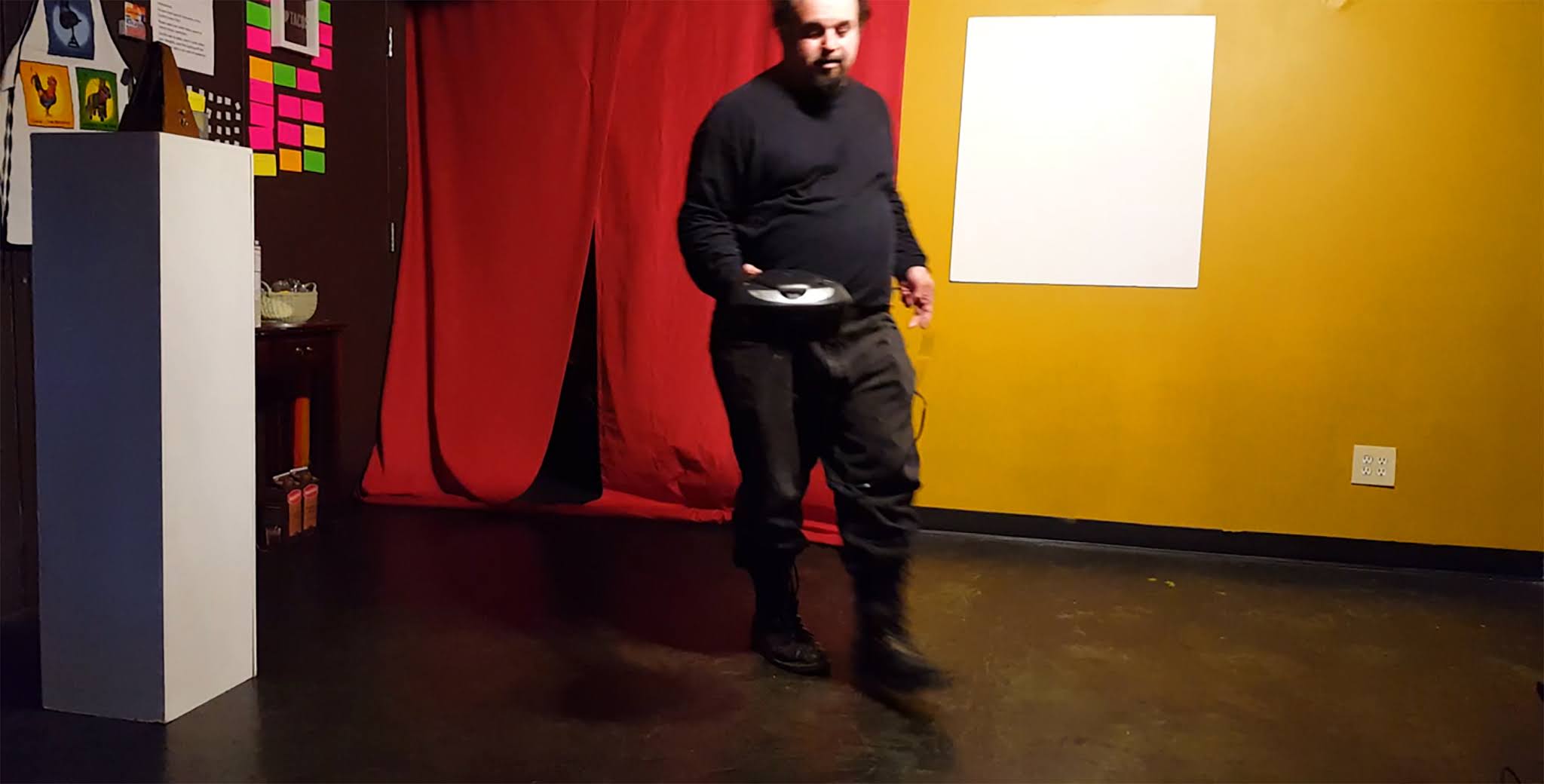
"Dada Death 2.0." Performance Art. Echo Echo Gallery. Greenwood Collective. Greenwood, Seattle, WA. 2017. Final Version.
We live in the age of Nefarious, an age of puppet kings and a lethargy that stems from the belief that we have discovered everything. But this is far from the truth, the truth is that we have become arrogant enough to believe that we cannot be excited, we believe that the same impulses that made us excited in the past do not and cannot thrill us. We live in an age that is more truly Dada than Marcel Duchamp and Andre Breton could have ever thought up, an age in which we are bombarded with the idiocies and indecencies of life on a daily basis. Perhaps shell-shocked is a better word, and waiting, we have become ossified and are ready to place ourselves into the machine. Even the smartest of us will sell his soul so he can eat. The age of the artist has passed and in its stead we have a sea of castrated bald white men, spouting the lines as if it was enough to memorize what Hegel or Jameson or even hooks said. We have forgotten the lessons of the first truly Post-Modern philosophers the Dadas had to teach us—we have forgotten how to fight, to kick each other in the eye, how a baritone belly-laugh feels and we have held our piss for far too long
Critical Theory, or rather philosophy was never meant to be the domain of School Teachers. It was never meant to be the tool for professionals to build their careers on. Criticism was always meant for the young, the artists, the poets and musicians the so-called practitioners—to feel the age they live in. Critical theory has become ossified and fat. It has lost the one thing that is unforgivable--a sense of humour.
We are filled with candy and all sorts of preservatives. Our houses and cupboards are brimming over with purple plastic-coated soft drinks and Twinkies. We are what we eat and from here that doesn’t look too good. Let us take a moment and look at the metaphor of eating, of what we eat. Let us take a moment to look at the Twinkies, Chicken McNuggets, and Coca Cola that we ingest. It has been said that the Twinkie is known to have a shelf life of many, many years. Open a Twinkie and you will find that it is an odd little thing—unexpectedly perhaps it is a moist even wet affair, it is a soft cylinder of unnatural yellow. Wrapped within this manufactured cake is a creamy filling of vanilla. Beneath the perfectly flat, flaky-golden brown base of each Twinkie there are three small perfect oblong holes. It is these small holes, the same on each cake through which the cream surprise has been injected. These holes are perfect, the same from one Twinkie to the next. It is their perfection, which we have come to expect in our enjoyment of each Twinkie. It is this perfect cake that we ingest, with the promise that the next one will be exactly the same.
Awhile back, I lived in Germany for a year. It was very interesting. I had a couple of art shows there and I made many friends there as well. The Germans are the kindest, sweetest people–especially the youth–at least they were when I was there. I hope that they have not been poisoned like Eastern Europe has.
However, my friend’s hearts were broken when I told them that, as Americans, often we synechdochically use the word “German” to mean Nazi in many cases. Especially in the movies.
The Germans are a beautiful people, but they were broken by their own history. Their psyches were shattered and now they suffer from amazing self-hatred and collective embarrassment for what they cannot escape as being part of them. Part of their story. Part of their skin.
There are no flags in Germany, very little examples of patriotism-especially on the boorish level that we might be used to.
One day, I was on the bus and this old guy wanted to apologize to me personally for what the Nazis did. It was a very uncomfortable experience. It was amazingly poignant and by the time I was getting off the bus, I realized that he wanted me to absolve him of the guilt of a child who ha seen the Nazis as heroes. Just as we are now taught as children to admire our policing agencies–as agents of order. This now, grandfather was forced to view the gypsies, Jews and queers as agents of decay, as the very rats that they had been told to see them as.
In Germany, this constant self-loathing is everywhere, but it is very subtle and no one ever really acknowledges it, not to each other, not in the open–perhaps to strangers, but in a very real way as a nation they have lost their sense of identity as purely good human beings. Initially, this was forced upon them from without, but ultimately it has become a part of them, but this happened long enough ago that now, many of the kids are running around in Nazi bike gangs. I saw those as well, in Frankfurt. They are kind of scary.
Borrowing a term, though not the same idea–from Friedrich Nietzsche, this move toward agency can be seen as being “Beyond Good and Evil.” It just is. In a way that is neither good nor evil–they have begun to take that anger and self-loathing and have started to make something out of it.
In the lifetimes of these artists (the artists of Die Antwoord) they have witnessed humans doing the most horrible atrocities–under the guise of society. They know how cheap and meaningless life is or can be. They understand in a way that we are only beginning to get a glimpse of–just how easily money trumps life.
The baby talk they spew is deceptive of the most vile, evil, shit that they are trying to warn us all about.
The simplism of their form is like standup comedy. It is like the bright, multicolored blotters that acid used to come on. A pretty, simple, wrapping for something that takes away your innocence and imparts knowledge of the shape of the universe and gives you a taste of the darkest and brightest candy-colored parts of your mind.
That is why I believe that Die Antwoord is so important–they are the best example of what is created after we as humanity have lost our souls and after we have lost our faith in everything– and believe me when I tell you that as a collective species–we have very definitely lost our souls. I thought it would have to wait until humanity realized that the universe was approaching heat death, for us to realize this–but at least in one way, we are a rather bright collection of animals.
But, I will say this. That because we are humans–and because everything we do and say is always deconstructed and creates a universe in which its opposite is true–that Die Antwoord is also a band that is equally about hope. I know it sounds like a contradiction and, in fact, it is–but it is just as true.
The fact that we as humans need to have things wrapped in shiny, plastic is why I also believe that something like Pop is the most perfect medium for conveying the things that art needs to say in this day and age. It, like the obscene, baby talk rap lyrics–it is the perfect form for communicating the nature of the void. In baby talk expletives and candy-coated color-fields. To answer your earlier question, though–yes, artists need to live–but artists also really need to be able to convey their meaning–they are all blind men and women describing an elephant view of the universe.
I think that things evolve–different things make sense in different eras–in the era of the Pre-Raphaelites (which in itself was a conservative reaction [alors--you now have groups of artists seeking inspiration from a movement that was already retrospective in its original incarnation]) or the Mannerists, etc. the “Pretty Vacant” was invisible (just as there are forces that are at work now, that we can’t see, because the connections are not yet visible)–it was there, but could not be seen–meaning then was conveyed in purely narrative forms and by way of symbolism–but as happens in any system–entropy increases and things that once did–no longer make sense. We are beyond mere narrative; we are beyond mere representation, we are in an era of terrible beauty and pop conceptualism.
Truth does not change, that is the kernals remain the same and we float around them and it is our perception of what the truth is changes over time. That sounds obvious, but I want you to bear with me for a moment. We perceive, naturally that he universe remains the same, which is actually not true, stars die and we move around the stellar arm of the milky way, bu, in essence much of what we call the universe, at least, appears mostly the same--but truth now looks nothing like it did to the first women and men. We scoff at the logic systems of the earliest philsophers, can't believe that astronomers thought the earth was the center of the heavens and even the moderns seem outdated to our post-postmodern sensibilities, so we understand that our sense of truth changes--we could not expect to agree with a cave-person on even the most fundamental of things.
I want us to focus for a moment, especially on our perception of things--the truth in things, right now the public at large, is being taken through a period in which we are being asked to look at everything that we held true just minutes ago and to rewrite it, to alienate ourselves from it and to look at it through new eyes--for better and often for worse. I tried to explain this to a friend like this. Take a painting that was created by or for the priests at the Palais des Papes in Southern France--before the Renaissance, a painting that was made as a pure celebration of the majesty of religion--that actual, physical painting is the same now as it was when it was painted hundreds of years ago, it is constituted by essentially the same atoms that have made it up since its origin--it is a monadic whole--maybe some of the pigments and therefore the colors have broken down as they breathe in the oxygen of the ages and take in the light of candles and later, flourescents--but otherwise they have not changed in any significant way. But, what they mean, what they signify and how we perceive them, I guarantee you that, that has changed. And I guarantee you that can be said of everything, from the functional Ancient Greek objects that are now sitting in vitrines at the Smithsonian to the religious paintings of the past, and this is especially true of any text that you might find, from a painting to a book or anything that works with signs and significators.
The way these things are seen change through the ages--their essential meanings have changed and yet the objects themselves have not. Now, let's put together a little mental exercise, if you were to go back in time, if you had a time machine and could actually do this, and you stood in front of one of the paintings in the hallway at the Palais, you might have a moment of awe, you might feel the pangs of nostalgia for an earlier age, you might even have a religious moment, but I also guarantee that you would not see the artworks in the same way that the people of the 11th century saw it. You would not suddenly understand the meaning of that age as somehow inherent in the painting standing before you, you would not be able to even see what that truth was supposed to be. Just as you can only imagine now how that work was meant to be seen by the artist that painted it originally.
But that truth is still there, would still be there for those people, even if they were suddenly sent to the future now. As is the truth of the Renaissance painters, who dissected the work and saw its limitations, just as the Papists who saw it as sacrilegious, just as the Enlightenment saw it different and just as those tin the future will see those paintings, however they see them. But the objects have not changed and those truths--all of them have always been there. It becomes clear therefore that all truths that are applied to an object and even an age are all always inherently present in an object or indeed anything--all truth exists at once--simply waiting for us to discover it. Truth, all truths are always there, waiting to be discovered--like the skins of an onion, unwrapping over time.
We live in an age of unprecedented change–things are dying off every day–not making it to the next era.
8-tracks, Xerox paper, the clicking sound of movie projectors, film-strips, forty-fives.
If you see any of these it is because nostalgic forces are in play.
Last night I painted a landscape, it was a very nice landscape. But, I wanted it to be more–I decided that it just didn’t have the gravitas that I wanted it to. So I decided to rectify that and I gave it a title that conjured up images of not just “sturm” but also the mightiest “drang” that anyone has ever experienced! In words, I threw in allusions to Herakles and Ovid, I forced everyone who read the title-card of this piece to ponder their own mortality and question the meaning of not just their own, but everyone’s existence. However, despite all of the poesy of my heroic words, despite the finest ink and most expensive acid-free paper, ultimately, what I had created was really just a fucking landscape. A very lovely landscape. But a landscape all the same.
We live in an age of unprecedented change and there are nostalgic forces in play.
The Diabetic Luchador (Nothing but a Nothing.) Final Version. When the Body Speaks. Full. A Night of Performance Art by Xavier Lopez. Cast: Xavier Lopez, Grace Larenard, Basil Mayan, Girlgoth and Kaz. Supported by Artists Up - Grant Lab Award from Seattle Office of Arts & Culture, 4 Culture and Artist Trust. Music changed to adhere to copyright laws. Performance Art. InArtsNW. Seattle, WA. 2017. Filmed by Loren Herrera.
The Diabetic Luchador was a new character created with this "night of performance, part of the "Putoh" night's events.
In this part of the night's performances, the Diabetic Luchador tears apart the sheet ghost of the prior scene.
In 2017, I was awarded the "Artist-Up Grant," presented by three amazing arts organizations--4Culture, Artist Trust and The Seattle Office of Arts & Culture. I was asked to take my work to the next level. The plan, with guidance from Irene Gomez, was to be in a completely different place with my work afterward--little did I know just how much I would grow.
The first part was to put together my own art book--which was amazing. But it was the second project that made me truly nervous! I was to present a short "one-man performance" dealing with issues of "Latinoness," entitled "When The Body Speaks," it would be about Illness, specifically illnesses targeting Latinos and which run through my family tree, directly through my body and in my blood!
Ultimately, however, I would craft a longer, more complex event than initially planned, enlisting five other artists--a first for me! I did a forty-five minute performance and I was extremely nervous because of my ailments. Would the nerve-endings in my feet flare up? Would I suffer from vertigo? Before this, my longest performance was 25 minutes and I was much younger then. But over the year of practice I brought my weight down by twenty pounds and when I hit the stage I was certain I could do it.
The event, itself was part biography, part endurance and part conceptual art. I introduced Seattle to "Putoh" a mestizo hybrid of cultures and performance genres! On top of that, I did something I thought I never could have--I sang in front of a live audience! That night I grew as an artist, possibly even extended the definition of Latinx art today, but more importantly, I expressed the way that I see the world. I was overjoyed and proud of what I had accomplished!
In the background, two figures, one dressed as a blind ghost and the other dressed as a vampire bat chant, "You're Nothing but a Nothing, You're Nothing but a Nothing."
My work is always intensely personal and conceptual--it comes from me. I work with a variety of materials and in many methods. I tell stories and create new connections questioning the meanings of our most commonly held notions. My work is about associations and creating a discourse between myself and the viewer. I love these connections, they are my joy, they are the things I look for at all times and which permeate my work. It is my goal to completely change current discourse and deconstruct the way that we view art and race.
I am part of a new breed of Latinx artists for whom artmaking is autobiographical and personal, yet eschews the most obvious tropes of masculinity and race. As a Latino artist working much of his life with materials that have been pared down to their core elements, minimalized and purified, creating fiercely personal narratives, I have long been forced to deal with oversimplified views of color, masculinity and biography, but in a world and at a time, in which so many of these definitions are changing, my shift in point of view is fiercely important. I am intent on making my own way as an individual artist, speaking my own name and making art that comes from my experience of this world. I connect to a post-postmodern dialogue and speak to personal obsessions and desires that are not bogged down by obvious cultural history. This is a very important stance of liberation, which in and of itself is powerful and revolutionary. Now, having said this, mine is not a simplistic stance, nor is it a mere ignoring of reality--instead it is a journey, an intellectual investigation and as an artist, I am aware that we are not post-race and my work is not either.
This year's version is a wonderfully multicultural affair, in tune with a world that is getting smaller and more open-minded, even while the news tries to tell us the opposite. The first act sets the stage for the rest of the production as we are presented with a very Derridean frame within a frame, has a wonderful tree and a beautiful window--wherein we can see some of that Nutcracker magic. We get some really nice costumes, starting with Herr Drosselmeier's togs, which include an Olivian reference in his red-and-white-and-black cape--we also get lovely costumes for the various toys and all the celebrants--and that is just Act 1--the costumes in act 2 are even better!
Gus Was a singing Ghost. When the Body Speaks. Performance Art. InArtsNW. Seattle, WA. 2017. When the Body Speaks. A Night of Performance Art by Xavier Lopez. Cast: Xavier Lopez, Grace Larenard, Basil Mayan, Girlgoth and Kaz. Supported by Artists Up - Grant Lab Award from Seattle Office of Arts & Culture, 4 Culture and Artist Trust. Music changed to adhere to copyright laws. Performance Art. InArtsNW. Seattle, WA. 2017. Documented by Loren Herrera.
The performance of myself dressed as a ghost and singing in front of a live audience, actually started as many of my performances do, by picking up the pieces of "discarded" performances--or more specifically, performances that I haven't gotten around to yet and which have morphed and mutated in the time since their first imagining.
In this case, Gus is a mixing of my continuing "Sheet Ghost" series of performances and a performance that I still intend to do some day, wherein I am dressed as the English band Depeche Mode's singer and Songwriter Martin L. Gore, standing outside Seattle's Pike's Public Market or some similar spot lipsynching to Depeche Mode songs for cash.
The Sculptural Installation, "A Recreation of My Teen-Age Bedroom," Showing how autobiography plays throughout my entire oeuvre of artworks.
"Day-Dream Believer," Installation. Seattle, Ethnic Heritage Art Gallery, an installation, which like the recreation of my bedroom is made up of personal, autobiographical artifacts.
In this performance, I sang in front a live audience for the very first time, a song entitled "When The Body Speaks," A Grabbing Hands Sonnet.
Gus the Ghost is a continuing character throughout my sculpture and performance art. When we were children we had three "ghost" imaginary friends.
I had been working with the ideas of ghosts ever since I was an undergraduate at the University of Nevada, Reno in 1990, where I did a performance titled: Poltergeist. This was part of a solo exhibition I did at the Faire Gallery Cafe. The piece included sound and a looping video that can be accessed here:
Soft Cyborg Video: Ghost Story
When the Body Speaks...All else is Hollow.
What is beneath the sheet?
In the end, after the song, I pulled off the sheet, thus beginning the second act.
Gus the singing Ghost. When the Body Speaks. Performance Art. InArtsNW. Seattle, WA. 2017. A Night of Performance Art by Xavier Lopez. Cast: Xavier Lopez, Grace Larenard, Basil Mayan, Girlgoth and Kaz. Supported by Artists Up - Grant Lab Award from Seattle Office of Arts & Culture, 4 Culture and Artist Trust. Music changed to adhere to copyright laws. Performance Art. InArtsNW. Seattle, WA. 2017. Filmed by Loren Herrera.
After On the Edge: Latinx Performance Art Festival, I became part of (the wonderful and personal high-point) the John Cage celebration that was put together to celebrate the work of John Cage.
In 2016, I was asked to take part in the John Cage Musicircus, a mixed-media performance festival held at Seattle's prestigious Town Hall. What follows is a mixed-media performance piece that I created for the event, perhaps one of strangest pieces I have created so far. Broken up into two pieces, this is the abstracted ghost piece.
"Seance (Performance.) The John Cage Musicircus. Seattle, WA. 2016. Originally Titled "I Always Cry at the Oscars. David Bowie (8 January 1947 – 10 January 2016.)" Became the ghost piece ("Seance.") presented at John Cage Musiccircus. Later called, just "Cancer." All sounds created by Xavier Lopez and the environment within the Town Hall John Cage Musiccircus Event. Many thanks to the folks who put on the event, especially Melanie Voytovich. Performed November 19th, 2016.
Cacophany Anodyne has so far been performed twice, once at the Greenwood Collective, where it had its innaugural performance in, I believe 2015 and later in August of 2016 as part of the opening performance at On the Edge: (First) Latinx Performance Festival. The idea behind this performance began from a simple drawing and was called either Easy Listening or Uneasy Listening--but later evolved in Cacophany Anodyne, for some reason, I'm not sure. The idea was simple--I had always wanted to fill a room with sound--a cacophany made out of something completely inoccuous, something pretty and banal turned into something loud and rauccous--even overwhelming, like when a band prepares for a concert.
My work had always had an element of sound, such as in one of the first Dum Dum Boy Art Exhibitions, where I deconstructed the sounds from a Kate Bush Album, "Running Up That Hill," focusing on the track entitled "Waking the Witch."
Another sound piece, this time sculptural was titled "Antigone and Creon: Angels and Beasts" and dealt with the impossibility of communication and how when the truth is spoken sometimes it is impossible for humans to understand as it is spoken in the language of angels and animals.
Cacophany Anodyne was part of the opening to my piece for the Latinx Performance Art Festival 2016, part of both La Sala's La Cocina Pop Up and that Year's Art Fair.
Xavier Lopez presenting: "Toward a Dada Dialectic and the Soft Cyborg," at UCDavis
GSA Interdisciplinary Graduate Symposium.
In 2001, I was in graduate school, working toward my MFA in Studio Art: Sculpture, with a specialization in critical theory. I was a member of the UCDavis, Graduate Student Association and was working on a side project that had been influence by several of my feminist classes, by the work of Donna Haraway and especially by the concept of taking ideas and turning them into performance. I was also highly influenced by the courses that I was taking outside the art department and especially the classes on Critical and Linguitic theory and the theater courses on Peformativity. It was during this period and perhaps in one of these classes in which I met the Jewish/Cuban, feminist, Butoh performance artist Katherine Adamenko, who would prove to be fundamental to the course of my progress--but we will talk more about her in the next section.
The Soft Cyborg.
The Soft Cyborg began as a paper that I knew I could never turn in for a grade because it was just too far out there for any of my art classes--too strange for art history and too literate for Studio/Fine Art. My only hope was to get it accepted to a conference as I had for two other papers, "Depeche Mode Ate My Balls," and "Longing For Reconcilliation In The DC Comics Multi-Verse," which were both outside of the box. Soft Cyborg's main premise, or goal was a tongue-in-cheek attempt to find or create a dialectic for a movement that eschewed language and art as having any true, actual or cohesive meaning--so that was a programme that was meant for failure from the very beginning. But strangely, the saritical vehicle for this, which was never meant to be taken seriously, ended up making more sense and being a generative, not-so-liminal space that tied to Donna Haraway, Mikhail Bakhtin, the idea of the "Carnival," Mickey Mouse, Twinkie the Kid, cartoon emcees, Furries art and even politics in a way that fit very well with the performances that I had been doing up to then.
The Lost performance.
Prior to the performances at Katherine Adamenko's "Salons," my performances had mostly taken place at the University of Nevada, Reno, but during the second year of graduate school at UCDavis, during one of our studio visits, I decided to put on a performance for our graduate group. I don't remember the details so much, except that it was very loosely a precurser to Tales of "The Soft Cyborg: The Spaniard," which in turn owed a great deal to the work of Joseph Beuys. In this production, I walked up to my sculptures and berated them in German. The class clearly had no idea what to do with this, and as usual Lucy Puls was clearly unimpressed.
As for me, that night was important in that it excercised some long unused muscles and definitely reawakened the desire whithin me to do some more performance art.
Soft Cyborg paper Presentation and Putoh at UCDavis. Putoh, co-created by Xavier Lopez and Katherine Adamenko. 2001. Musical composition "Song of the Cyborg" by me.
University of Nevada, Reno. Version 2. "Night of Performance," "Honest as Hell II: Poltergeist." University of Nevada, Reno. A group show of solo performances with five others. Poltergeist was a performance mixing sound and action before an audience. 1993.
In 1993, I was asked to be a part a night of performance, which was, I believe made up of a bunch of us that had been in Joanna Freuh's first seminal performance art course at the University of Nevada, Reno. Influenced by ideas of ephemera and especially the "Happenings" of Alan Kaprow, Dick Higgens, George Brecht and The New School, which brought a kind of individualistic, "Mannerist" approach to performance art, it's narrative, symbology and approach.
This was also the first of my art pieces, aside from a few drawings and any preliminary sketches, that dealt with the idea of the sheet ghost/ghost. Ghosts, at this point were one of the few, truly biographical objects that I allowed myself at the time, though, I still believed in the Rauchenberg/Johnsian ideal of denying the artist's presence in their own work. This is something that I continue to back and forth with, never settling on a single position of comfort. Though, it's interesting to note that the drawing I ever turned in for an art class at UNR, was entitled ,"The Fan/Fanatic" Something that I would come back to once I was at UCDavis, several years later and which would lead me to far more autobiographical work. I suppose that, if I'm honest with myself--the work is fairly autobiographical and always has been.
"Exquisite Corpse." Performance Art. Originally performed in Joanna Freuh's Performance Art Course. This reconstruction documents my second performance. 1992. Images and photography by Krista Lee Wolfe. Music by Haunted Me -- Pleasure.
Beads of sweat were pouring down my forehead onto my ears and down the sides of my face. With my eyes wide open, I could only see the white of the sheet-become-shroud that was covering me from head to ankles—leaving my toes exposed.
On my big toe hung a tag with a big X and on the opposite side, my name, age and vital statistics. Picture it in your head and you know exactly what this looked like. Lying on a large, white, operating table, I was perfectly still. In the background I could hear and was vaguely aware that there was an audience forming in the dark room.
Around me rose the scent of Lysol, bleach and rubbing alcohol—definitely a heady mix, which in conjunction with my current situation was filling me with nerves and making me kind of dizzy at the same time. I could feel my heart pounding in my chest shaking the void of the space that held me trapped in its wombic, membranous cavern. Ambient noises started to creep in, “Dr. Koeple, Dr. Koeple, Paging Dr. Koeple! Chris Bordeaux 319!” repeated over and over as if on a loop--which of course, it was. As I lay there, I remembered the first time that I ever did a performance art piece. Not performance, like singing or dancing, but performance art, like Chris Burden, Joseph Beuys, and Paul McCarthy.
I was dressed in a clown mask, black shorts and Minnie Mouse ears. I could barely see anything. In the background a loop tape played the “Bag of Laughs” from the death of the Joker in the first Batman movie. I was propped up against a wall, as Robert Morrison’s sculpture class walked in, all of them watching me as I stood there, loop after loop playing endlessly, until my shaking legs gave way and I dropped from sheer exhaustion. As I stood there, I remembered the inspiration for this piece. I was walking through Toys R Us in Reno one day, when I passed a wall of laughing bags and, just as I did so, Reno had its largest earthquake up to that date.
Bag after bag began to laugh, loudly, maniacally--the moment was terrifying--it sliced deep into the heart of me. It meant so much, it meant so many things all at once--eviscerating the seriousness of life and opening death up to the ironic, sarcastic meaninglessness that only a mechanical, mindless wall full of novelty gags could begin to approach. A memory within a memory. A dream within a dream. I snapped back into reality. That’s when the lights went up and the performance began. As I began to speak, telling stories and recounting all the times that death had crossed my path, trying to make sense of each and every one of these abstracted moments, I felt as though the sheet over my head was bobbing back and forth frantically.
I was certain that the effect was being ruined, that I was moving and rattling beneath the sheet and that what should have been a very serious piece about life and death was turning, instead, into a comical scene, ruined by my inability to lie perfectly still. However, immediately afterward, when the class met to discuss the performance--the other students in Joanna Frueh’s Performance Art Class, raved and celebrated the performance, telling me that it didn’t look like the sheet was moving at all and some even wondered if my voice had been piped in, which it had not.
A perfect effect. A perfect performance.
A perfect moment.
Everyone was fooled.
I was beaming with pride!
The Subaltern Has Teeth! A meditation on art, oppression, life, and post-modern modernity Enzyme Magazine. 2016.
This was my very first Performance, it was unrecorded as we were too young and just didn't know any better. This was before we all carried cameras and we just didn't know, didn't understand the importance of documenting things.
"Preliminary Sketch for "Dum Dum Boy" Performance. This performance was very simple, influenced by the work of Gilbert and George. 1991/1992."
From my upcoming biography: "I remember the first time that I ever did a performance art piece. Not performance, like singing or dancing, but performance art, like Chris Burden, Joseph Beuys, and Paul McCarthy.
I was dressed in a clown mask, black shorts and Minnie Mouse ears. I could barely see anything. In the background a loop tape played the “Bag of Laughs” from the death of the Joker in the first Batman movie.
I was propped up against a wall, as Robert Morrison’s sculpture class walked in, all of them watching me as I stood there, loop after loop playing endlessly, until my shaking legs gave way and I dropped from sheer exhaustion.
As I stood there, I remembered the inspiration for this piece. I was walking through Toys R Us in Reno one day, when I passed a wall of laughing bags and, just as I did so, Reno had its largest earthquake up to that date.
Bag after bag began to laugh, loudly, maniacally--the moment was terrifying--it sliced deep into the heart of me. It meant so much, it meant so many things all at once--eviscerating the seriousness of life and opening death up to the ironic, sarcastic meaninglessness that only a mechanical, mindless wall full of novelty gags or a rampaging virus could begin to approach.
A memory within a memory. A dream within a dream. I snapped back into reality."