
1. UNR Days, first
performances, Cowboy attitude, Car Accident, Initial Ghosts and moving forward.
Flash back to the beginning of time.
Once, maybe twice, perhaps even
three once-s upon a time, there was a group of apes trapped in a holographic
projection of a multi-millennia-long game of Sid Meyer's “Civilization.” The
rules of this game have always been relatively simple--stay alive long enough
to procreate, try to come up with something-anything that will advance your
people and don't let the vandals destroy everything you've built up. Don't get
destroyed by a giant asteroid like the dinosaurs, don't fall into the ocean
like the Atlanteans, don't fuck yourself out of existence like the Neanderthals
and by any and all means don't end up as slaves to the fascists in the very
matrix you are living in, filled with its agents in business suits and
sunglasses--preparing you for a very short and brutal existence--all without
single-payer healthcare. And finally, definitely don’t allow yourself to die
when humanity yet again finds itself going through another world-wide Pandemic,
wherein thousands upon thousands die and the only thing a person can do is get
as much out of the way and pray that you are one of the lucky ones.
This
is, of course where we find ourselves as I write this--in a situation that
appears to happen every hundred years or so and which, to be fair shouldn’t
have come as a surprise as it has been foreshadowed for at least the last
thirty years. Further back, Giovanni
Boccaccio’s libidinous, lustful celebration of the carnivalesque--The Decameron
begins with a surprisingly modern description of the plague of 1348—The Black
Plague. His descriptions of the outbreak
as his characters move out of the city to evade death captures the fear and
terror that we as cool post-post moderns try very hard to suppress, but which
leaks out through the cracks and fissures within the stories that we tell about
ourselves. For “Boccace” those stories were libidinous, semi-morality tales and
fractured fairy tales, full of the passions, weaknesses and the bawdy, tawdry
excretions that humans are prone to. Here
is his description of the Bubonic Plague to which he was able to see firsthand.
“…it began to show itself in the spring of the
aforesaid year, in a sad and wonderful manner. Unlike what had been seen in the
east, where bleeding from the nose is the fatal prognostic, here there appeared
certain tumors in the groin or under the arm-pits, some as big as a small
apple, others as an egg; and afterwards purple spots in most parts of the body;
in some cases large and but few in number, in others smaller and more
numerous--both sorts the usual messengers of death. To the cure of this malady
neither medical knowledge nor the power of drugs was of any effect”
This first-person conveyance of intimate,
personal experience and information is always, in itself, a performative act,
even when it is disguised in the passive attire of the written word and the
passage of time. However, whether sharing
is accomplished via the expelling of air past vibrating vocal cords, pushing
ink onto a blank page, the movement of microscopic waves of electricity through
tiny tendrils of blood through the brain and body, the tapping of keys in front
a pulsing computer screen or a performer moving from one point in space and
time to another, the conveyance of information and performance are inextricably
linked.
In fact, the first person, singular (or even plural)
is, in fact, the perfect metaphor for Performance. As evidenced in Boccaccio’s description, by
its very nature the first person imparts as much information about its author
as it does through its description—it says clearly, in words and the
documentation of those words through an impression left on paper, sand or tape,
“I was here! This is what I saw!” “This
is what this meant to me.” The first
person, then, is also always about identity, as much as it is about
identification--it is always both a performance and an artifact left after
describing the events of a performance—that is why it is also art and not just
a conversation.
Performance is also always an
attempt to say something—but we will get to that and in fact that may be
exactly what the rest of this book is about, figuring out exactly what it is
that I have been attempting to communicate, what I am trying to say right now
and what I might be moving toward in the future.
Over time, I have learned that
whether my own performance work denies the body, celebrates my fat, unathletic,
Latinx physique, whether the work is painfully honestly diaristic or secretive,
masked and elusive—all the work is in fact about me and continues to be presented
in the first-person—and likely will, until I shuffle off this mortal coil. Herein, there is the least perceived distance
between the author (me) and the audience (you).
Here, I speak directly to you, my body and my mind are present directly
to you, whether I am masked or not, whether it is through text, live or on
Youtube. Here, I perform and communicate
directly to you—though what and how much and what is actually communicated is
dependent on both of us. Sometimes.
______
Performance, the idea of performance
as something more than television, movies or theater, for me, began long before
I even knew what art was. When I was
still very young my parents would take us to the museums in Los Angeles and I
was introduced to artists like Andy Warhol, Joseph Beuys, films showing Jackson
Pollock splashing his paints onto canvases laying on his studio floors and Yoko
Ono staring down her audiences as she experimented with the darkest sides of
humanity. It should not be surprising
then that when I finally got to college I practically glommed onto Foucault,
Lacan, Derrida, Guillermo Gomez-Pena, performative theory, queer and feminist
theory--and scoffed openly at my pro-hegemonic "masculinities"
professors at UC Davis with their simplistic, "Iron John" self-help
psychologies. I particularly derided Masculinities’ apparent inability to
create a theoretical and conceptual basis for critique, unlike their more
intellectual siblings. I ate, drank and slept this "Postmodernist
stuff", but only--If I'm honest, after a very strong--if short-lived
period of mourning over the death of modernism. For a time I was definitely
in shock--who wouldn't be--artists before Postmodernity, were heroes, great big
faux-masculine gods plowing their way through life by the power of their
presumably oversized penises and their equally exaggerated imaginations--think
of artists like Jackson Pollock, Willem de Kooning and Barnett Newman with
raging hard, abstract expressionist erections and you get the picture--but do
not think of artists like Helen Frankenthaler, Elaine de Kooning or Norman
Lewis--as they were supposed to be relegated to the sidelines, the margins and
we were told they had nothing to say. As
a child, of course, I didn’t realize that I felt into this “silenced minority.”
Modernism and especially the
Abstract Expressionist movement was the last collective gasp of
western-humanity's ideal of "manifest destiny" and artists were its
"chosen Zen warriors"--the Obi-Wan Kenobi's of that era-- the focal
point of society's need for magic--these artists became a walking, talking
Bakhtinian parade of jokers and clowns--and for one last moment I was sad to
see that go away forever. In fact, something
similar is happening at a national level as I write this.
I remembered hearing about the
Abstract Expressionists, and I remember watching an episode of the old “Batman”
television show in which the Joker posed as an artist and bamboozled the
dynamic duo–and I remember asking my father, who was working on a large
painting at the time whether he was a good guy or a bad guy–he told me that it
was much more complicated than that. He also told me that only other
artists truly understand what it really means to be an artist–that artists must
think and paint with their eyes and with their minds. He told me about
Giorgio Vasari–the very first art critic and art biographer and gave me a copy
of the book, “Lives of the Most Excellent Painters, Sculptors, and
Architects”–and he told me that it was of the utmost importance that Vasari was
also a very accomplished artist and worked alongside his peers–for he could
truly understand every word that he wrote in a way that a mere watcher could
not. He taught me that artists have been arguing about art since the
beginning of time–and the greatest artist of them all was a man named Marcel
Duchamp--who I wouldn’t truly understand until college--because he took art out
of the realm of the purely retinal and placed it firmly in the arena of the
mind. My Dad is a very wise man and his words still guide me in many
ways. But what did I know then, I was, what? Five? Six? I knew so
little about the shape and substance of the world I lived in.
Fast Forward: Our story begins
at UNR, the University of Nevada, Reno, it was my first year as an artist and
everything was going gangbusters, I had just moved out of my parent's house,
well more like I was thrown out of my parent's trailer and after a summer spent
on several couches, I had finally moved in with my first, real girlfriend and
her chain-smoking grandmother.
At the University of Nevada,
Reno Art School, where I met Laura Akers, who I would eventually marry, I was a
bit of a Chicano art star. I had just been asked to be part of a three-person
"Day of the Dudes" Show with two of my professors Ed Martinez and
Michael Sarich--something that was a huge deal for a student, any student--as
it was apparently the first time that anyone had been asked to join any of
their professors in an art exhibition.
A couple of months earlier,
Professor Sarich had bought one of my artworks, a sculpture of a found Virgin
Mary wired to a plank of found wood painted with the colors of the Italian flag
because I had gotten the Mexican flag wrong. That year, I won a materials grant
for my work and for showing great promise, but something was missing. All in
all, I must have been in twenty "Day of the Dead" shows that year!
There were no particularly
discernible dinosaurs hanging around on campus on that certain blisteringly hot
Nevada semester day and all the Neanderthals on the planet had long-since lost
their sloping foreheads and could move about undetected--except under detailed
genetic analysis and at UNR, at least, these particular "cavemen"
preferred to couch their more primitive inclinations into more artistic
activities and endless discussion on the finer points of deconstruction,
rhetoric and irony and all-the-while things were always bit more rugged, a bit
more seminal, a bit more cowboy, UNR never lost that primal edge--more than
once I was almost shot--by one of my professors, but we'll get to that a bit
later!
As I was attempting to explain,
those were different times--and UNR had created its own insulated art
culture--never losing a sense of hope and the idea that we would all become
extremely important artists and that everything we made was instilled with a
kind of magic. Years later, when I was accepted to UCDavis for grad school, one
of the professors there confided to me that they had a great respect for the
teachers and students at UNR.
During this seemingly
never-ending summer of my extended adolescence--four professors--especially,
were very important to me--sculpture professor Robert Morrison, painting Professor
Michael Sarich, performance artist and mistress feminist Joanna Frueh and
photographer Peter Goin. They were the egos, superegos and ids to my artistic
infancy.
For a very glorious period of my
undergraduate experience, in fact, every Friday we would head to one of the
local bars with a few of these professors and we would get very drunk, smoke
ourselves sore, and talk and talk and talk about philosophy, biography and all
the while we would be thinking about how our art would change the world--just
as it was changing our very souls and opening our imaginations in ways that
even now I do not fully understand.
It was during this period, too,
that I was first introduced to the ideas of Michel Foucault, Jacques Derrida,
the mixed media of Matthew Barney--who was still climbing walls and restraining
himself for all to see, and it was also then that I fell in love with Robert
Rauschenberg and Jasper Johns and came to worship Marcel Duchamp. It was then that I first understood the power
of noise with John Cage and danced with Merce Cunningham, ate my first helping
of Naked Lunch, ran from Gargantua and Pantagruel, had Akira completely blow my
mind, met (in the flesh) Allen Ginsberg, Graham Chapman, Terry Allen, Rachael
Rosenthal, Alan Wilder, Paul Humphries and missed Andy Warhol by mere
minutes--all the while having the time of my life and filling my head with the
dreamy dreams of an aspiring artist.
But back to the amazing bacchanals
that we were having--at those old-world "secret society" meetings.
Here mystery women and mystery men told stories of New York gangsters and opium
dens, of Montana artists in cowboy hats and chaps--crooning songs and setting
up artistic boxing rings. We heard tales of professors who in their past lives
broke people's fingers for money--and mangled hands in meat-grinders due to
non-payment. I heard stories of a young Bruce Nauman and his performances on
the Davis campus, tales of the "Hairy Who" and Robert Smithson, of
Jackson Pollock and the invention of conceptual art and so much more.
In time, word would come down from
"the regents" or "whomever" that professors could not
fraternize with their students like this--but for one long magic moment
everything seemed possible.
Back to the beginning and to my
very first performance, it was unrecorded as we were too young and just didn't
know any better. This was well-before we all carried cameras and we just had no
clue about recording things for the future. Because of this, my very first
performance at UNR is completely gone and undocumented--something I would never
allow today! But as I said, we just didn't know, didn't understand the
importance of documenting anything. We were just a bunch of artistic punk kids!
At the time of this first
performance, I had been making small box sculptures, with dioramas, a mixture
of painted text and object, often with toys unceremoniously nailed outside of
hastily put together frames or found boxes, standing in front of the artwork
like tiny emcees, in other installations I would place customized "action
figures" on small metal stands that were screwed to the wall, just
standing there. At this time, I also created a metal mouse with a familiar
shape that became a kind of hero for a series of wall-mounted sculptures, again
standing against the wall—everything was a mixture of painting and sculpture.
As part of my pre-planning for
the performance, I drew many preliminary sketches, and began to fill
sketchbooks with notes and ideas that would later become either sculptures or
performances--something that I do to this very day! The "Dum Dum Boy"
performance as it has come to be known, was based on many things including a
conversation between myself and another sculptor named Heidi--who told me about
a character that she was creating, something like the "Burning Girl"
or something like that. That was the last bit of inspiration that I needed and
the "Dum Dum Boy" was born.
At the time, as well, I was
quite worried that I was dyslexic, and I just couldn't understand any of my
math classes--something which actually jeopardized my entrance into graduate
school. I felt very much like a dumb
boy, even though I was also reading voraciously all things about art,
philosophy and history and spent evenings at the library pouring over anything
that I could get my hands on.
The performance, itself was very
simple, influenced by the work of Gilbert and George, the wall pieces and,
well, everything that was going on at the time. I remember it clearly, it was,
after all, the very first time I ever did a performance art piece. Not
performance, like singing or dancing, but performance art, like Chris Burden,
Joseph Beuys, Yoko Ono or Paul McCarthy.
I was dressed in a clown mask,
black shorts and Minnie Mouse ears, and I could barely see anything. In the
background a loop tape played the “Bag of Laughs” audio from the death of the
Joker in the first Batman movie.
I was propped up against a wall,
as Robert Morrison’s sculpture class walked in, all of them watching me as I
stood there, loop after loop playing endlessly, until my shaking legs gave way
and I dropped to the ground from sheer exhaustion.
As I stood there, I remembered
another inspiration for the piece. I was walking through Toys R Us in Reno one
day, when I passed a wall of laughing bags and, just as I did so, Reno had its
largest earthquake up to that date.
Bag after bag began to laugh
loudly, maniacally--the moment was terrifying--it sliced deep into the heart of
me. It meant so much, it meant so many things all at once--eviscerating the
seriousness of life and opening death up to the ironic, sarcastic meaninglessness
that only a mechanical, mindless wall full of novelty gags or a rampaging virus
could ever even begin to approach.
A memory within a memory. A
dream within a dream. I snapped back into reality.
That was it—the performance
itself lasted less than ten minutes, scared the hell out of me, but ended in
enthusiastic applause and heaps of missed opportunities—but it was mine and it
left me completely changed. I was never
the same and I could not wait to do this again.
I could not wait until I had the opportunity to do another performance
and investigate this form of art and communication again!
Second
Performance:
I have always been amazed by the
sheer, almost-infinite power of the black box of an empty stage to become the
setting for anything that anyone can possibly imagine. As far back as I can
remember I have always loved, needed and sought out the sense of verisimilitude
that only exists in the make-believe world created by an artist attempting to
fool us into believing. It is in fact, quite possible that every performative
instinct in me was born on one fateful day when as children, my brother, sister
and I went to a puppet show of Hansel and Gretel that I never wanted to leave. I think something broke for me that day and
the line between reality and fantasy was broken down. But that was a lifetime
ago and the line between the real, reality and fantasy is very tenuous at that
age. I was born in Southern California, half-way between Hollywood and
Disneyland. My first memory is of the warmth of the California sun on my cheeks
and visions of the bright blue sky overhead as the song "A Theme From a
Summer Place" played all around me in the background of the car radio.
From birth, when it came to telling the difference between what was real and
what was make-believe--well, I never stood a chance!
I came from a family of three
siblings and when we were kids, we used be left alone at the Hollywood Wax
Museum and auto museum and would spend literally days staring at the Batmobile,
Bat-cycle and full-sized wax models of old Hollywood stars. When we got home,
we would make Batman and Robin costumes and fight invisible bad guys until
sundown.
Disneyland, too, was such a
prevalent part of my childhood that I actually recall nightmares of the Haunted
Mansion before I even remember having been old enough to make sense of the
ride. My father used to taunt us by saying, "You're nothing but a nothing,
you're nothing but a nothing..." which was a song from some scary Disney
cartoon about a mouse who wanted to be a bat. He would also take our stuffed
animals and trick us into believing that they were alive--though my brother who
was always much smarter than I, was never fooled.
Flash forward back to UNR, a
little later, in performance artist and writer Joanna Frueh’s performance
course, I saw the same dark space of an emptied classroom become many things; a
hospital room, the visceral, liquid spaces inside of a body, a madcap circus
tent, a desert oasis--and even, just a generic, minimalist art space.
I remember how amazingly excited
I was on the day that I discovered that Dr. Frueh was going to be teaching a
studio course on performance art. I just knew that no matter what, I needed to
be in that class. I had no idea however, just how much my life would be changed
by this class and I also had no idea how much my life would change before the
first day of that class would come to pass. But in that moment before
everything changed, Robert Morrison had brought me my very first Starbuck's ice-cold
mocha latte and I was bouncing around like an extremely excited monkey-boy,
spouting out all sorts of ideas, with a mind full of uninhibited possibilities!
Only a very few weeks later,
however, I would find myself laying out in the warm, morning sun of the Mojave
Desert. In the background my ex-wife was screaming out in pain calling out for
her mother, while my sister was keeping local Christian vultures from
administering "Last Rights." For my part, I woke up on the scene,
spoke incredulously the words, "I'm alive?" Then I blacked out again.
I remember the dark ring of unconsciousness circling around me and reality
closed up, going black once again.
Of the actual car accident, I
would later describe the incident to insurance reporters as feeling "as
though we had been sucked through the back window" and as being thrown
from the car and that this was the last thing I remembered. I didn't realize at
the time that it was my brother's arm that had serendipitously broke the back window
and saved our lives. An event that cost my brother the use of that arm. And
something I never forgave myself for since I had had bribed everyone to come on
that trip.
The accident which happened on
our way to the "Happiest Place on Earth" also caused the death of a
dear friend and marked the end of an age of innocence by reminding all of us
that death is very much always around waiting in the wings and that nothing is
ever certain. Not love. Not friendship. Not anything. Not even life.
After a month of recuperation
and rehabilitation, I was able to return to UNR, just in time for my classes
and especially in time for Joanna's performance art course!
Fast forward to the day of my
second performance.
Beads of sweat were pouring down
my forehead onto my ears and down the sides of my face. With my eyes wide open,
I could only see the white of the sheet-become-shroud that was covering me from
head to ankles--leaving my toes exposed. On my big toe hung a tag with my name,
age and vital statistics inscribed upon it.
Picture it in your head and you
know exactly what this looked like.
Lying on a large, white,
operating table which for no good reason had been left in one of the drawing
classrooms and which I borrowed for the performance, I lay perfectly still. In
the background I could hear and was vaguely aware that there was an audience
forming in the dark room. Around me rose the scent of Lysol, bleach and rubbing
alcohol--definitely a heady mix, which in conjunction with my current situation
was filling me with nerves and making me kind of dizzy at the same time. I
could feel my heart pounding in my chest shaking the void of the space that
held me trapped in its wombic membranous cavern. Ambient noises started to
creep in, "Dr. Koeppel, Dr. Koeppel, Paging Dr. Koeppel! Chris Bordeaux
319!" repeated over and over as if on a loop--which of course, it was.
That's when the lights went up
and the performance began. As I began to speak, telling stories and recounting
all the times that death had crossed my path, trying to make sense of each and
every one of these abstracted moments--I felt as though the sheet over my head
was bobbing back and forth frantically. I was certain that the effect was being
ruined, that I was moving and rattling beneath the sheet and that what should
have been a very serious piece about life and death was turning, instead, into
a comical scene, ruined by my inability to lie perfectly still.
However, immediately afterward,
when the class met to discuss the performance--the other students in Joanna
Frueh's Performance Art Class, raved and celebrated the performance telling me
that it didn't look like the sheet was moving at all and some even wondered if
my voice had been piped in, which it had not. A perfect effect. A perfect
performance. A perfect moment. Everyone was fooled. I was beaming with pride! That
was my second performance and I can still remember every moment of it.
Looking back at Joanna Frueh's
class and especially at Joanna Frueh herself, this amazing and powerful woman
and professor at the University of Nevada-Reno has proven to be one of the most
important people in my life. Someone who I hold in the highest esteem and whom
I respect in the extreme and who has taught me several amazingly important and
valuable lessons that I hold dear to this very day.
Fast-forward a few months.
Dr. Frueh was working on her
latest book dealing with women and aging and in association with the work that
Dr. Frueh was doing, the amazing and imposing artist Rachel Rosenthal--gave an
awesome presentation to a packed audience. Ms. Rosenthal was especially
intriguing to me because I was (and am) such a huge fan of Robert Rauschenberg,
John Cage and Jasper Johns--who she used to hang out with--the only female in a
very queer, very masculinist circle! Her talk that night was amazing, but it
was also frightening as she was absolutely honest about the process of aging,
something that almost no one ever is. She spoke of the shifting perception of
time as you age, she told stories from her youth in the arts and she spoke
about her relationship to many decisions she had made and how, while others
always claim that they wouldn't change a thing--that that stance for her was
far too simplistic--inauthentic and actually, often dishonest.
She stood in front of the
audience--a true giant of a woman, bald and full of strength and told a crowd
of students in their twenties that if they were doing things right their view
of the world should change every ten years--that our relationship to the rules,
our perception of right and wrong should be in constant change--that when we
are faced with the same decisions, we should not be afraid to find new
solutions. She also spoke of life in a way that kind of haunts me to this day.
She spoke of history as existing on the threads of a screw--each point moving
toward the end--the spirals becoming tighter, shorter and faster, toward the
inevitable end--this was her reality--this was her addition to the game of
civilization. This is what her years of life on the planet had added to the
equation, and that, ultimately, is my point. It is a large part of human nature
to make sense of things--to take stock of the meaning of existence. I have only
ever met one human who had the gall to tell me to stop trying to understand the
world, let others define history--to let it play out the way that it will and
to play the dumb artist. But honestly, I believe that was merely self-serving
tosh and I didn't spend those hours as a child sitting in a corner reading
every encyclopedic dictionary I could get my hands on--to do that.
I spend a lot of time trying to
figure out what it means to be an artist, what it means to be a human being. I
spend a lot of time attempting to make sense of this world in which we all
live. And I believe we all seek to make sense of things--in essence, to find
our own kind of enlightenment. I believe it is human nature. I have spent a
great deal of time writing about the mechanics of power, the history of
knowledge and the structure of intellectual and artistic revolutions.
_______________________________________________
Xavier Lopez Performance Art: Performance #3 - Honest
as Hell: Poltergeist
University of Nevada, Reno.
"Night of Performance," "Honest as Hell II: Poltergeist."
University of Nevada, Reno. A group show of solo performances with five others.
Poltergeist was a performance mixing sound and action before an audience. 1993.
In 1993, I was asked to be a
part a night of performance, which was, I believe, made up of a bunch of us
that had been in Joanna Frueh’s first seminal performance art course at the
University of Nevada, Reno. At the time I was heavily influenced by ideas of
ephemera and especially the "Happenings" of Alan Kaprow, Dick
Higgens, George Brecht and The New School, which brought a kind of
individualistic, "Mannerist" approach to performance art, it's
narrative, symbology and approach.
This was also the first of my
art pieces, aside from a few drawings and many preliminary sketches, that dealt
with the idea of the sheet ghost/ghost. Ghosts, at this point were one of the
few, truly biographical objects that I allowed myself at the time, though, I
still believed in the Rauschenberg/Johnsian ideal of denying the artist's
presence in their own work. This is something that I continue to back and forth
with, never settling on a single position of comfort. Though, it's interesting
to note that the drawing I ever turned in for an art class at UNR, was entitled,
“The Fan/Fanatic" Something that I would come back to once I was at
UCDavis, several years later and which would lead me to far more
autobiographical work. I suppose that, if I'm honest with myself—my performance
artwork of the time was fairly autobiographical, continues to be and always has
been. But we will get to more of that as
I started graduate school and created Putoh and the Soft Cyborg.
2. UCDavis: Katherine Adamenko and the
Salons, Soft Cyborg and the invention of pre-Latinx Latinx Putoh, gender
troubles. As
a child, long before I even knew what art was, I would daydream about my future
as I watched my father paint murals in the Los Angeles Chicano Art Movement,
while multi-media artists expressed what it meant to be Chicano.
As a child of the seventies, in
some of my earliest memories, I used to tag along to the Mechicano Art Centers with
my father who was part of the Los Angeles Chicano Art Movement of that
era. I spent entire days mentally
devouring the exciting scenes of young, brown artists, men and women--both--working
together, each one with the single-minded desire of expressing what it meant to
be a Chicano back in the day.
Long hours, days, weeks and
months passed quickly as I watched my father paint murals, all the while, daydreaming
of a seemingly forever-away distant future. On the weekends, my parents would
take us up to La Brea and introduce us to the Los Angeles Museum of Art where I
first saw Warhol's Brillo Boxes, Rauschenberg's combines and my first
performance artists. Later, in college at the University of Nevada, Reno and even
later at UCDavis my mind would be blown away by the work of Marcel Duchamp, Andre
Breton and the Surrealists, Joseph Beuys and the Neo-Dada’s, the minimalists,
conceptualists and many many postmodern philosophers and their critical
theoretical brethren and sisters.
I do not speak lightly when I say
that my favorite artist has always been Marcel Duchamp, the great, white hegemony-buster
with the wicked profile and the ideas that he stole for us, not the man,
really, but his mind and what came out of it–he took art out of the realm of
the purely retinal into the conceptual. He ended the thousand-year primacy of
the eye and handed it over, or rather, returned it to the mind—where art began
as the communication of our ideas—before language took away its function. All art that has come after Duchamp has been
inflected by Duchamp—signed by R. Mutt, so to speak. I would not be an artist
without him. I could not be the artist that I am artist without him.
As I was saying before, while UNR introduced me to a
pantheon of artists and philosophers and taught me how to think like an artist,
it was at UCDavis, a top five art school at the time that taught me critical
theory and that changed everything.
It was also at university that I
began to perceive a very big difference between how my heroes made art and how I--as
a young Latino artist--was expected to make art. When a Duchamp or a Beuys made
their work it was about ideas, more specifically, it was about their ideas and
it reflected the way that they saw the world. But when anyone saw my last name,
it appeared that they only wanted to see work that met a very limited scope or
it would not get shown, funded or promoted—could get ridiculed and even worse
defaced or destroyed in the name of decency. As long as work was "Day of
the Dead"and dealt with Latino issues it was safe and I could expect to
get tons of exposure, at least in the month of October.
I rode high this way for a time,
but I soon became dissatisfied, I wanted more, I wanted above all to explain
myself. I thought internally, unwilling
to speak these thoughts aloud to anyone else, "why does no one expect
Western, European artists to make work about their heritage? Why were they
celebrated for their individuality, why were they expected to create work out
of their individual experiences instead of being perceived as revolutionaries
that had to sublimate their own lives in favor of fighting for a corporate
identity called race? Ultimately this would lead to the series entitled, “Just
Being,” but for the moment it remained a question. Why did none of my friends
have to worry about their “backgrounds?”
While I was expected to be obsessed with nothing else?
No one asked Duchamp to make work
about his heritage—or to wait for the annual Halloween exhibition in order to
show it. I desperately wanted to make art that had meaning beyond the
expectations of others—art that reflected my individual life! I searched unsuccessfully for proof that my
work had a place, but there were no referents, no history to fall back on. I
asked myself, just how many individual lives of color have been erased, lost
and ignored due to these same cultural expectations? It was as if a veil had
been lifted and I could see something that had previously been invisible.
While Davis, opened my mind it
also taught me to question the many hegemonies that control us, even as it was
clear that conservatives were beginning to take control of the academy and
masculinities courses were picking up steam. It became obvious to me that
something was missing from my schooling, aside from a small handful of artists
there were huge lacunae in my studies. Where were the Latino, Hispano-American
artists and aside from Gillermo Gomez-Pena and his associates, where were the performance
artists, I asked myself? Where were my
role models and especially where were any postmodern brown people? That was the question that I often asked throughout
my graduate studies, so, instead, I focused on queer, feminist and gender
studies and investigated Matthew Barney's lush, CIS, white male performances.
With these realizations, I
decided that I had only one course of action, I decided to make art that came
from my own individual experiences, I decided that I would be my own referent
and create my own history and that I would make work that was unique to my own view
and that above all else it would be art that was about ideas—my ideas. From then on, I sought to make my own way as
an individual artist, seeking to express my own view of the universe, my own
personal issues, obsessions and desires. This was a very important stance of
liberation, which in and of itself was powerful and revolutionary, and it would
prove to engender a lifetime’s journey--a complex intellectual investigation.
As an undergraduate, I had
already chosen personal, mundane, everyday materials, often manipulated into
new forms or painted, a collage of sheets, candy, fake flowers, tin foil and other
personal items in order to tell my story. This was an important conceptual,
performative and material shift that cannot be overstated and it brought every
together—as the Beatles would say, “Over me! As I said before, this was indeed
a stance of liberation, pushing the boundaries of expectation that dares to say
that an individual life of color matters, which, in itself, was powerful and
revolutionary, problematizing racial, masculine, cultural and identity
essentialism in an intellectual investigation that is in no way post-race.
Xavier Lopez
presenting: "Toward a Dada Dialectic and the Soft Cyborg," and Putoh at
UCDavis
GSA Interdisciplinary Graduate Symposium.
Fast forward to 2000.
I was in graduate school, working toward my MFA in Studio Art:
Sculpture, with a specialization in critical theory. I was a member of the
UCDavis, Graduate Student Association and was working on a side project that
had been influence by several of my feminist classes, especially the work of
Donna Haraway and the desire to take ideas and turn them into performance. I
was especially influenced by the courses I was taking outside the art
department and especially the classes on Critical and Linguistic theory and
theater courses on Performativity. It was during this period and perhaps in one
of these classes in which I met the Jewish/Cuban, feminist, Butoh performance
artist Katherine Adamenko, who would prove to be fundamental to the course of
my progress.
THE SOFT CYBORG.
The Soft Cyborg began as a paper that I knew I could never
turn in for a grade because it was just too far out there for any of my art
classes--too strange for art history and too literate for Studio/Fine Art. My
only hope was to get it accepted to a conference as I had for two other papers,
"Depeche Mode Ate My Balls," and "Longing for Reconciliation In
The DC Comics Multi-Verse," which were both outside of the box. Soft
Cyborg's main premise, or goal was a tongue-in-cheek attempt to find or create
a dialectic for DADA--a movement that eschewed language and art as having no true,
actual or cohesive meaning--so that it was a programme that was meant for
failure from the very beginning. But strangely, the satirical vehicle for this,
which was never meant to be taken seriously, ended up making more sense and
being a generative, not-so-liminal space that tied to Donna Haraway, Mikhail
Bakhtin, the idea of the "Carnival," Mickey Mouse, Twinkie the Kid,
cartoon emcees, Furries art and even politics in a way that fit very well with
the performances that I had been doing up to then.
THE LOST
PERFORMANCE.
Prior to the performances at Katherine Adamenko's
"Salons," my performances had mostly taken place at the University of
Nevada, Reno, but during the second year of graduate school at UCDavis, during
one of our studio visits, I decided to put on a performance for our graduate
group. I don't remember the details so
much, except that it was very loosely a precursor to the Tales of "The
Soft Cyborg: The Spaniard," which in turn owed a great deal to the work of
Joseph Beuys. In this production, I walked up to my sculptures and berated them
in German. The class clearly had no idea what to do with this, and as usual
Lucy Puls was clearly unimpressed.
As for me, that night was important in that it exercised
some long unused muscles and definitely reawakened the desire within me to do
some more performance art.
Katherine Adamenko at one of
the Salons
Before and after our literary
and performative presentations at the UCDavis Interdisciplinary Graduate
Symposium there was the “Salons” at Katherine Adamenko's Apartment about four
blocks away from the UCDavis campus in a set of very house-like apartments. The
Soft Cyborg and the Dada Dialectics were concepts that easily gave birth to
many characters and continues to do so to this very day in my current
performances. These performances came directly from my own theories and, which
like Putoh, also created during this time were directly resultant from classes
and discussions that folks like Scott Hilton, Katherine Adamenko and myself
were having at UCDavis while taking art history and performative classes there.
Katherine's amazingly exciting
and in-your-face feminist performances laid the groundwork for a group of
artists, sculptors, photographers and performance artists to come together and
experiment with their ideas for performance, without judgement and backed by
their studies, they began to set their sights on the future of performance and
its intrinsic connections to theory and identity and especially the theories of
identity. This would also be the perfect petri dish for Xavier Lopez and
Katherine Adamenko, through their many conversations, to create the pre-LatinX,
LatinX discourse: Putoh, which we will talk about a little later, but before
that we will talk about another important idea that invested my work of the
time—The Soft Cyborg.
THE SOFT CYBORG
_____________________
"We live
in the “Age of Nefarious,” an age of puppet kings and idiot princes, a period
in which politics has metastasized and turned on its own people. An age in
which the special and the grandiose has been eschewed in favor of the mundane
and the insipid and a lethargy has taken hold. A lethargy that has stemmed from
the belief that we have discovered everything, that all we have left is
recombination–an infinite helix of all that has gone before–in the hope that
this will create the sense of the new that we so desperately desire–but,
without any of its impulses.
But this is
far from the truth, instead, we have become arrogant enough to believe that we
cannot be excited, that our blood has become stilled–that we have become
blasé’. We have been told for far too long that the same impulses that made
humans and beasts excited in the past do not and cannot thrill us. That we are
too enthralled by irony and ennui to lift our jaded eyelids and actually see
something new in this tired, weary world. We dress our men in baggy pants and
baseball caps–celebrating the prisons that have broken our society’s spirits
and which stand in stark contrast to the costumes of excitement and adventure
that we should wish to reclaim.
We live in the
age of Nefarious, a bionic age when artists equipped with angel smiles and
back-pack demolition preach their death-sentence prayers to zombified cartoon
cutouts. This is an age in which we have become deaf and dumb, in which
shellshock has stunned us into a stuporific stasis. We now live in an age that
is more truly Dada than anything Marcel Duchamp or Andre Breton could have ever
thought up, an age in which we are bombarded with the idiot atrocities and
indecencies of life on a daily basis. But the questions of Post-modernism have
been answered in blood; the waiting is over and the games have now begun (in
fact Post-Modernism, itself is now long dead.) While pitiful professors stand
shell-shocked and ready to place themselves into the machine—the rest of us
have seen the ever-increasing cracks of hegemony and the lies of bookkeepers
and presidents no longer convince even the “C” students among us-though they
still become presidents.
The age of the
artist has passed and in its stead, we have a sea of castrated bald white men,
spouting their lines as if it was enough to memorize them. We have forgotten
the lessons the first truly Post-Modern philosophers–the Dadas had to teach
us—we have forgotten how to fight, to kick each other in the eye, how a caustic
baritone belly-laugh feels and we have held our piss for far too long.
Critical
Theory, or rather, philosophy was never meant to be the domain of School
Teachers or worse–art critics and historians. It was never meant to be the tool
for professionals to build their careers on. Criticism, theory, and thought has
always been meant for the young, the artists, the poets and musicians–those who
actually feel the age in which they live--in their inchoate, pulsing blood, in
the music they listen to, in the alcohol they drink and in the hazy, thick air
which they breathe.
We need to
rediscover our own arrogance, to become excited as we sup on the bones of the
deadest of the dead, white, western men. In fact, Critical Theory, itself, has
long since died, but it has refused to be buried–and most importantly, it has
lost the one thing that is unforgivable–it has long lost its sense of humour.
_____________________________________________
Toward a more
Dada Dialectic – The Soft Cyborg Manifesto 2014. We are all Soft Cyborg.
By xavier_lopez_jr on November 28, 2013
There were three Salons in total—I
think I actually missed out on one of them, or maybe there was one before I
joined. I’m not sure—I guess you’d have
to ask Katherine or one of the lucky few who got to perform or watch. As for
me, well those were heady, exciting times—the kinds of times that pulse with
energy and excitement, where you feel as though something important is
happening—maybe how I imagine early Nirvana concerts must have felt. I remember
watching Katherine Adamenko’s raucous, libidinous performances—all of us
crammed into her tiny kitchenspace as she performed some of the earliest
“Putoh” performances.
For me, my entrance into the
events began as the “Ghost Host" introduced the very first Soft Cyborg
performances at Katherine Adamenko's Salons. The performances were filmed by
Scott Hilton as the host came out, myself dressed in a clown mask found at a
garage sale, gloves from Goodwill and a medical gown borrowed from a local
hospital, laughing a broad, goofy laugh and introduced each performance
section, A Big Bear painting a flower, the “Krazy Kat” who loved cereal and the
Trix/Tryx Rabbit who failed to make a sculpture.
While "The Ghost Host"
was named after the disembodied voice at the Haunted Mansion at Disneyland, the
character and his behavior was completely different than the Paul Frees
voice-track, except, perhaps in that they both took their participants on a
kind of voyage through the mind of the Soft Cyborg. While the effect, I
believe may have been more comedy than horror, this underscored an element that
I had not been aware of, but which has been there since the very first of my
performances. This performance also
points out that there has always been an underlying tension between the Real
and reality in my work that reads as horror. In a similar way, painter Lisa
Yuskavage describes her work in a way that is applicable to some of this
menagerie of creatures that I have created for my own performances:
"I like to think of my
characters as “The Brood”… have you seen that movie? It is by Cronenberg. It is
about a woman who is the main suspect in a series of brutal murders, but her
perfect alibi is that she is locked up in a mental hospital, so (she) couldn’t
have done the deeds… Then you find out that her...therapy is producing these
creatures, which are manifestations or personifications of her different
neurosis… They then go out and “heal” her by killing the responsible parties.
Cool, huh?[14]" While I don't like to think of my own work in such simple
terms, nor as a kind of therapy, the idea that I am creating these characters,
half-beings, mutations--all broken--seems to me to be a fertile space that may
gain power as I move into the next phase in my work, most likely mixing my
ghosts with pantomime. As I do move forward, I would not be surprised if many
of my characters might often be presented to us as armless, leg-less, blind or
otherwise un-whole--especially as I grow older, I think and it becomes clear
that one cannot always count on the body to do what it is supposed to(but this
is just speculation at this point.)
Super
Sugar Bear
At the same performance of the
Soft Cyborg, The Super Sugar Bear is an exemplification of the Soft Cyborg and
how this manifesto was turned into performance. In this performance, I dressed
up in a giant grey teddy bear from which I had taken out all the stuffing. The name
I used for the character was taken from a friend of my father's when I was
growing up, who was part of the Chicano Art movement in California, he was
called "Sugar Bear," and if I remember correctly, he might have even
been my godfather! I actually remember
asking my parents what this meant and being worried that he was going to take
me away!
In the actual performance, I
dressed as a cute human-sized teddy bear, who mugged for the camera and
elicited many oohs and ahs/awes, much like a real teddy bear would. The bear
then reached into an opening in the "bottom" of his bear suit and
mirroring the first art act for many of us, reached in and pulled out chocolate
icing and drew a big flower on the kitchen wall behind him. This act of
creation is part of most of my performances and the flower has evolved and changed
over and has even become an abstract pattern as in "Teaching a Hare to
Tell Time," or become darker and more of a warning as the flower morphed
into a painting of a nuclear explosion in "The Magician" segment of
"When the Body Speaks” in 2017.
Xavier Lopez Performance #5C: The Krazy Cat. Katherine
Adamenko's Salons. 2001.
At just under an hour, the first,
Soft Cyborg "variety show" introduced us to a whole menagerie of
characters from a giant Trix/Tryx/Tricks Rabbit, a big, gray teddy bear, a
ghostly clown creature and now we have the Krazy Cat.
My work and writing, including
"Toward a Dada Dialectic and the Soft Cyborg," which I had just
presented at the 2001 UCDavis Graduate Student Association Interdisciplinary
Graduate Symposium, was influenced by the idea of the "Carnivalesque"
as described by Mikhail Bakhtin. "The Krazy Cat" is actually physically
a Mickey Mouse stuffed teddy bear bought at the park, which when turned inside
out actually ended up looking more like the cat in the performance—something
akin to our conceptual opposite of a mouse--possibly.
When I was a child I remember a
cartoon dog that used to float up in the air in a state of what has to be
described as orgasmic bliss, when he was given a doggie treat. I loved this
doggie and was fascinated by how happy he could become when he received the
object of his affection. Of course, I don’t have to reach so far back to find
his contemporaries. Scooby Doo, for one will do anything to get his “Scooby
Snacks.” He will easily apprehend the same villain that had eluded the Scooby’s
for the first half of the cartoon. He will happily overcome his own fears and
attempt all sorts of inexplicable super-heroic feats for the promise of these
snacks. He too becomes orgasmic and ecstatic in the presence of his main
addiction.
Let’s look at perhaps, the most
well known of these creations, better known than even Bugs Bunny, I am of
course speaking of Mickey Mouse. A moment ago, I spoke of a Bakhtinian idea
that comes from the caves and grottos of the mythic world, images that have
come to be called grotesque. In these ancient drawings and carvings animals and
humans were seen to be interacting, often in vulgar and obscene ways, at other
times and throughout history we have seen fantastic images of men and women who
may have been the offspring of these grotesque carnivals. Mythology is filled
with Minotaurs, hecubii, etc. those creatures, which are a mixture of man and
animal. However, now these creatures have lost their connections to the real
animals, they once mimicked, they are fabrications instead of having
connections to their real counterparts. These are creatures like Mickey Mouse,
who wear pants and shoes, who live in 50’s houses and who own other animals,
speak openly and who’s jobs seemingly are to act as spokes-creatures and
film-stars. But there is something more here, something that gives these creatures,
perhaps, an even greater claim to being real than you and I. No longer happy
with Pinocchio’s simple desire to be a boy, to be human, to enter our world and
be one of us. These Soft-Cyborgs are claiming immortality. They are immortality
machines, hegemony in its furriest of forms.
Xavier Lopez Performance #5C:
The Tryx Rabbit. Katherine Adamenko's Salons. 2001.
The Trix, Tricks or Tryx Rabbit
continues the adventures of the Soft Cyborg as the ultimate consumer/emcee
creature. In this performance, donning the head of a stuffed bunny and wearing
a tank top, I proceeded to mix plaster and the fruit-loops from the earlier
Krazy Cat performance in a failed attempt at making art.
As emcees, by selling its
animated soul to monopolies and mega-corporations the Soft Cyborg has become
larger, longer-lasting, stronger, more powerful than the men that created them.
The Soft Cyborg is immortal and can no longer die when its creator/s die/s. They simply acquire a strange
voice, a new stance, realistic shadowing and continue on. The soft Cyborg have
become demi-hegemonic, that is, they continue as long as the product they speak
for continues to sell. This sell/cell/cellular aspect of the soft cyborg is
fascinating and puts our mortal bodies to shame. In Roger Rabbit’s tale, who made those first
tentative steps into our world in the thirties, only to find that he missed the
comfort of his own world, we can find a system that has begun to invert itself.
One in which it is humans who are attempting to enter the world of these
cartoon characters, to trade in their flesh and blood for the promise of
immortality. That is the secret of the
Soft Cyborg—this has always been about us—about saving ourselves from the
artificial construcrs that we have created and which are killing us.
The
Impossibility
As a
writer, artist and performance artist of color–I can’t help but think of the
idea of the borderland, certainly of the borderland identity—the kind of
identity that Guillermo Gomez-Peña invokes in his performances, more likely to
read as true to us people of “colors”--as I like to refer to us. We who grew up
drinking out of “tasas” and sleeping in the “sala” in front of reruns of Archie
Bunker as our mothers would tell us that it is important to know our enemies,
and all the while we could only think of how much that duet piano theme song
sounded and felt just like home.
We are,
of course, in fact, not only made up of borders, we are the borderlands,
we grew up without a single, unitary identification, a simply defined
identity—and because of this, we did not suffer the great shock and loss of
this particular postmodern decentering bugaboo. I am not just speaking of
people of color here–rather everyone of this generation--us–is a mixture of
cultures, identities, ideologies–the era of essentialized identity is over and
it is now time for an infinitude of alliances. What I am saying is that those
like me–we exist, write and theorize from a position that has already always
been post-modern—post identity, post singularity. We know inherently, what it
means to walk among several spaces at the same time; we know what it means to
wear many contradictory masks, to speak many accents and languages. We do not
recreate a white male desire to reconstitute identity–because it is not--and
never was--part of our history. We do not call for society to recreate a space
of modernity to lie to ourselves so that we can move on. Instead, we claim a
new, shifting, mobile space of many, even antagonistic identities—which we
deploy when needed.
Trust me
when I say that the future will have to create a new kind of multiculturalism,
we will not be manipulated by infantile cries against "cultural
appropriation"--and the calls for "cultural purity"–instead we
will celebrate diversity, interdisciplinarity and shared, overlapping
identities commemorating the differences that come from individual lives lived
to the fullest–each of us fostering a multiplicity of entities–individual and
shared--with the knowledge that no one is lessened by these differences,
creating a system where no one is “othered”–because they have seen through the
current ploys to divide us draped in the wolves clothing of a language that we
have been speaking for so long that the enemy has learned to use it against us.
We are instead, reclaiming something that we have already always known,
something that was never a shock to our multi-national, multi-ethnic,
multi-vocal selves–we all are very different–just as we are all the same and we
must celebrate both of these truths.
In the
wintry month of November in 2017, I put together a night of Performance Art,
presented by the Seattle Office of Arts & Culture, 4 Culture and
ArtistTrust at the recently reconsecrated INARTS NW building. On this night, I
returned to a hybrid artform that I created alongside the wonderfully Feminist
performance artist and Butoh artist Katharine Adamenko, when we were both
taking graduate courses at UC Davis. Named “Putoh,” it was a hybrid in every
sense of the word. Putoh celebrates individuality and intersectionality.
Invented in the year 2000 at the university of California Davis, it is a
portmanteau of ideas, vision and philosophies. Linguistically, the term
"Putoh" is a fusion of two languages and two words. Of course, there
is the Japanese Butoh, meaning, literally Dance But also the Spanish-in this
case-Mexican, gutter word Puto. Which has many meanings, but which has a very
similar etymological history to the word "Punk”, and it is in that spirit
that the two words were married.
Flashback
to Katherine’s performances, it was the birth of both the Soft
Cyborg and of “Putoh” and it was a heady time that
stands in direct contrast to the zeitgeist of today where we felt as though we
could accomplish anything–where we didn’t feel as though the world was always on
the brink.
WHAT EXACTLY IS "PUTOH?"
The Salons in 2001, between
February and June--were the most exciting of times, the "Salons" at
Katherine Adamenko's Apartment in 2001 included the first performances of the
"Soft Cyborg," as well as the creation of "Putoh," which
was/is an ahead of its time mixing of Japanese "Butoh" and a Latinx
sensibility with a personal irreverence holding it all together. With
"Putoh" and the search for a Dada Dialectic and the Soft Cyborg
Manifesto my performances took a turn for the theoretical when I went to
Graduate School at UCDavis.
In her
Salons, Adamenko created a safe space for experimentation and for
"post-Avant Garde" performance. It was, as they say-- the best of
times! Katherine Adamenko and were both students at UC Davis and we met, if I
remember correctly, either at a Butoh training in which we were asked to go
through the life cycle of a flower or it was in a Performative Theory course in
which we studied the work of Guillermo Gomez Pena, who I had met a few years
earlier, as an undergraduate, either in one of Joanna Frueh's courses or Peter
Goin's film-making class.
We
quickly hit it off and invented "Putoh" together. Putoh is an
irreverent hybrid of a Punk Chicano aesthetic and philosophy and the far more
sedate, methodical and expressive Japanese Butoh. Celebrating individuality and
intersectionality. Invented a year earlier than the Salons in the year 2000 at
the University of California Davis, it is a portmanteau of ideas, vision and
philosophies. Linguistically, the term "Putoh" is a fusion of two
languages and two words. Of course, there is
the Japanese Butoh, meaning, literally "Dance." Mesh that with the
Spanish-in this case-Mexican, gutter word "Puto." Which has many
harsh and vulgar meanings, but which has a very similar etymological history to
the word "Punk”, and it is in that spirit that the two words were married.
The
performance form itself was created by two very different, yet very similar
people, one Chicano--the other Cubana, pre-Latino, pre-Latinx, both feminists,
both performance artists, both graduate students at the university of
California, Davis. Katherine Adamenko and Xavier Lopez came from very different
backgrounds Xavier, a California, Mexican-American, complete with a Valley girl
brogue and Katherine Adamenko a New York City, Jewish and Cuban/Spanish
feminist, performance artist with a huge personality, were destined to create
something that the world was not prepared for--something that refused to be
categorized and which meshes many forms and many cultures, genders and
philosophies and which will make more sense as we exit this current age of
atavistic essentialism and collective intellectual ethnocentrism.
With both
Putoh and the Soft Cyborg, I wanted to show how my practice could be seen to
reflect my own ideals and that included point of view deeply influenced by
gender studies, queer theory and feminism.
I was surprised to find that when I went to connect my theoretical and
performative artistic praxis that incredible and unexpected happened. My world shifted, my ideas and my ideals became
more focused, clearer and sharper than they had been before this. As a poet
friend of mine once said, quoting Bukowski’s Women, I believe– I stood
stark-ravingly sane. During that last year
at UCDavis I had been reminded just how unimportant coursework, theorization
and talk are without hands on, real, effective practice. The series of
performances that both Katharine Adamenko and I had undertaken that quarter
made it clear to me that I was much more than a student, I am and was an
artist, writer and performer—but most importantly, and perhaps patently
feminist—I was a practitioner. I realized then as I do now that neither my
work, nor my theory is abstracted or cold and calculated, rather, I create and
perform my ideals for those around me, not the least of which is a profound
belief in the ideals and programs centered around gender studies, queer theory
and Feminism.
I had
always been proud of the fact that especially feminism has never forgotten the
body, the mind and the space that each exists in, a space that as Carol Boyce
Davies, bell hooks and Patricia Hill Collins (as well as many others,) note is
a complex one filled with inconsistencies, possibilities and mistakes. I have
also always been proud of the fact that within feminism there has always been
the idea that radical thought must be followed by action, as Davies points out
when she notes that language is both a political act and one which is marked by
the inflections of space and time.
For me
this was a perfect blending and overcoming of the supposedly abstract nature of
ideas and performance. It is commonly assumed that even the most abstract
notions are made available to others in the performance of speech. Speech has
come, through the works of Butler and others, to be seen as an inescapable and
performative evidence of the body, evidence of thought as an act. For me the
two are not separable, we are not Hegelian robots—split and separable from
ourselves, this is evident all around us in performance art, in poetry, in lovemaking
and life.
It became
clear to me, that, in my performances, not in the research or the
reconstructing of other’s thoughts and actions, which could be made to
inadequately explain what I had been trying to say, that I had been able to
find my own voice again. I was excited; lucky even, for having found my own voice
and I was loath to give it up again. In performance, especially one performance
that I will explain further, I had come to grips with several questions that had
haunted me for a long time.
In the
performance “Nightmare: Re: construction,” (Later, retitled “The Utter
Impossibility of Truly Understanding the Position of the Other.”) I came to
some answers and many more questions. Some of these include: what does it mean
and why is it of utmost importance, now, for a male to recognize and
reconsecrate his connection to feminism? Why do I feel that feminism is the
most important critical, theoretic and performative movement undertaken by
women and men? These questions had been brewing in my heart and mind for ages
but came full-force to the surface over those last three quarters in which I had
enrolled in three separate feminist courses, one of which was ironically
entitled “Masculinities.” This was a time in which I had re-upped and
re-recognized my inherent connections to feminism. I had stated in the past
that I did and do not feel alien to the tendencies and practices of feminism. I
do not feel as though they are not about me, perhaps this is queer, it
certainly seems anti-masculinist, both of which I stand by gladly. It just
seems as though my issues, issues of race, identity, gender all began as
feminist issues. If one is honest, s/he will note that none of the spaces that
we recognize now, none of the voices that we hear now could be recognized
without feminism.
One of
the most important achievements of feminism has been to open up spaces and
allow those that had not been able to speak to hear their own voices and to
share their dialogues with others. To speak about the history of silence, the
silencing of voices and finally the reclaiming of those voices by taking words
and feelings and making them into artwork, something tangible and beautiful
stands as a model for me. The ability to speak and to be heard is something
which all of us, me as an odd little boy, me as a young Hispanic male, me as a
comic book fan and victim of the eighties, me as a melancholy lover of sad
poems and British television-owes to feminism; the ability to share with pride
even the most unique aspect of myself. Feminism has opened up the queerest
spaces and like the speculum that Haraway theorized, it allows us to look
inside and see the blossoming complexities within each of us.
THE
PERFORMANCE OF GENDER
For me,
even then one of the most important group of theorists, those dealing with the
expansion of gender and those that have championed the idea that gender is
performed was a huge basis for much of my writing and of my performayive work. These
authors postulate that gender is created and cultivated and most especially how
gender can be used as a space for resistance. Authors like, Haraway, Butler,
Wilson and Silverman have further opened masculinity to a set of critiques that
are to me of utmost importance. For me Butler’s words were nothing short of
revolutionary. They made sense in the very core of my being and they have been
used since then to show us a proper set of tools to deconstruct the very
notions that have kept us all either quiet, marginalized or both. In my work I
use those tools to create subversive spaces, subversive acts and subversive
speech. It is, I feel, within these subversive margins that the most powerful
forces of creativity and creation are to be found.
Let me
look at that last sentence for a moment, I wrote the words “I feel,” and those
words are very important, they scream through much of my work which exemplifies
the ability to feel your way through a text-as-performance and a
performance-as-text, to search for yourself and to find that you were there all
along, complex and rich. It has always been in the best performances of others in
which I find myself to be incredibly moved, I feel myself in their words, in
their actions. I am in there. I exist in the hinterlands of several borders. It
is an important realization, the fact that one cannot suppress feelings and be
whole, perhaps however whole is the wrong word, for we are in fact a
multiplicity of voices and a multiplicity of positionalities.
It is
equally important to question the Western Tradition’s handling of emotions, of
the irrational; to deconstruct the mind/body split that has been in effect
throughout Western history. In performance, in my performances, this split is
no longer possible—it is denied. Let me go into this further, perhaps it would
be best for me to describe the performance and its genesis within this very
class.
NIGHTMARE RE: CONSTRUCTION
The
performance was originally titled “Nightmare Re: construction,” and was later
changed when it became clear that the performance had chosen its own meaning. The
performance "The Impossibility of Truly Understanding the Other;"
exemplifies my process. The process began with a theoretical, pro-feminist
idea, influenced by Judith Butler and other feminist writers, then moving into
a more personal tone centering around everything my mother gave up as a Latina
woman. My work is multi-vocal and Latinx, refusing essentialist identity, as
Marvin Carlson describes in "Performance: A Critical Introduction,"
"There is a growing body of...artists who specifically identify themselves
as Latinx, headed by...Xavier Lopez...These and others were featured in the
first festival of Latinx performance, held at the Good Arts center...in
Seattle... Latinx represents an important orientation in modern
performance...concern(ed) with developing more inclusive and flexible attitudes
toward designations of gender, race, and ethnicity."
I seek to engender, enlarge and
expand the conversation of what Latina/x/o art is and what it can be. We live
at a time in which definitions of race, masculinity, gender and art are
changing, and through my performance I seek to be a voice in this change and to
translate this mission into a body of work that is consistent with these goals.
The
performance which among other things investigated Karma’s relationship to her
mother. This made me think of my own relationship with/to my mother, one that
has been inflected by history and biography. While listening to Karma’s words,
I was filled with an overwhelming desire to cry, later that week I kept having
nightmares, in these dreams I was filled with the feeling of loss, frustration
and knowledge that my mother had given up so much to make her life here in the
United States. I realized, too that she had given up a great deal to my father
and to the three children that came out of her. In the dream, I was in her
place, I was made to feel what it might feel to helplessly watch time pass as
each of my dreams moved on without me.
Waking, I realized however, that
this was not just my mother’s story, but also a story that has been implicit
and explicit throughout history. This has been the story of many women, through
many ages, who have watched their dreams through their lover’s eyes. I do not
want to sound like I felt as though, through the presentation of my phallus
that I alone could change that, for I do not believe that this is the case. We
are all complicit in this history and none of us can call themselves untainted
by it. But through performance, through my body and through my actions—I might
be able to feel and make others feel a kind of triumph and perhaps show others
how we are not so different, despite genitalia that is not the same.
I knew that I was supposed to have
some kind of performance; I had the date, location, everything—thanks to
Katharine—who gave up her space so willingly. Now I had an idea. I called my
mother and had a long talk about dreams and her childhood, I asked her what she
might have wanted to be, what she had wanted to be growing up. At first, she
was unable to say, she had locked up that part of herself for a long time, she
said, but she did remember wanting to be a singer and that she had always had a
wonderful singing voice. There, I had it, that’s what I would do. I would sing
for my mom, well not exactly sing–but I could at the very least, lip sync for
my momma! I wasn’t aware at the time, just how much of a failure this was
destined to become.
The day of the performance, I was
ready to transform myself, to shave my legs, my beard, put on a wig, stockings
and dress and sing. To sing a torch song, by Marlene Dietrich. At the end,
after cutting my legs to shreds with a dull blade, failing to hide the shadow
of my beard and at times coming across as a mere transvestite, I realized I had
failed in what I sought to accomplish, I did not make others feel the pain of
past sexisms—I had shown to myself just how little I understood them, how
despite my desire to be a part of her suffering, I could not because it was not
my own. I considered this a failure, for a long while, at least until I heard
the words of the others who had seen the performance.
Before I go on, I do not believe
that the reasons that the performance did not do exactly what I intended are
because I believe that there is any inherent difference in the way that women
and men think, believe and perceive the world, at least none that are not
created by extensive cultural forces–As Harding and Longino suggest. What I do
believe is that my emotions, the irrational, desire all got in the way of any
clean reading of what I did.
When I spoke to the others, however,
I was dumbfounded; definitions of the performance were so varied that few could
agree with why I did what I did. What happened instead was that others began to
tell me their stories, relating experiences with their mothers, sisters, their
own desires to get in contact with the feminine or masculine, some felt that
what I did was too much about personal narrative, others felt it was about
culture. What I was moved by however, was the desire by so many people to tell
me their stories. I wanted to hear them all, and they definitely wanted to
share. It was a completely different reaction than the one I had intended, far
more sharing, generative and personal—and it was great!
This reminded me of so many of the
articles that we had read in that class almost twenty years earlier than 2017
of Torres and the ability to find oneself in our own stories, in your
history–or herstory–as it were (interestingly, as I type this into “Word”, of
course the word herstory is underlined in red, telling me that it is, not
surprisingly, an unrecognized word). A sad realization, but a very important
one.
This was a growth period for me, the
last three months, in which I realized more fully my dissatisfaction with
hegemonic, masculinist modes of thought and my acceptance of other ways of
being and seeing. It has given shape and tools to what had been an awkward,
undirected dislike of this hegemony. For me, the shape of that tool is
ultimately performative—a space in which the rational and the irrational
co-exist, in which the body is not denied, but is the main vehicle for
expression. Performance Art, to me, at least, is a fundamentally feminist
enterprise, because it does not disallow anything, it does not deny anything,
but instead is open to all modes of expression and expressability.
I still wince, when I see my soft,
fat body on a television screen, when I see myself revealed and naked for
others to grade and gauge me in comparison to whatever models of the human body
they have in mind. I still wince when I see a misstep in my performance, but
perhaps a bit less often, now as I become accustomed to the shape and substance
of my message.
Despite all of this, however, I have
no intention to put aside the theoretical, even abstract tools of men, even
though, like bell hooks, they will be inflected, interrogated by a new set of
tools, that are less rational, at times, more rational at others. For it always
strikes me just how reflexive the definitions of masculinity truly are in order
to maintain the illusion that they are aloof and undefined/undefinable. They
bounce back and forth, encompassing as many definitions as possible, for it is
difficult to hit a moving target. At the same time, they are more than willing
to deal with other groups as though they were simply defined, as irrational, as
queer, etc. Masculinity has the privileged location of being all things to all
men, the center—but as Yates has said, the center cannot hold.
CONCLUSION
I just got off the phone with Kath,
and she reminded me that this is supposed to be a reflexive paper, about
ourselves and how we feel, so I am gonna take a moment, here at the end to talk
about things and how I feel. I am leaving for a year, going to England and
France and well, though I know that this is supposed to be a great adventure, I
am sad and really greatly depressed, I have made some incredible friends and I
feel certain that I will see very few of them again. I feel as though a part of
me is dying and it has really gotten in the way of me writing and I am sorry.
It’s not easy having an artist’s temperament, I always feel things too deeply,
irrationally. I am sad. But I do know that out of this period I have created
some things that will stay and grow, that seems to be the metaphor for me right
now, the flower, the plant that grows and becomes—it is a proper metaphor, it
is a metaphor that is about life and about change, it has a place and can be
uprooted to live in another spot.
This quarter, as I have said, I have
reacquainted myself with some of the things that are most important to me—art
and performance. Katharine and I have created a new movement—entitled Putóh, as
she says, “con accento.” It is like the two of us a type of performance born of
the borderlands, between Central and South America, Japan and the United
States. Like us too, it comes from the margins and bursts forth with power and
enthusiasm—the power and force of two people born on the very same day (both
Kath and I were born on May 17).
I know that I may be depressed at
the moment, but I also know that I am extremely lucky, the performances that I
have done, and will do, the art I make and even the theses that I produce will
continue to be influenced by the work of feminists. I forget, now who said that
we can’t confuse feminism with the feminine. It is a program that is about much
more than gender, much more than birthmarks. It is about life and it is like a
flower, growing and changing, beautiful and unafraid, or when it is afraid, it
is not afraid to share these fears.
I guess, finally, and I know this
paper is coming up short and I apologize for that, in conclusion, what I wanted
to say is that performance seems to be a very feminist space, filled with
unabashed emotion—the irrationality that has the power to affect all texts, it
is a generative thing. I will always take this class with me, the readings and
especially the tools—never forgetting that feminism’s most powerful aspect is
that it is always about action—it never separates the mind and body—and for
that alone it is truly loving.
As an example of my process, the
performance "The Impossibility of Truly Understanding the Other;"
exemplifies my praxis and my theories of what a Latinx theoretical movement
would entail. Beginning with a theoretical, pro-feminist idea, influenced by
Judith Butler and other feminist writers, my process then moves into a more
personal tone centering around everything my mother gave up as a Latina woman.
My work is multi-vocal and purely Latinx, refusing essentialist identity, as
Marvin Carlson describes in his first description of our work before the most
recent update in "Performance: A Critical Introduction," "There
is a growing body of...artists who specifically identify themselves as Latinx,
headed by...Xavier Lopez...These and others were featured in the first festival
of Latinx performance, held at the Good Arts center...in Seattle... Latinx
represents an important orientation in modern performance...concern(ed) with
developing more inclusive and flexible attitudes toward designations of gender,
race, and ethnicity."
I seek to engender, enlarge and
expand the conversation of what Latina/x/o art is and what it can be. We live
at a time in which definitions of race, masculinity, gender and art are
changing, and through my performance I seek to be a voice in this change and to
translate this mission into a body of work that is consistent with these goals.
What exactly is
Putoh?
Putoh is a hybrid in every sense
of the word. Putoh celebrates individuality and intersectionality. Invented in
the year 2000 at the University of California Davis, it is a portmanteau of
ideas, vision and philosophies. It is pre-Latinx and yet very much presages the
current movement in many ways and Putoh may in fact be the first truly post-postmodern
movement of the new millennium. Linguistically, the term "Putoh" is a
fusion of two languages, two words, but many ideas. Of course there is the
Japanese Butoh, meaning, literally Dance, but also the Spanish-in this
case-Mexican, gutter word Putoh, which has many meanings, but which has a very
similar etymological history to the word "Punk" and it is in that
spirit that the two words were married.
The performance form itself was
created by a Chicano, pre-Latino, pre-Latinx, Mexican American and a Jewish
Cuban woman. These two bringing their experiences and ideals to the artistic
form. Both feminists, performance artists, university students and multimedia
artists, Katherine Adamenko and Xavier Lopez came from very different
backgrounds Xavier, a California Mexican American complete with a "Valley
Girl" brogue and Katherine Adamenko New York City Jewish and Cuban/Spanish
feminist performance artist with a huge personality were destined to create
something that the world was not prepared for--something that refuses to be
categorized, meshes forms and cultures, creating a Post-postmodern world of
intersectionality and a multidisciplinary melding of art and performance.
Even in 2001, blocks away from the
UCDavis campus, shaving my legs in front of an audience until they streamed
blood in the pro-feminist, anti-gender-essentialist performance: "The
Impossibility of Truly Understanding the Other;" it was clear that the
seeds were already growing for a genre-breaking, anti-essentialist movement, as
Marvin Carlson described it in "Performance: A Critical
Introduction," "There is a growing body of...artists who specifically
identify themselves as Latinx, headed by...Xavier Lopez...These and others were
featured in the first festival of Latinx performance, held at the Good Arts
center...in Seattle... Latinx represents an important orientation in modern
performance, clearly anticipated by artists like Fusco and Gómez-Peña... concern(ed)
with developing more inclusive and flexible attitudes toward designations of
gender, race, and ethnicity,...Latinx will doubtless be joined in the future by
other...terms addressing this major reorientation of the field."
My name is Xavier Lopez, I am a
conceptual, mixed-media, Latinx, performance artist. I received my MFA from the
University of California-Davis. Issues of gender, race and identity permeate my
work. I am part of a new breed of Latinx artists intent on making our own way
as individual artists--as humans navigating the world. This is an important
shift that cannot be overstated, a stance of liberation, which in itself is
powerful and revolutionary, problematizing racial, masculine and cultural
essentialism in an intellectual investigation--we are not post-race and my work
is not either.
Through
my work, I see myself and other contemporary Latinx artists defining how our
art is perceived, accepted and what form it will take in the future. I see
Latinx art defined by complexity, criticality and biographical and theoretical
strength creating a "Latinoism" based on alliances that owes more of
its form to the Queer and Feminist programs that lead the way for identity
movements than to an essentialized Latino-ness. I seek to engender, enlarge and
expand the conversation of what Latina/x/o art is and what it can be. We live
at a time in which definitions of race, masculinity, gender and art are
changing, and through my performance I seek to be a voice in this change.
Photograph taken during performance
of “Nightmare: Re: construction,” (Later, retitled–“The Utter Impossibility of
Truly Understanding the Position of the Other.”) (Full Title.) 2001. Katherine
Adamenko's Closeted Salon.
"What I am saying is that
those like me–that we exist, write perform and theorize from a position that
has already always been post-modern—post identity, post singularity. We know,
inherently, what it means to walk through several spaces at the same time; we
know what it means to wear many contradictory masks, to speak many strange
accents and in multiple languages. We do not emulate a white, male desire to
reconstitute identity–because it is not part of our history. We do not call for
society to attempt to recreate a space of modernity—to lie to ourselves so that
we can move on. Instead we claim a new, shifting, mobile space of many, even
antagonistic identities—which we deploy when needed. Trust me when I say that
the future will engender a new kind of multiculturalism, we will not be
manipulated by those that cry “cultural appropriation” in an inauthentic,
ignoble attempt to keep us in place–but we will celebrate diversity,
interdisciplinarity and shared, overlapping identities and the differences that
come from individual lives lived to the fullest–each of us engendering a
multiplicity of identities–individual and shared with the knowledge that no one
is lessened by celebrating difference–a space in which no one is
“othered”–because we have seen through the current ploys to divide us draped in
the wolves’ clothing of a language that we have been speaking for too long, one
which the enemy has learned to use against us. We are instead, reclaiming
something that we have already always known, something that was never a shock
to our multi-national, multi-ethnic, multi-vocal selves–we all are very
different–just as we are all the same and we must celebrate it all–individual
Lives Of Color–matter. That is to say that every moment, every dream, every
hope and failure of every individual life in color–matters."
I do suppose if you were told for
millennia that your identity was fixed, that history was fixed, that you could
drop your life into a construct made up out of generation upon generation of
others who looked exactly like you, where civilization was coursing in a
predictably positive way, whereupon each generation could applaud itself and
ignore the bumps and fissures and massacres of others that did not fit into
your cozy, neat narrative, which only included lives that you could pronounce,
name and claim –that this loss would be pretty startling. But it is not, cannot
be, if you never had those expectations in the first place.
In the performance-“Nightmare: Re:
construction,” (Later, retitled–“The Utter Impossibility of Truly Understanding
the Position of the Other.”) I have come to some answers and many more
questions. Some of these include: “what does it mean and why is it of utmost
importance, now, for a male to recognize and reconsecrate his connection to
feminism?” “Why do I feel that feminism is the most important critical,
theoretic and performative movement undertaken by women and men?” These
questions have been brewing in my heart and mind for ages, but have come
full-force to the surface over the last three quarters in which I enrolled in
three separate feminist courses, one of which was ironically entitled
“Masculinities.” This has been a time for me in which I have re-upped and
re-recognized my inherent connections to feminism–especially as a performance
artist.
I have stated in the past, in this
class that I do not feel alien to the tendencies and practices of feminism. I
do not feel as though they are not about me, perhaps this is queer, it
certainly seems anti-masculinist, both of which I stand by gladly. It just
seems as though my issues, issues of race, identity, gender all began as
feminist issues. If one is honest, s/he will note that none of the spaces that
we recognize now, none of the voices that we hear now could be recognized
without feminism.
One of the most important
achievements of feminism has been to open up spaces and to allow those that had
not been able to speak to hear their own voices and to share their dialogue
with others. To a certain extent all of the authors have spoken about the
history of silence, the silencing of voices and finally the reclaiming of those
voices, certainly Hipple, hooks and others have pointed to the need for as many
voices to be heard as possible. Hipple, especially, by taking words and
feelings and making them into artwork, something tangible and beautiful stands
as a model for me. The ability to speak and to be heard is something which all
of us, me as a queer little boy, me as a young Hispanic male, me as a comic
book fan and victim of the eighties, me as a melancholy lover of sad poems and
British television-owes to feminism; the ability to share with pride even the
most unique aspect of myself. Feminism has opened the queerest spaces and like
the speculum that Haraway theorizes it allows us to look inside and see the
blossoming complexities within each of us.
Today, I still wince, when I see my
soft, fat body on a television screen, when I see myself revealed and naked for
others to grade and gauge me in comparison to whatever models of the human body
they have in mind. I still wince when I see a misstep in my performance, but
perhaps a bit less often, now as I become accustomed to the shape and substance
of my message.
"Now, in the present tense, at
least one thing has been seen to be true–the form of a Latinx criticism is
shaping up and it will be a far cry from what has come before. It will not be
inflected by the crap of “magic realism,” or a masculinist parentage–but it
will “come out” from the borders, for it is ultimately a criticism from outside
the margins (in all of its myriad meanings: paper, maps, personalities, etc.)
it will be a raucous, hearty, alien form of criticism patently outside of any
of the historically “coded” binary positions, it will be neither black nor
white, but at times it will be both, it will be both male and female–and at
times it will be neither, it is queer and straight–though it is more queer and
de-centered than many dare to realize–it does, definitely owe a great deal to
Fusco and Gomez-Peña’s borderlands, but it is ultimately less essentialist and
less interiorizing–it is a forward moving, active and ironic stance that
replicates itself endlessly–and it is, ultimately, the future—all of our
futures." --Happy Holidays–The Author Goes Back in Time to a Simpler Age
and Graduate Paper’s Past! By xavier_lopez_jr on December 17, 2017 at 1:45 AM
Even in 2001, blocks away from the
UCDavis campus, shaving my legs in front of an audience until they streamed
blood in the pro-feminist, anti-gender-essentialist performance: "The
Impossibility of Truly Understanding the Other;" it was clear that the
seeds were already growing for a genre-breaking, anti-essentialist movement, as
Marvin Carlson described it in "Performance: A Critical
Introduction," "There is a growing body of...artists who specifically
identify themselves as Latinx, headed by...Xavier Lopez...These and others were
featured in the first festival of Latinx performance, held at the Good Arts
center...in Seattle... Latinx represents an important orientation in modern
performance, clearly anticipated by artists like Fusco and Gómez-Peña...
concern(ed) with developing more inclusive and flexible attitudes toward
designations of gender, race, and ethnicity,...Latinx will doubtless be joined
in the future by other...terms addressing this major reorientation of the
field."
3. Return to America. The imperfect body and the difference between
performance art and ballet. From Blood Telling to the Diabetic Luchador. Your
Blood will betray you. Possible DNA tie-in.
In the lifetimes of these artists
(artists like Die Antwoord) they have witnessed humans doing the most horrible
atrocities--under the guise and cover of society. They know how cheap and
meaningless life can be. They understand in a way that we are only beginning to
get a glimpse of--just how easily money trumps life. The baby talk they spew is deceptive of the most
vile, evil shit that they are trying to warn us about. The simplism of their
form is like stand-up comedy. It is like the bright, multicolored blotters that
acid used to come on. A pretty, simple wrapping for something that takes away
your innocence and imparts knowledge of the shape of the universe and gives you
a taste of the darkest and brightest candy-colored parts of your mind. That is
why I believe that bands like Die Antwoord are so important--they are the best
example of what is created after we as humanity have lost our souls and after
we have lost our faith in everything-- and believe me when I tell you that as a
collective species--we have very definitely lost our souls and especially our
faith. I thought it would have to wait until humanity realized that the
universe was approaching its own heat death, for us to realize this--but at
least in one way, we are a rather bright collection of animals. But, I will say
this. That because we are humans--and because everything we do and say is
always deconstructed and creates a universe in which its opposite is true--that
this is also eventually about hope. I know this sounds like a contradiction
and, in fact, it is--but it is also no less true.
The fact that we as humans need
to have things wrapped in shiny, pretty plastic is why I also believe that
something like Pop is the most perfect medium for conveying the things that art
needs to say in this day and age. It, like the obscene, baby talk rap
lyrics--is the perfect form for communicating the nature of the void--using
baby talk expletives and candy-coated color-fields to convey their
meanings--artists are all blind men and women describing their elephantine view
of the universe.
I believe that everything
evolves--different things make sense in different eras--in the era of the
Pre-Raphaelites (which in itself was a conservative reaction [and you now have
groups of artists seeking inspiration from a movement that was already retrospective
in its original incarnation]) or the Mannerists, etc. the "Pretty
Vacant" was invisible (just as there are forces that are at work now, that
we can't see, because the connections are not yet visible)--it was there, but
could not be comprehended--but like a monadic kernel it was there all the same
waiting to come out as homunculoid whole--and as happens in any system--entropy
increases and things that once did--no longer make sense. Today, we are beyond
mere narrative; we are beyond mere representation, we are in an era of terrible
beauty and pop conceptualism.
We live in an age of
unprecedented change--things are dying off every day--not making it into the
next era. 8-tracks, Xerox paper, the clicking sound of movie projectors,
film-strips, forty-fives. If you see any of these it is only because nostalgic
forces are in play. Last night I painted a landscape, it was a very nice
landscape. But, I wanted it to be more--I decided that it just didn't have the
gravitas that I wanted it to. So I decided to rectify that and I gave it a
title that conjured up images of not just an overwhelming "sturm" but
also the mightiest "drang" that anyone has ever experienced! In
words, on the pulpy matt board of the title card, I threw in allusions to
Herakles and Ovid, I forced everyone who read the title card to this supposed
metaphorical masterpiece to ponder their own mortality and to question the
meaning of not just their own, but everyone's existence. However, despite all
of the poesy of my heroic words, despite the finest ink and most expensive
acid-free paper, ultimately, what I had created was really just a fucking
landscape. A very lovely landscape. But a landscape all the same. We live in an
age of unprecedented change and there are definitely nostalgic forces in play.
Of Failed
Interviews, Failed Landscapes, Die Antwoord and Nostalgia–We live in an era of
terrible beauty and pop conceptualism.
By xavier_lopez_jr
on July 1, 2014 at 4:22 AM
Flashback 2002, I had just moved to
Seattle after living in Europe and teaching English at the University of
Johannes Gutenberg—I had recently been separated from my ex-wife and I was
looking for work at local art galleries and was consistently being told that
either I was perfect, but that there were no positions available or that I was
over-qualified—one person from a local museum even told me that if they hired
me I’d me trying to get her job. It’s funny how little things change and as I
find myself again looking for a job, I find myself reminiscing about a period
in which I new must less about art in Seattle than I do now.
One rainy day, I walked into an a
3rd Avenue gallery to introduce myself to the director to see if I could get a
job or a show or either—I got neither. But strangely, what I did get was a
really good and really honest conversation with someone who will remain
anonymous—but whose works have stayed with me to this very day.
Flash forward to this weekend, where
I spend most of my time in Vancouver eating amazingly complex concoctions of
Chinese tapas-like creations, watching obviously idle-rich, gangsta-rich and
son-of rich Vancouverites go past conspicuously consuming everything they could
get their fat, ringed fingers on. If you’ve ever been to Vancouver—then you
know that in every way Vancouver is a big city—a huge city—in fact. As you walk
through its city-streets—you experience the same Gothic sensation that
Christians felt sitting in the imposing, towering churches that reminded
worshippers daily of their mortality, their insignificance—it kept them praying
and consuming.
I had hoped to find an amazingly
vibrant art scene, something as big as the city itself—if there is one, I just
didn’t find it—strangely, I didn’t even find the Vancouver Art Museum, but
found the Vancouver Art Gallery instead. I saw lots of Northwest art, lots
First Nation art. What I did not find was a terribly complex or complicated art
scene. What I saw was safe, boring and well…just…really safe and boring.
Flash back to that rainy day in 2002
and the words of that local Gallery director. “Xavier,” he turned to me and
sighed, “There is one big problem with the Seattle Artworld.” I looked at him
with what must have been the dumbest, greenest, least understanding eyes in the
planet and squeaked back at him, “What is that?” I returned. “Seattle is
provincial. The artists, the galleries, the public—all of it—provincial.” “Do
you understand me, Mr. Lopez? Provincial.”
I smiled
back at him—no, I didn’t understand, how could I? I just got here. I didn’t
know anybody. Seattle was alien to me—strange and unknown and I was just
starting to make sense of it. All I knew was that I would be leaving there
without a job and only a vague promise of the possibility of a future show. But
those words—they stuck with me. As I get to know the Seattle Art World more and
more—they still stick with me.
Xavier Lopez Performance #7: Tales of the Soft Cyborg: The
Spaniard.
After several years, after having lived in Europe, after
having been married and gone to graduate school, I was single and ready to
return to doing performance art, this time in Seattle, WA. After a devastating
divorce that had left me demolished; I took a year off from everything and had
just begun showing work again, especially sculpture and painting. At this time,
as well, I began to write for the local online newspaper, the Post
Intelligencer and became fast friends with local artist Ryan "Henry"
Ward and a particular band of Street Artists. The "Soft Cyborg" had
moved into the world of sculpture, including ghost sculptures and moving,
flexible, latex sculptures.
Soft Cyborg: Ghost Story: A mixed media audio/visual
sculpture including the video Soft Cyborg: Brothers, which was played below the
ghost forcing the viewer to look under the skirted folds of the ghost's sheet.
Video of Soft Cyborg: Brothers from underneath the Ghost
sheets.
This is the video projection part of an installation I did
at the Faire Gallery Cafe in Seattle Washington as part of the Soft Cyborg
series.
During my time at the University of California, Davis, I
had been working with latex and plaster making large sculptures with them.
It was a logical next step for latex to find its way into
the performance.
The actual performance took place at the Anne Bonney, an
antique shop that was next door to the Faire Gallery and Cafe, at which I often
showed art. The Spaniard, the creature/protagonist/antagonist in this
performance was very loosely based on the infamous shaving scene from the
Melville tale, "Benito Cereno." More for the feeling than in any
concrete way. but also possibly in the way that the scene depicts the
consummate definition of an unreliable narrator.
In fact, this entire performance is about telling stories,
whether real or imagined, truth or lies. The performance begins with the
Spaniard either speaking through or speaking to a stuffed monkey and ends with
the Spaniard wearing a sailor's cap playing records telling war stories and
painting pictures.
Cacophony Anodyne has so far been
performed twice, once at the Greenwood Collective, where it had its inaugural
performance in, I believe 2015 and later in August of 2016 as part of the
opening performance at On the Edge: (First) Latinx Performance Festival. The
idea behind this performance began from a simple drawing and was called either
Easy Listening or Uneasy Listening--but later evolved in Cacophony Anodyne, for
some reason, I'm not sure. The idea was simple--I had always wanted to fill a
room with sound--a cacophony made out of something completely innocuous,
something pretty and banal turned into something loud and raucous--even
overwhelming, like when a band prepares for a concert.
Another sound piece, this time
sculptural was titled "Antigone and Creon: Angels and Beasts" and
dealt with the impossibility of communication and how when the truth is spoken
sometimes it is impossible for humans to understand as it is spoken in the
language of angels and animals.
4. On the Edge: The Latinx Performance Art Festival. Returning to Putoh.
In 2016, I, alongside La Sala/La
Cocina, with organizational assistance from Lauren Davis, created "On the
Edge: Latinx Performance Art," the first all-Latinx performance art
festival in Seattle. We came to understand how profoundly new this concept
was-worldwide, when Marvin Carlson named our event in Routledge's textbook
"Performance: A Critical Introduction" becoming part of university
curricula across the globe. We are working toward creating the second biennial
event in 2021--moved forward due to the current pandemic.
“La Cocina” was a series of
summer events using the notion of ‘cooking’ as a creative metaphor for the
development of new artistic work. Headlined by a month-long pop-up salon in
Pioneer Square’s new “Good Arts” building, a cohort of curators (a multi-disciplinary
group of professional Latino arts leaders and artists in visual, dance,
theatrical, music, and literary arts) programmed each week with events and
exhibitions mixing ‘ingredients’ from the diversity of Latino/a/x history and
cultures. Coinciding with the Seattle Art Fair for visibility, the new visual
and performing works created for “La Cocina” blended technology with heritage,
as well as local and international flavors of ‘Latino Futurism’ and performance
art to audiences and participants.
The first On the Edge Festival
was a one-night event, small but expansive, dedicated to serving Seattle and
the Seattle Latinx community, giving voice to local Latinx Artists presenting
work that is rarely seen in our communities.
Xavier Lopez is a
contemporary, Latinx/o conceptual, mixed media and performance artist. Lopez
received his MFA from the University of California, Davis, where he created the
theoretical/artistic thesis of the "Soft Cyborg." He is part of a young
group of artists who are seeking to move beyond contemporary mainstream art
ideas, becoming post-genre, mixing sculpture, performance art, theory, painting
and anything else they can get their hands on to create something exciting and
new.
"In 2016, I was asked to
program an evening of performance art for La Sala Latinx Artists Network’s ‘La
Cocina’ in Pioneer Square, which exceeded all our hopes."
Xavier Lopez and Lauren Davis
put together the very first Latinx Performance Art Festival. (They are
currently planning more in the series.) Then in 2017, Xavier Lopez alongside
Vicente Montanez were cited in the Routledge critical theoretical textbook "Performance:
A Critical Introduction"--by Marvin Carlson in the third edition of his
seminal work, as leading figures in the Latinx Performance Art movement,
something for which they are extremely proud.
"As a Latinx performance
artist, I knew our 2016 event was unique and vital to the Seattle community,
showcasing Latina/x/o artists' identity and genre-expanding work. But none of
us could imagine that our event would become part of worldwide university
curricula inspiring a new generation of Latina/x/o artists. Academic Marvin
Carlson wrote in Routledge's textbook "Performance: A Critical
Introduction,” “There is a growing body of...artists who specifically identify
themselves as Latinx, headed by...Xavier Lopez...featured in the first festival
of Latinx performance, held at the Good Arts center...in Seattle... Latinx
represents an important orientation in modern performance... concern(ed) with
developing more inclusive and flexible attitudes toward designations of gender,
race, and ethnicity...addressing this major reorientation of the field."
--original wording about our event, which was later updated to include the
creation of Putoh.
This, then is the
final wording for the book "Performance: A Critical Introduction"
straight from the pen of Marvin Carlson:
"The First Latinx
performance venue was established in 2013, the Teatro Publico de Cleveland, and
there is a growing body of theatre artists who specifically identify themselves
as Latinx, headed by Xavier Lopez Jr. and Vicente Montanez. Lopez created the
first festival of Latinx performance, held at the Good Arts center for
experimental theatre in Seattle in 2016, in which Montanez performed. Lopez is
also co-creator, with performance artist Katherine Adamenko of New York City,
of Putoh performance, a melding of Chicano performance art and contemporary art
inspired by Butoh."
Lopez is part of a new breed of
Latinx artists for whom art-making, while still personal and autobiographical
in the broadest sense, eschews the obvious tropes of masculinity, hegemony and
race. As an Hispanic artist, it has become clear to Lopez over the course of
his thirty-plus year career that his work has focused on a more personal kind
of conceptualism, centering on autobiography and his own set of obsessions,
hopes and fears.
Vicente Montanez at
the first Latinx Performance from On The Edge: Latinx Performance Art Festival:
This image spotlights Vicente Montanez performance from our first festival in
2016. The evening of August 5, 2016. On the Edge: Latinx Performance Art featured
experimental performance art by contemporary Latino/a/x artists, featuring
Xavier Lopez, Jr. and Vicente Montanez and coincided with the 2016 Seattle Art
Fair and was part of the programming for the exhibit La Sala presents La
Cocina.
"On the
Edge" is aptly named as it is all about the cutting edge, it is about
intersections and breaking the bounds and definitions of history. Latinx is,
perhaps, the first movement of the twenty-first century and may, in fact be the
first redefinition of the post-postmodern era. Latinx is a true reinvention and
reinvesting of what it means to be Latino, through performance, through our
work, I and other contemporary Latinx artists are defining a term that is
defined by complexity, criticality and biographical and theoretical strength
creating a "Latinoism" based on alliances that owes more of its form
to the Queer and Feminist programs that lead the way for identity movements
than to an essentialized Latino-ness. This festival seeks to engender, enlarge
and expand the conversation of what Latina/x/o art is and what it can be. We
live at a time in which definitions of race, masculinity, gender and art are
changing, and "On the Edge" seeks to be a leading voice in this
change.
Hi, my name is Xavier Lopez--MFA
graduate 1998-2001. I am pleased to be able to share some important news about
my art/performance art career with you, specifically concerning the update for
the final wording on the 3rd Edition of Marvin Carlson's Routledge Press publication: Performance:
A Critical Introduction. The latest
edition includes a paragraph mention of my performance artwork done in Seattle
with a group called La Sala-- specifically, concerning putting on the very first Latinx
Performance Art Festival in 2016 (On The Edge: Latinx Performance Art Festival) and also mentions work that was done while I was a student
in your MFA program.
This is the final wording for the
book until then, straight from the pen of Marvin Carlson "...and there is
a growing body of theatre artists who specifically identify themselves as
Latinx, headed by Xavier Lopez
Jr. and Vicente Montanez. Lopez created
the first festival of Latinx
performance, held at the Good Arts
center for experimental theatre in Seattle in 2016, in which Montanez
performed. Lopez is also co-creator, with performance artist Katherine
Adamenko of New York City, of Putoh
performance, a melding of Chicano
performance art and contemporary art inspired by Butoh."
Originally, the third edition had
confused me and my work with that of a famous comedian and I am super-chuffed
to see this correction, which will be included with all of the newest
printings--they no longer have to create an entirely new edition for these
things. In this update, I am also super-excited that Mr. Carlson has added the
work that I have done and continue to do with Katherine Adamenko,
specifically "Putoh," which "is a hybrid in every sense of the
word. Putoh celebrates individuality and intersectionality. Invented in the
year 2000 at the University of California Davis, it is a portmanteau of ideas,
vision and philosophies. Linguistically, the term "Putoh" is a fusion
of two languages and two words. Of course there is the Japanese Butoh, meaning,
literally Dance. Mesh that with the Spanish-in this case-Mexican, gutter word
"Puto". Which has many harsh and vulgar meanings, but which has a
very similar etymological history to the word "Punk" and it is in
that spirit that the two words were married."
I am looking forward to seeing
just what future forward motion this may lead to and I wanted to share this
with my Alma Mater and I hope that you will join me on this amazing adventure!
As a Latinx performance artist, I
knew our 2016 event was unique and vital to the Seattle community, showcasing
Latina/x/o artists' identity and genre-expanding work. But none of us could
imagine that our event would become part of worldwide university curricula
inspiring a new generation of Latina/x/o artists. Academic performance
historian Marvin Carlson wrote in Routledge's textbook "Performance: A
Critical Introduction,” “There is a growing body of...artists who specifically
identify themselves as Latinx, headed by...Xavier Lopez...featured in the first
festival of Latinx performance, held at the Good Arts center...in Seattle...
Latinx represents an important orientation in modern performance... concern(ed)
with developing more inclusive and flexible attitudes toward designations of
gender, race, and ethnicity...addressing this major reorientation of the
field."
This is the final wording for
the book until then, straight from the pen of Marvin Carlson "...and there
is a growing body of theatre artists who specifically identify themselves as
Latinx, headed by Xavier Lopez Jr. and Vicente Montanez. Lopez created the
first festival of Latinx performance, held at the Good Arts center for
experimental theatre in Seattle in 2016, in which Montanez performed. Lopez is
also co-creator, with performance artist Katherine Adamenko of New York City,
of Putoh performance, a melding of Chicano performance art and contemporary art
inspired by Butoh."
As a child, before I even knew
what art was, I would watch my father paint murals as part of the Los Angeles
Chicano Art Movement, where I would tag along to the Mechicano Art Center on Whittier
Blvd mentally devouring the exciting scenes of Latino artists expressing what
it meant to be Chicano back then! Days passed as I watched my father paint his
expressionist, politically charged murals, day-dreaming of my own future. Every
month my parents would take us to the LA Museums and galleries, where we would
see Warhol's “Brillo Boxes,” conceptual sculptures and the films of Joseph
Beuys and Gilbert and George.
Later, in college, at the
University of Nevada Reno and UCDavis, my mind was blown away by the work of
Marcel Duchamp and the Dadas, who influenced my now, mixed media performances.
It was also during this time
that I began to perceived an unspoken difference between how my heroes made art
and how I--as a young Latino artist--was expected to.
Let me tell you a story. As a
young artist, I searched everywhere for successful Chicano artists for a sense
that my work had a place. When Duchamp or Beuys made their work it was about
lives, their ideas, it reflected their view of the world. No one asked Marcel
Duchamp to make work solely about his heritage—and he did not have to make
artwork for the annual Halloween exhibition. I desperately wanted to make art
that had meaning beyond other's expectations—art that reflected my own life and
how I saw things? But I had no models, no history to fall back on. Because of
this I did the only thing that I could, I decided that I would have to be my
own model.
Ultimately, At UCDavis, critical
theory, personal history and personal artifacts began to infuse themselves into
my work opening it up to incorporate queer, feminist and other identity
discourses. I created two theoretical treatises, "The Soft Cyborg," a
variation on Haraway's "Cyborg" and "Putoh"--melding
Japanese Butoh and Latino identity performance. In 2016, I co-curated "On
the Edge: Latinx Performance Art Festival" the first all-Latinx
performance art festival--apparently--ever. I did this with Lauren Davis, La
Sala Collective member and Assistant Director at Art Exchange Gallery. This led
to me becoming part of university curricula across the globe when Marvin
Carlson mentioned our event in Routledge's textbook "Performance: A
Critical Introduction."
Today, Issues of gender, race
and identity permeate my work and it is through performance that I seek to push
the boundaries of how we perceive the essence of ethnic/cultural/Latinx
performance, to give voice to underrepresented groups and, moreover, to expand
the language of marginalized performance and even to broaden access through
guerrilla and drop-in performances. As a conceptual artist, I am confronted
with the sense that "Conceptual Art" is often considered to be an
elitist, hegemonic realm. It has become visibly and conceptually associated
with purity, intellectualism, masculinity and hegemony. As a Latino Artist who
works with many materials that have been pared down to their core elements,
minimalized and purified so to speak--creating fiercely personal narratives--I
have been forced to deal with oversimplified views of who can make what and
what art can be made.
I am part of a new breed of
Latinx artists intent on expanding the themes and expectations available to
minority artists--making art that is individual--defying traditional
expectations of collective identity. I choose personal, everyday materials, a
collage of sheets, candy, fake flowers, tin foil and personal items in order to
tell my stories. This is an important conceptual, performative and material
shift that cannot be overstated. It is a stance of liberation, which pushes the
boundaries of expectations and dares to say that individual lives of color
matter; which, in itself, is powerful and revolutionary, problematizing racial,
masculine, cultural and identity essentialism in an intellectual investigation
which is in no way post-race.
Perhaps the greatest engine that
keeps me going is my over-developed desire to correct social injustices and my
love for constant creation. Building community has always been one of my
primary concerns; I have taught courses at UC Davis, UNR, Europe and art
classes here in Seattle. I understand firsthand, the power of art to change a
person and give their lives new meaning. Beginning at UNR, I have been in many
art exhibitions, community events, auctions and live painting activities. In
the last five years, I have been part of 8 teaching and artistic workshops with
the Seattle Art Museum. In 2016, I was asked to put my dreams into action by
programming an evening of performance art for La Sala Latinx Artists Network’s
‘La Cocina’ in Pioneer Square. This collaborative project entitled "On The
Edge: Latinx Performance Art Festival," was the first all Latinx night of
performance art. Up to that point, apparently, there had never been an all
Latinx night of performance art in the Pacific Northwest. I had been wanting to
get back into that part of my oeuvre. Not performances--that happens all the
time--performance art--in all of its difficult to classify, irreverent,
problematic, transient, impossible to document glory. In less than a month, we
put everything together from scratch. I worked very closely with Lauren Davis
of ArtXchange Gallery and Miguel Guillén as well as the rest of the folks at La
Sala and La Cocina and the other performers. The night itself was not just
historic; it was an amazing success! This magical event exceeded all our hopes.
The first On the Edge Festival was a one-night event, small but expansive,
dedicated to serving Seattle and the Seattle Latinx community, giving voice to
local Latinx Artists presenting work that is rarely seen in our communities.
What we created with On the Edge is a sense of freedom and inclusion that I
have always searched for in my journey as a performer exploring themes of
Latino/x identity, gender and class privilege. We had a very nice crowd and at
least once, I heard a very audible gasp as I was on stage. There is something
very real and very magical about doing something as visceral and honest as
performance art in front of a live audience--it is an amazing feeling for the
audience as well as the performer. Our night of performance had something for
everyone and at the same time, the whole event was fundamentally individual and
Latina/o/x, and is part of a larger conversation working not only to continue
and preserve a set of cultural traditions, but seeking to redefine the nature
of these traditions moving forward as we live at a time in which definitions of
race, masculinity, gender and art are in flux.
In 2016, there were only a
handful of us, each of us taking the stage one after the other. From spoken
word poetry and more traditionally Latino performance. I was the last one that
hot, August night and as a cacophony of layers and layers of looped recordings
of the tune "Theme From A Summer Place" played while I, dressed as a
ghost handed out flowers into the audience, later I painted in chocolate and
strawberry syrup, and dressed as a giant teddy bear--none of us had any idea
that we were the first ones to put together a festival of Performance Art that
was brave enough to claim the term Latinx. We had no idea that this was the
first all-Latinx performance art festival--in all of its difficult to classify,
irreverent, problematic, transient glory. The night itself was wonderful; then
we became part of university curricula across the globe when Marvin Carlson
claimed us in Routledge's textbook "Performance: A Critical
Introduction."
The first performance of the
night began with me placing multiple "boom boxes" out throughout the
room all playing the same track in a kind of staggered "row row row your boat”
sort of way. Then I came out as a ghost and handed flowers to the audience.
For the last
twenty years I have been working with Sheet Ghost installations, performances
and sculpture. Beginning first with my performance art in 1993, wherein I first
used the "sheet ghost" in a significant way--I have found the ghost
to be an amazingly expressive means of dealing with many issues ranging from
the extremely personal to themes of isolation and even more abstract ideas as
was the case in the most recent installation I did for the Seattle Office Arts
& Culture's "Dialogues in Art" series, wherein I dealt with
issues of homelessness. In Hope/Home, the first installation with multiple
figures, the sheet ghosts became stand-ins for my family as we dealt with a
period of homelessness that we experienced when I was still very young. Over
the course of several installations I have seen my process become increasingly
narrative and more and more theatrical.
"Dream of
the Soft Cyborg (Performance Art) : "Explaining the world to a Hare,"
Pioneer Square, Seattle, WA . La Cocina. Rumor has it that this was the first
night of all Latinx non-solo Performance Art in Seattle history--but who knows
for certain. 2016.
This performance, like the
earlier Spaniard performance at Anne Bonney in Seattle and a lost performance
that I did at UCDavis all owed significantly to the performances of Joseph
Beuys, whether I was aware of it or not. His mythology and mine overlapped in
some very significant ways.
If I was somehow
given the opportunity, I would love to work on a performance with Joseph
Beuys--of all the artists throughout history--his is the one that I seem to
come back to the most--visually, we share some striking similarities--which is
odd--because for both of us the performance work is extremely personal,
autobiographical and anecdotal. I'm sure that Beuys himself would say it has
something to do with a kind of post-Jungian--artistic collective mind--but all
of that is just a little too new agey for me--though I love Beuys for being so
out there and for being so willing to go out on a limb for what he believed--no
matter what!
As a child, before I even
knew what art was, I would watch my father paint murals in the Los Angeles
Chicano Art Movement as I would tag along to the Mechicano Art Center on
Whittier Blvd mentally devouring the exciting scenes of Latino artists expressing
what it meant to be Chicano back then! Days passed as I watched my father paint
his expressionist, politically charged murals, day-dreaming of my own future.
Every month my parents would take us to the LA Museums and galleries, where we
saw Warhol's “Brillo Boxes,” conceptual sculptures and the films of Joseph
Beuys and Gilbert and George. Later, in college, at the University of Nevada
Reno and UC Davis, my mind would be blown by the work of Marcel Duchamp and
Dada, who influenced my now, mixed media performances.
"Dream of
the Soft Cyborg (Performance Art) : Polymorfy: "Super, Sugar Bear
(Performance,)" Pioneer Square, Seattle, WA. La Cocina. 2016.
Flashback:
The year is 1999 or was it 2000?
Yeah, I think it was the millennium and I was in the last year of my Art
History program at UC Davis. I remember it like it was yesterday, so bright and
vivid in David Hockney pastels, the weather was beautiful as it often is in the
warm, Zephyrus, Southern Californian sun. I was standing in front of the Art
History class that I was "T.A.'ing" for Dr. Dianne Sachko Macleod;
who was my advisor until I switched over from an emphasis in Victorian Studies
to an emphasis on contemporary art and gender issues. I have been very lucky
over the years to have studied with some of the most amazing and accomplished
professors female and otherwise--and Dr. Macleod was no exception. She was
always a remarkably badass professor and hard as nails. Her classes almost
kicked my ass, but on many occasions she left me full of new insights and
changed my view of the world, the structure of scientific revolutions, the
archeology of knowledge and the dialectic of history!
In the background, a jet flew
overhead. At some point, in every college class that I have ever taught,
especially the ones where I felt a real connection to the students, I have
tried to take one day to just communicate with them, to get a feeling for the
world that they live in--a sense of how they view their lives. Add to that a
love of Socratic Method and Platonic ideals and of course that meant that I had
to teach a class beneath the eucalyptus trees just outside the UC Davis Art
Department.
It was the last day of regular
classes. The next one would be test preparation and then we would meet for
finals, which I would then have to grade. In many ways I actually knew these
students better than the professor did--but that was the nature of the University
experience. We were the grunts, but because we cared so much about what we were
doing, they kept piling more and more duties upon us. If you've ever seen
Project Runway--imagine that times a hundred and you've still got no idea what
grad school is like.
We spoke of many things that day.
We spoke of contemporary music, how things had changed since I was an
undergraduate and we talked about just how crappy "Star Wars: A Phantom
Menace" was. We talked about philosophy and the students' own plans for
the future--and I realized that it didn't look like they could truly articulate
any. Then I asked them for their sense of the current state of the world,
reality--life, the universe and everything--their sense of existence in 1999,
or was it 2000.
One person asked me if I had ever
seen the video for "Numb" from the 1993, U2 album, Zooropa. Another
said she felt as though she were trapped in plastic, wax, amber or
"something like that." That's what she said..."or something like
that." It was odd that I remember that so clearly--it wasn't even out of
the ordinary, but then again, maybe life is actually made out of an ever
increasing series of ordinary moments, moments of no apparent consequence that
only become consequential upon reflection.
The next student said that it
felt as though they were waiting for something, like they were locked in place,
going through the motions--waiting for something. I asked what they thought
they were waiting for. The end of the world? The Second Coming? "Yeah,"
they said. They didn't know, but they all agreed that they were waiting for
something, something that would change everything and bring form and meaning to
their lives.
Flashback further:
When I was a child I remember a
cartoon dog that used to float up in the air (in a state of what has to be
described as orgasmic bliss,) when he was given a doggie treat. I loved this
doggie and was fascinated by how happy he could become when he received the
object of his affection. This fascination seemed like utter bliss to a young
child, but, I don’t have to reach so far back to find his contemporaries.
Scooby Doo, for one will do anything to get his “Scooby Snacks.” He will easily
apprehend the same villain that had eluded the Scooby’s for the first half of
the cartoon. He will happily overcome his own fears and attempt all sorts of
inexplicable super-heroic feats for the promise of these snacks. He too becomes
orgasmic and ecstatic in the presence of his main addiction.
Think of cereal commercials with
their animated emcees, those spokes-chickens, muscle-bound Tigers and
Sugar-bears. Think of the Trix Rabbit, who is named after the product of his
affection—one that according to the logic of his mythos, he can never attain,
because when he does, if he is not stopped by the children around him--he goes
insane. This is true also about Sonny, the Cuckoo for Cocoa Puffs Crow, who
wants nothing more than to be one with his General Mills cereal. But what
drives these characters to be such all-consuming need machines?
It is interesting that one of the
ways to see the evolution of our society is as one of an increasing alienation
of mankind from the baser needs of the human as animal. This is evident in our
language, in our supermarkets and oddly, it is evident in our media. Recently,
I have had the pleasure of rediscovering another program of my childhood--the
old "Our Gang" comedies--also known as the Little Rascals. In these comedies, aside from the casual racism of the
age which is horrible and seeps into these epic, little stories--children of
various ethnicities hang out together and have amazing adventures. But
something else interesting occurs here--these children, the main protagonists--
are very poor, poor in the way that we simply do not see presented anywhere
today, but they are proud, smart and damned clever. And there are several
episodes that center around these children attempting to find--or rather, steal
food.
Now this is something that we
simply do not see anymore--it is not part of how we allow ourselves to be
represented. Starving children, children fighting for their existence is simply
not considered funny. In fact, there are very few instances in the popular
media in which the food chain is ever dealt with--excepting two very notable
areas. Firstly, television commercials--of course, deal with food and feeding
in very abstract ways--but still, it is a component of many of their one-minute
narratives. Secondly, however, many of the narratives of cartoons continue to
deal with the intricacies of the food chain, animal against animal, hunter and
hunted, cat and mouse, vulture and rabbit, wolf and roadrunner all with the
frustrated intention of feeding (something, which I am just now realizing could
be made to connect to the frustration machine that Marcel Duchamp created with
his large glass. I will have to come back to this. 2020.) These dramas continue
to this very day in new Warner Brothers Cartoons, Ren and Stimpy and even on
the Simpsons with the Itchy and Scratchy Show.
It is with these cartoon
characters that we have allowed a kind of Lacanian imaginary space to grow--one
in which we safely and with a distance allow our baser needs to be represented.
The need to feed, which includes the need to kill, which includes countless
chicken-beaks, and which is not pretty, clever, comforting or kind--as
Morrissey said ages ago--"it is the unholy stench of murder."
However, again, we see a kind of sublimation--a fetishization which occurs and
allows us to distance ourselves from the baseness of these dark, animalistic
desires and which makes them palatable, which in turn allows us to deal with
even deeper issues than mere feeding--issues of addiction and even of
desire--again, from the safe distance of sublimation into the alien/alienation.
In fact because the text is
opened to us by way of the distance that is allowed us through alienation and
fetishization--it actually becomes easier to see why these cartoon
spokes-creatures love these products so much—they are in fact addicted to them.
Desire and addiction fuel these narratives. Cocoa Puffs and Trix are the drugs
that they seek. They wrap their existences around these products; they promote
them and thus they become part of each other. This is evident when we look
closer at characters like Toucan Sam, and Sonny, the emcee for General Mills’
Cocoa Puffs, who are even the same color as the product that they promote. It
is a part of their cellular makeup and especially Sonny seeks to return himself
to his originary place of utter bliss, one in which he and cocoa puffs can
become one.
If we imagine that Sonny is real,
for a moment, we will discover that this is actually a very easy thing to do.
In fact, if we look very closely at these commercials we will see that we have
always been asked to imagine that they are indeed real beings--these cartoon
emcees. These characters are seen to exist in a world that is very much like
our own. Like Roger Rabbit, they interact freely with the humans they
encounter. There is no barrier between the children and mothers in these
commercials that the Trix Rabbit, for instance, must contend with.
And like Roger Rabbit, these
commercial emcees, too, seem to exist via a set of defining rules, their
existences calculated to make others happy, like Roger, they are also incapable
of passing up the punch-line to a joke and they seem to exist as slaves to our,
and especially their, own passions. Sonny, Toucan Sam and the Trix Rabbit may
be cartoons, soft and furry and made of painted cells like Roger, but they are
something more--they live in and effect our world.
This is an odd assertion to make
about characters that are, in fact creations of corporate men and women—whose
sole agenda is to sell a product. But if one looks around, she will see that
these hybrid creatures are in fact everywhere, from Mickey Mouse, The Michelin
Man, the Jolly Green Giant, talking and singing dogs on TV and at X-mas™, even
Snuggles the living teddy-bear—we must admit that we are surrounded by these
grotesqueries and I will make many more assertions before I am through.
Let’s look at, perhaps, the most
well-known of these creations, better known than even Bugs Bunny, I am of
course speaking of Mickey Mouse. A moment ago, I spoke of a Bakhtinian idea
that comes from the caves and grottoes of the mythic world, images that have
come to be called grotesque. In these ancient drawings and carvings animals and
humans were seen to be interacting, often in vulgar and obscene ways, at other
times and throughout history we have seen fantastic images of men and women who
may have been the offspring of these grotesque carnivals. Mythology is filled
with Minotaurs, hecubii, etc. those creatures, which are a mixture of man and
animal.
However, now these creatures have
lost their connections to the real animals, they once mimicked. They are
confabulations and fabrications instead of having connections to their real
counterparts. These are creatures like Mickey Mouse, who wear pants and shoes,
who live in 50’s houses and who own other animals, speak openly and who’s jobs
seemingly are to act as spokes-creatures, ad-monsters and film-stars.[1] But there is
something more here, something that gives these beasties, perhaps, an even
greater claim to being real than you and I.
No longer happy with Pinocchio's
simple desire to be a boy, to be human, to enter our world and be one of us.
These "Soft-Cyborgs" are claiming immortality.
Let's think for a moment about
how stories and texts are subverted, often despite their original intentions
and are opened up to new interpretations. Within Fantasyland attractions, for
instance, little attention is given to the original, “authorized” narratives of
the books and movies. Especially in rides like Alice or Pinocchio the
narratives break down and are overturned, becoming new ride narratives. Because
of this, often there is little chance for the rider to make sense of these
rides in a traditional sense. At times, characters appear and disappear for no
good reason, and events occur out of order. In Alice, for example, the White
Rabbit appears at times when he is meant to be missing. The Queen of Hearts
screams at riders unprovoked and the Madhatter’s Tea Party occurs at the end of
the tale.
Pinocchio is one ride that
especially contests the traditional narratives found in the Pinocchio book,
film and the moralities of the park in favor of an amoral ambivalence. The
savage interior of Pinocchio’s Daring Adventure is one of the many places in
which Disneyland logic breaks down, and a cautionary tale transforms into a
celebration of the vulgar and low. This “daring adventure” is a breakneck of
Carnivalesque imagery, ultimately turning Disney’s own messages against him.
Several biographers have noted
that Disney was very much in favor of the wild, adventurous, seeking,
experimenting (male) child.[1] Film
characters like Peter Pan, the Lost Boys, Pecos Bill, and even Mickey Mouse and
Pinocchio, are to some extent--examples of this. But, if Disney in the movies
questions the world of adulthood and its breaking of the child’s will through
rules and procedure, in Disneyland he gives almost completely into the
propriety of civilized mannered society. Pinocchio’s Daring Journey was
originally meant (like Mr. Toad) to be an admonishment to children against the
dangers of breaking the rules of society. This, however is not what occurs in
the ride.
Throughout the ride, walls are
painted with scenes of Pinocchio’s temptation. Disney is meticulous in showing
the threat and punishment of desire. From the start, however, Disney’s
intentions are thwarted. Riders begin at the gates to the puppet theatre,
already mise-en-scene. Pinocchio is shown dancing on strings, already entrapped
because he has succumbed to the temptations of sublimated sexual desire and the
greed of fame. He has chosen an “actor’s life” (literally, he has chosen to be
an actor,) to take active control of his life and environment, and is no longer
the passive puppet that F.C. Sayers accuses Disney guests of becoming.
Like the civilized admonishment
and implied threats throughout the park, this daring journey was also meant to
be about the control of base emotions and the unregulated id (the child in us
all.) In the adventure though, Pinocchio’s conscience, (Jiminy Cricket) is
always shown attempting to catch up and only ever reaches the puppet at the end
of the ride--when he has safely returned home. In this telling, Pinocchio never
has to deal directly with his conscience.
Interestingly, this ride contains
a Disney representation of a carnival. However, unlike the Bakhtin carnival,
riders are not meant to enjoy the ironically named “Pleasure Island.” Very
quickly, any implied pleasure turns into menace. This is a manic, malicious
carnival that hurls riders through at a breakneck pace while a loud calliope
organ plays atonally, in the background. As guests pass through a debaucherous
orgy of smoking, gambling and sex, they are unnerved by the distant braying of
donkeys--the threat of Pinocchio’s eventual transformation into beast. This is
the ultimate fear of coupling with our own animal natures. To add to the
threat, against the last wall before Pinocchio’s transformation can be seen a
jumbled sexualized creature--a mixture of moving human and animal figures.
Once Pinocchio has finally and
utterly succumbed to all sorts of debauchery and has become a jackass, he is
almost immediately swallowed by “Monstro the whale.” The next scene immediately
shows the “good fairy” returning Pinocchio home safely. Where Geppetto greets
him with the words, “I’m so happy.” But something is amiss and the traditional
story has been radically changed. Pinocchio has not renounced the ways of
debauchery and sin. Within the ride, we do not see a moment in which the puppet
has a change of heart. Any misgivings must be extrapolated from sources outside
the ride—outside of this text. Instead, here Pinocchio has to be saved only
when events would surely have destroyed him. This Pinocchio has unremorsefully
enjoyed all that the carnival has to offer, and (just barely) survived. To
further show the lack of his awareness, in the final scene of the
ride--Pinocchio has not become a boy. He has chosen to stay in this imperfect
state. The traditional Happy Ending has been thwarted. Here, the attraction
itself has “overturned” the Disney’s narrative in favor of a new ambivalent
one. Despite all of their scriptwriting, Imagineers have been incapable of
controlling their own text.
Further thwarting any simple
understanding of the assumed texts, as emcees, by selling their animated souls
to monopolies and mega-corporations they have become larger, longer-lasting,
stronger, more powerful than the men that have created them. They no longer
die, when their creators die. They simply acquire a strange new voice, a new
stance, chiaroscuro shadowing and continue on. They have become demi-hegemonic,
that is, they continue as long as the product they speak for continues to sell.
This sell/cell/cellular aspect of the soft-cyborg is fascinating and puts our
mere mortal bodies to shame.
In opposition to Roger Rabbit,
who according to his own mythology, made those first tentative steps into our
world in the thirties, only to find that he missed the comfort of his own
world, we can find a system that has begun to inverse itself. One in which it
is humans who are attempting to enter the world of these cartoon characters, to
trade in their flesh and blood for the promise of animated immortality.
What, then, exactly is the allure
of the Soft Cyborg--what is the carrot that is dangled before us in order to
make us even want to become soft in the first place? What desire can possibly
be fulfilled by us becoming a cross between human and cartoon character? What
do we gain from becoming soft? What happens when flesh becomes furry? What is
the value of pliant flesh? Pliant, suppliant metal against flesh?
Let's start at a point that is
more manageable and which seeks to be more descriptive. Going back to when I
was a graduate student at UC Davis working on my second thesis paper, I read a
few German magazines speaking of the birth of a new kind of Mannerism, pretty
much going as far back as Matthew Barney's Cremaster series. For the sake of
any easy to work with definition we will consider "Mannerism" to be a
period that is a break of sorts from the traditional styles of a time, a break
from the classical, but also a continuation of it and a growth from it,
generating work that tends to be more stylistic and individual than it is about
replicating the accepted rules of what is considered classic, rote, etc.. It is
then, a kind of collecting, internalizing and understanding of the rules,
elements and tropes of a previous period and taking that knowledge to play with
these tropes.--In essence, a mannerist period is one in which artists take and
make the tropes, styles, tricks, aesthetics, philosophies, limitations etc. and
bend them to their will, making them their own. Essentially, it is play after
the rules have been set and understood.
Let us look at what I will call
the ill-mannered mannerists--because their desire was to remake the rules,
remake art in their own image. Back when I was a child, the first exhibition I
ever saw was an installation at the Los Angeles County Museum of Art. It was an
exhibition of mannerism in which all of the paintings were of women and men
with the most translucent, white skin and the longest of all possible long
necks. It was a group show, involving several mannerist artists and included
paintings and sculpture of the period.. The artists had reworked anatomy to the
point that it no longer had anything to do with reality--think of Ingres and
his reclining nude with the extra bones in her back and really take that many
steps further. When I first saw these paintings and sculptures, I thought that
perhaps this meant there was another race of creatures on our planet, all of
them with longer necks and perfect skin. I took these paintings at face value
and I asked my mother if they were, in fact, aliens. She just smiled and said
that that was the style of the time. I was about six--what did I know about
style, history, anatomy or art.
My second point here is not
merely aesthetic, but critical and theoretical--and more-so, it is actual.
Going back to the story that I opened this dialectic with, the story of my
students who could not describe what was happening to them.
The students, who had earlier
become speechless, were alienated from their own place in history, waiting for
something to change everything--some sort of a sign, which would give them
direction or, at the very least, wake them from their slumber. They appeared to
be in search of a break from what had gone before. In my estimation that
horrible break actually did come in 2001, on my mother's birthday in September
and it came with a price tag that was to be amazingly terrible, but which
created a very decisive, very definite cut-off date for the Post
Modern--especially, the late, last part of the Post Modern (and by extension)
the program of Modernism.
This last part being one wherein
there was an intrinsic desire to return to the roots of the modern and to
regain the abstract and abstruse ideals of the early modern philosophers and
through this conservative return to the roots of modernity to again deny any
real, critical, theoretical or physical access/ability to and of the
subaltern--and by extension all of us. For that was the secret of the
subaltern; that, in the eyes of the institution, if you are not hegemonic, you
simply have no meaning,- no reason, and you are speechless.
WE ARE TWINKIES
We are Twinkies in that we are
ingesting, and here I am talking about a real scientific evolution—us becoming
addicted at a cellular level to the products of our desire.
The value of course is that it
may be both our inevitable end and our only survival skill, if we imagine a
world like the one in Max Headroom—a program that was simply too honest to last
long on television-we can imagine a world that is owned part and parcel by
large corporations-these corporations are viruses, in that they seek to live
for as long as they can using the resources of their host body till the host is
destroyed and empty. They are the viruses that we have created, hard-edged and
machine like they kill us with their cyborg bodies and hard-edged hegemonic
minds.
If we are to survive, we must
become like Roger Rabbit, we must become like Road Runner and Wile E. Coyote,
our flesh must be pliant and perfect—we must become the plastic and rubber that
bounces back after being dropped from the top of the Empire State Building. We
must discover the nirvana that occurs in those few moments when we are
suspended in mid-air before we drop. Our skin must stretch like Plastic-man and
allow the machine to pass through us effortlessly. We must never bleed and
instead we must ooze. We must see through the wild, white lidless eyes that see
all and know the rules of the mystery. If not, the Terminator 2000 will
necessarily destroy us. In essence we must evolve, grow and become what we were
always meant to be. Soft.
We must be soft, but strong in
order to get and be the good stuff. But what is this cool stuff, is it the
desire to run fast, to be stronger, more agile than men, to live forever like
advertisement emcees and cartoon characters? Perhaps the truth is ultimately
less romantic and much more insidious. Perhaps the truth is one that we might
actually prefer to keep hidden and mysterious, perhaps we would be better off
to avert or even close our eyes to the answer, or answers. Perhaps, however,
what I have spoken of is in fact a survival skill, perhaps our soft-cyborg
skin, mutable and fluid like the skin of a cartoon, our addiction and slavery
to our own creamy centers is what it takes to live in a world where we are mere
mortals, slaves to forces that are much more powerful than we can ever hope to
be, perhaps there is a silver-lining in a dialectic that places the human in a
world in which large monopolies and lying presidents care more about money than
the individuals that they are mutating into the soft-cyborg.
Our bodies like Twinkies,
Furries,
We are soft cyborg—we eat, drink
and even sleep for the machine etc.
This is evolution. Period.
Xavier Lopez Performance #12: "Seance" at
John Cage Musicircus. 2016.
After On the
Edge: Latinx Performance Art Festival, I became part of (the wonderful and
personal high-point) the John Cage celebration that was put together to
celebrate the work of John Cage.
John Milton Cage Jr.
(September 5, 1912 – August 12, 1992) was an American composer, music
theorist, artist, and philosopher. A
pioneer of indeterminacy in music, electroacoustic music, and non-standard use of musical instruments, Cage was one of the leading figures of the post-war avant-garde. Critics have lauded him as one of the most influential
composers of the 20th century.
In 2016, I was asked to take
part in the John Cage Musicircus, a mixed-media performance festival held at
Seattle's prestigious Town Hall. What follows is a mixed-media performance
piece that I created for the event, perhaps one of strangest pieces I have
created so far. Broken up into two pieces, this is the abstracted ghost piece.
"Seance (Performance.)
The John Cage Musicircus. Seattle, WA. 2016. Originally Titled "I Always
Cry at the Oscars. David Bowie (8 January 1947 – 10 January 2016.)" Became
the ghost piece ("Seance.") presented at John Cage Musiccircus. Later
called, just "Cancer." All sounds created by Xavier Lopez and the
environment within the Town Hall John Cage Musiccircus Event. Many thanks to
the folks who put on the event, especially Melanie Voytovich. Performed
November 19th, 2016.
DOMESDAY BOOK
_________________
"But the shrill shriek
of doomsday and the threat of absolute destruction has been going on for the
last forty years at least–and still we remain–forever at the brink of
destruction. At some point art, philosophy, architecture, poetry, critical theory
and yes, even politics has to stop looking back–has to decide that even if we
are as they say–at the end of things (how many times have we read that art is
dead, painting is dead, etc. and etc. and so on!)–even if the world is truly
falling apart, even if the world economy is on the brink, even if civilization
really is on the verge of collapse–we must stop making excuses and take a
stand, now.
We must realize that
civilization is not going to go away this very minute, that society is not
going to fall apart today and that the threat of our dissolution has been held
over our heads for far too long. It is time for us to look forward and to begin
a new kind of Renaissance–to shift our viewpoint and quit looking backward to
what has been created in the past and to create our very own, brand-spanking
new renaissance for a new age!
Art at its very heart is
hope–it fights for what it believes in and is an expression of humanity’s
greatest desires, fears and aspirations. If we are, in fact going to be able to
see our ways out of this era–if we are going to move out to the stars and preserve
this planet’s ability to contain us–it will be artists who will have to
envision these possibilities.
Just as we were the ones who
gave humans the first images of heaven and hell–just as we created angels and
aliens and all manners of monsters that no human eye has ever seen–so will the
tribes of poets, painters, sculptors, modelers, filmmakers, writers–creators
all–so will they show us the way out of these turbulent times into the next
great Renaissances of human development. So, let’s do it now! Change those
chips that hold each of us back, fake it ’til we make it and start a brand new
day and a brand-effing-new Renaissance!
___________________________________________
A New Renaissance–We’ll Have to Invent One–A New
Renaissance For A New Age.
By xavier_lopez_jr
on March 10, 2015 at 3:01 PM
The term subaltern is
originally a military term, which identifies and describes the man, the woman,
and the social group who is socially, politically, and geographically outside
of the hegemonic power structure of the colony and of the colonial mother country.
In describing “history told
from below”, the term subaltern derived from the cultural hegemonic work of
Antonio Gramsci, who identified the social groups who are rendered speechless
and invisible as they are excluded from society’s established structures for
political representation, the means by which people have a voice in society.
As I intimated earlier, in
the last period of post-modernity, mostly western, white, male, conservative
theorists sought to uproot all the work that had been done by theoretical
movements such as feminism, queer theory, Chicano studies, as well as those of
any antiestablishment movements, etc. Basically, these critics sought to
overturn all identity theory with the exception of the inept, simplistic and
acritical masculinist programs.) Essentially they sought to shift the argument
just as these “othered” groups were finding their voices.
Theory was now claiming that
there was never any actual voice to be heard, no argument to be made nor tools
to be used that could make any difference against those institutions that had
achieved hegemonic status in the first place. In fact, Post Modernity at this
stage began to metastasize and turn on its hosts (treating all identity
criticisms as viruses to be done away with) seeking the dematerialization of
identity politics, positionality and especially any form of meaningful
protest--attempting to force these groups to fight for supposedly limited
resources, to view freedom as a zero sum game and to engender as much
in-fighting as possible. Something these groups took to like bees to honey.
________________________________________________________
The Subaltern Has Teeth! A
meditation on art, oppression, life, and post-modern modernity
Enzyme Magazine. 2016.
Xavier Lopez Jr. is candid
about his experience with homelessness. He’s been homeless three times and that
part of his life isn’t far from his recollection or artwork.
The first time he was only 10
years old. He recalled leaving his childhood home in Montclair, California,
with vivid accuracy. His parents and two siblings took what they could and left
the rest behind. Lopez was resolute in not parting with his beloved G.I. Joes.
“I grabbed all of my action
figures and stuffed them into two boxes, put them in my lap,” Lopez said. “I
was not going to let them go, even though I let everything else go. Our Star
Wars sheets, basically everything. Everything that mattered to me at the age of
10.”
The contemporary mixed-media
artist still has those action figures and used them in a prior art
installation.
Lopez is one of four artists
addressing homelessness in the space at Fifth Avenue and Columbia Street. It’s
part of the “Dialogues in Art: Exhibitions on Homelessness” series created by the city of Seattle’s Office of Arts
and Culture. Communications Manager Erika Lindsay said a panel selected Lopez
because of his personal experience with homelessness.
Last year’s “Dialogues in
Art” theme was ending racial injustice. Lindsay said this year they chose
homelessness because Seattle is experiencing dramatic affordability issues.
“So many people are
struggling to stay in their homes or have been homeless. The city hired a
director of homelessness to work on the issues related to it,” Lindsay said.
“The purpose of ‘Dialogues in Art’ is to be able to have a conversation around
large systemic and structural issues through artists’ voices. The homeless
crisis is something we wanted to have this conversation with artists about.”
Lopez and his family were
homeless for about two months. They lived in their car for much of that time
traveling from church to church looking for help. They weren’t always met with
mercy and grace; Lopez explained some churches turned them away.
Initially, Lopez said, it
felt like camping and it was somewhat exciting.
Xavier Lopez Jr. stands near the installation he
calls “Hope/Home.” Photo by Jon Williams
“At first it was like, ‘Oh
well, at least we’re all together and we’re in this. It won’t get so bad
because we’re family.’ And there were times that were quite scary ultimately,”
Lopez said. “We stayed in an abandoned shack for a little while that we found
on this land that they were building on. We got kicked out in the middle of the
night.”
The Lopez family was on the
move again and eventually settled in Reno, Nevada. Once they were back in a
home, getting their lives back on track didn’t happen overnight.
“Trying to get back to
normalcy, that took a lot longer, until we were pretty much in high school.
Even then we lived in trailers and at one point we had a kerosene heater and we
were all huddled in one room because it was so cold in Reno,” Lopez said. “We
had to use that one heating element to keep us all warm and we would end up
with black soot in our noses when we woke up in the morning. It was pretty
difficult.”
He created the installation,
titled “Hope/Home,” for the Seattle Presents Gallery located at the Seattle
Municipal Tower. It addresses this specific time in his life.
Inside the space are five
“sheet ghosts” representing Lopez and his family. The sheets are held up by
numerous strings attached to the walls of the gallery. They are shapeless
figures and Mickey Mouse ears adorn the youngest member of the Lopez family. Dozens
of framed drawings, portraits and artwork are on the wall. A still life
portrait by his father is included as well as a painting of roses by his
mother. Lopez said the exhibit is a Rorschach.
Mickey Mouse ears mark the smallest of Lopez’s
family of ghosts. Photo by Jon Williams
“You see whatever is really
driving you,” Lopez said. “I wanted to make sure that essentially what you have
is a background, that while it’s filled with objects from home, specifically my
home, it was also open-ended enough that someone could see part of themselves
in it.”
The space has a Victorian
feel to it, which is intentional. The sheet ghosts are a nod to a time when
people would cover furniture in houses and castles to prevent them from getting
dusty while no one was there.
Lopez said eventually the
sheets became synonymous with ghosts. Last winter it all came together for
Lopez, and it’s also a reminder of how he felt being homeless himself.
“I started seeing a lot of
homeless people covering themselves and that’s when the whole connection to
homelessness started really fitting. I started doing some of the sheet ghosts
on the street, just leaving them there with a little tag letting people know it
was an art piece,” Lopez said. “There was a sense of invisibility. The sense
when my dad would take us out to ask for some money that most people didn’t
want to look at you. Most people wanted to look past you or ignore you.”
He wants others to know that
most of the homeless people he’s encountered have never given up hope. They
want to change their circumstances, and being homeless is not their identity.
“Homelessness doesn’t just
affect single people, it can affect entire families. You can find yourself in
the situation very easily,” Lopez said. “The next time you see somebody who is
homeless, just a simple nod, a simple bit of appreciation — even if you can’t
afford to give them any money — can make all the difference in the world.”
“Hope/Home” shows any one of
us can become anonymous sheet ghosts moving through the world. It’s an
installation highlighting what is and what can be.
Lopez’s
work will be on display until June 16.
"A Falling Piece."
Final Version. Artist Up: Grant LAB Shout Out at Oxbow. Original performance on
5/10/17. Photography: Bruce Clayton Tom.
Influenced by the
"Happenings" of Alan Kaprow and especially the "Dangerous"
performances of Dick Higgens, when I was invited to Artist Up: Grant Lab Shout
Out I decided to take advantage of the opportunity to do a performance "on
the fly" as they call it and do a falling piece.
The performance itself was
extremely simple. When I was called to give my presentation, I stumbled several
times on my way to the top of the stairs where I was to speak about my artistic
oeuvre and to describe my plans for what I would be doing with the grant later
in the year.
I energized the space and
like Dick Higgins was dedicated to go all in with the performance.
Stumbling...
and dragging myself up the
stairs...
...and falling back down
several times...
...refusing help...
Until I made it to the top.
Where I gave my presentation.
In order a photo-documentation
of the event, photographed by Bruce Clayton Tom. 2017.
By way of explanation, one of my
ex-wife's big past loves was a magician--an honest-to-god maker of magic
tricks--complete with top hat and bunny rabbit. This man always struck me as a
beautiful, tragic, would-be poet-artist and an inveterate gambler and
drunk--but he was also one of the most wonderful people you could ever hope to
meet. Back in the day, we used to get drunk and talk about life, death and what
it meant to be a magician--why magicians do their tricks. On a similar, side
note, some of the most miserable and unhappy people I have ever known have been
comedians and some of the most angry have been clowns-- and I believe that this
is all connected--that comedians take to the stage because they very
desperately need to laugh--and that the most tragic--like Robin Williams are
deeply, inconsolably depressed.
Similarly, magicians spend their
lives searching for real magic. But just as they say that if you love hot dogs--you should never see how they
are made--if you love magic--don't ever become a magician. Especially if what
you really want to do is trick yourself into believing that it truly exists.
The Magician. Short video shot
from stage left. Part 2. When the Body Speaks. Full. A Night of Performance Art
by Xavier Lopez. Cast: Xavier Lopez, Grace LaRenard, Basil Mayan, Girlgoth and
Kaz. Supported by Artists Up - Grant Lab Award from Seattle Office of Arts
& Culture, 4 Culture and Artist Trust. Music changed to adhere to copyright
laws. Performance Art. InArts NW. Seattle, WA. 2017. Filmed by Lily Munn. After
singing as Gus the Ghost and tearing about the sheet ghost as the Diabetic
Luchador, I meet...
Up to this age,
up to this period in time--children's book, horror stories, cartoons etc. have
long told the same tale--the Pinocchio story of the artificial becoming real.
Becoming "a real boy"-- has become a trope--a modern icon--according
to Wikipedia, which also says that Pinocchio is one of the most adapted
characters of all time.
But recently something has
changed, I first noticed it and wrote about it in a presentation I did at a
conference at UCDavis, a couple of years ago. Ours is the first generation in
which Pinocchio has lost interest in being a real boy and instead has decided
that rather than going back to being anything as silly as wood, or staying
flesh, it is time to turn to plastic, foam and rubber instead. And I suggest
that this is not mere musing, something is going on here and it may be
zeitgeist--the flesh made plastic.
I would love to work on a
performance with Joseph Beuys--of all the artists throughout history--his is
the one that I seem to come back to the most--visually, we share some striking
similarities--which is odd--because for both of us the performance work is
extremely personal, autobiographical and anecdotal. I'm sure that Beuys himself
would say it has something to do with a kind of post-Jungian--artistic
collective mind--but all of that is just a little too new agey for me--though I
love Beuys for being so out there and for being so willing to go out on a limb
for what he believed--no matter what!
Scene microphone and stand on
stage outcropping. Stage right Grace La Renard is standing dressed as a ghost.
On a table, also stage right is a blue cloth and a top hat filled with a
glowing light. Further back-stage right is a male ghost. In the background
stage right is an easel and white canvas and near that is a bucket filled with
flour and a chair.
From off stage I walk on
stage dressed as a ghost carrying a plastic pumpkin filled with flowers. After
a beat I begin to sing the Depeche Mode song "When the Body Speaks."
As the song ends, I take off the headphones and phone and place them in the
bucket, toss some flowers at the audience and place the pumpkin bucket stage
left so that Lily can retrieve it.
As the song ends the two
other stage ghosts begin chanting "You're nothun' but a nothun'. You're
nothun' but a nothun'."
As this happens I begin
dancing the dance of lonely ghost--as the dance reaches its crescendo I take
off the cloak and reveal the "Diabetic Luchador," Who begins to dance
the dance of the Diabetic Luchador, while the two dancers continue to chant.
During this dance, I am looking like I suffer from vertigo and high and low
blood sugar.
At the end of it I grab the
ghost sheet and begin to tear it apart. Then wrap it around my hands and
barefoot legs. I move to the bucket and begin to put flower on my hands and
draw a mushroom cloud on the ground before me. Taking my sweet time. At the end
of this. I kneel down center stage. As soon as I kneel the Sorcerer's
apprentice music should start.
The two ghosts begin to chant
"Your blood will show you the way." and "Magic is in your
blood."
At this point Lily comes from
off stage and paints my face and blows glitter on me.
"The Dance of the
Magician" Begins as the Sorcerer's apprentice plays. As I pull flowers
then a rabbit out of a hat and then a ghost and then blood then paint a
painting.
Stage goes black as I turn to
the audience then say "When the Body Speaks--all else is hollow."
The end.
The Diabetic Luchador (Nothing but a Nothing.) Final
Version. When the Body Speaks. Full. A Night of Performance Art by Xavier
Lopez. Cast: Xavier Lopez, Grace Larenard, Basil Mayan, Girlgoth and Kaz.
Supported by Artists Up - Grant Lab Award from Seattle Office of Arts &
Culture, 4 Culture and Artist Trust. Music changed to adhere to copyright laws.
Performance Art. InArtsNW. Seattle, WA. 2017. Filmed by Loren Herrera.
The Diabetic Luchador was a new character created with this
"night of performance, part of the "Putoh" night's events. In
this part of the night's performances, the Diabetic Luchador tears apart the
sheet ghost of the prior scene.
Gus Was a Singing Ghost.
Gus Was a singing Ghost. When the Body Speaks.
Performance Art. InArtsNW. Seattle, WA. 2017. When the Body Speaks. A Night of
Performance Art by Xavier Lopez. Cast: Xavier Lopez, Grace Larenard, Basil
Mayan, Girlgoth and Kaz. Supported by Artists Up - Grant Lab Award from Seattle
Office of Arts & Culture, 4 Culture and Artist Trust. Music changed to
adhere to copyright laws. Performance Art. InArtsNW. Seattle, WA. 2017.
Documented by Loren Herrera.
The performance of myself dressed as a ghost and singing in
front of a live audience, actually started as many of my performances do, by
picking up the pieces of "discarded" performances--or more
specifically, performances that I haven't gotten around to yet and which have
morphed and mutated in the time since their first imagining.
In this case, Gus is a mixing of my continuing "Sheet
Ghost" series of performances and a performance that I still intend to do
some day, wherein I am dressed as the English band Depeche Mode's singer and
Songwriter Martin L. Gore, standing outside Seattle's Pike's Public Market or
some similar spot lip-synching to Depeche Mode songs for cash.
In this performance, I sang in front a live audience for
the very first time, a song entitled "When The Body Speaks," A
Grabbing Hands Sonnet.
Gus the Ghost is a continuing character throughout my
sculpture and performance art. When we were children we had three
"ghost" imaginary friends.
I had been working with the ideas of ghosts ever since I
was an undergraduate at the University of Nevada, Reno in 1990, where I did a
performance titled: Poltergeist. This was part of a solo exhibition I did at
the Faire Gallery Cafe. The piece included sound and a looping video that can
be accessed here:
Soft Cyborg Video: Ghost Story
When the Body Speaks...All else is Hollow.
What is beneath the sheet?
In the end, after the song, I pulled off the sheet, thus
beginning the second act.
Gus the singing Ghost. When the Body Speaks. Performance
Art. InArtsNW. Seattle, WA. 2017. A Night of Performance Art by Xavier Lopez.
Cast: Xavier Lopez, Grace Larenard, Basil Mayan, Girlgoth and Kaz. Supported by
Artists Up - Grant Lab Award from Seattle Office of Arts & Culture, 4
Culture and Artist Trust. Music changed to adhere to copyright laws.
Performance Art. InArtsNW. Seattle, WA. 2017. Filmed by Loren Herrera.
Xavier Lopez Performance: When the Body Speaks Act 2:
Performed on November 9th, 2017. Supported by an Artists Up / Grant LAB Award
from the Seattle Office of Arts & Culture, 4Culture & Artist Trust.
When the Body Speaks Act 2: Sheet Ghost/The Diabetic Luchador (Nothing but a
Nothing) finds the Diabetic Luchador confronting the ghosts of his past.
Starring: Xavier Lopez, Grace LaRenard, Basil Mahan and Lily C. Munn as
"The Guardian Angel." Live Music Editing by Kaz. Directed by Loren Herrera,
originally edited by Loren Herrera, project by Xavier Lopez, Filmed on location
at INARTSNW, November 9th 2017.
I was to present a short "one-man performance"
dealing with issues of "Latinoness," entitled "When The Body
Speaks," it would be about Illness, specifically illnesses targeting
Latinos and which run through my family tree, directly through my body and in
my blood!
Ultimately, I would craft a longer, more complex event
than initially planned, enlisting five other artists--a first for me! I did a
forty-five minute performance and I was extremely nervous because of my
ailments. Would the nerve-endings in my feet flare up? Would I suffer from
vertigo? Before this, my longest performance was 25 minutes and I was much
younger then. But over the year of practice I brought my weight down by twenty
pounds and when I hit the stage I was certain I could do it.
The event, itself was part biography, part endurance and
part conceptual art. I introduced Seattle to "Putoh" a mestizo hybrid
of cultures and performance genres! On top of that, I did something I thought I
never could have--I sang in front of a live audience! That night I grew as an
artist, possibly even extended the definition of Latinx art today and expressed
the way that I see the world. I was overjoyed, proud of what I had
accomplished!
What exactly is Putoh?
Putoh is a hybrid in every sense of the word. Putoh
celebrates individuality and intersectionality. Invented in the year 2000 at
the university of California Davis, it is a portmanteau of ideas, vision and
philosophies. Linguistically, the term "Putoh" is a fusion of two
languages and two words. Of course there is the Japanese Butoh, meaning,
literally Dance But also the Spanish-in this case-Mexican, gutter word Putoh.
Which has many meanings, but which has a very similar etymological history to
the word "Punk" and it is in that spirit that the two words were
married.
The performance form itself was created by a Chicano,
pre-Latino, pre-Latinx, a Mexican American, one Jewish and one post catholic,
two feminists, two performance artists, two university students, a painter, two
sculptors and a science fiction fan. Katherine Adamenko and Xavier Lopez came
from very different backgrounds Xavier, a California Mexican American complete
with a Valley girl brogue and Katherine Adamenko New York City Jewish and
Cuban/Spanish ("on my dad’s side") feminist performance artist with a
huge personality were destined to create something that the world was not
prepared for--something that refuses to be categorized, meshes forms and
cultures. So sit back, relax and enjoy the "Return of the Putoh" and
enter the Post-postmodern a world of intersectionality at every turn.
I put together a night of Performance Art, presented by
the Seattle Office of Arts & Culture, 4 Culture and ArtistTrust at the
recently reconsecrated INARTS NW building--a place that is housing some of the
most Avant Garde performance in the city.
In this performance, I returned to an artform that I
created alongside the wonderfully Feminist performance artist and Butoh artist
Katharine Adamenko, when we were both taking graduate courses at UC Davis.
Entitled "Putoh,"
I'll say more about it in a bit, but November 9th's
performance reminded me of a series of performances that we did together in the
late, late nineties. It was the birth of the Soft Cyborg and of
"Putoh" and it was a heady time that stands in direct contrast to
today wherein we felt as though we could accomplish everything--where we didn't
feel as though the world was on the brink and it is in that that spirit that I
present you with the description that I wrote about one particular performance
that I put on as part of a series of salons put together by my very dear friend
Katharine Adamenko, what follows is the paper--the last paper I wrote for the
last class I took at UC Davis, before embarking on a five year trip to
Europe--modified only enough to keep it from sounding too strange.
When the Body Speaks. (Augmented Mix.) Performance Art.
InArtsNW.
For the last twenty years I have been working with Sheet
Ghost installations, performances and sculpture. Beginning first with
"performance art" in 1993, wherein I first used the "sheet
ghost" in a significant way--I find the "ghost" to be an
amazingly expressive means of dealing with many issues ranging from the
extremely personal to themes of isolation and even more abstract ideas as was
the case in the most recent installation I did for the Seattle Office Arts
& Culture's "Dialogues in Art" series, wherein I dealt with
issues of homelessness. In Hope/Home, the first installation with multiple
figures, the sheet ghosts became stand-ins for my family as we dealt with a
period of homelessness that we experienced when I was still very young. Over
the course of several installations I have seen my process become increasingly
narrative and more and more theatrical. Ghost Walk #1 was the first of these
more cinematic performances.
Performance: Masking Tape (2019).
Making a mask out of masking tape,
what could be more natural. This performance marks the beginning of the
Dematerialization/Denial/Disintegration series of works. I am at the beginning
of this series and excited to see as it progresses.
I'M AFRAID
I'm afraid
I'm afraid
that it is cancer.
I'm afraid this
is a dream.
I'm afraid my
teeth are rotting.
I'm afraid I
need to scream.
I'm afraid that
it's not nice.
I'm afraid that
it's no good.
I'm afraid the
aliens are coming,
I'm afraid
we're all alone.
I'm afraid
there is no heaven
and we're never
going home.
I'm afraid I
have no money
and I'm lost in
all this debt.
I'm afraid that
we're all dying
and it hasn't
sunk in just yet.
I'm afraid this
diabetes
will take my
eyesight, legs and art.
I'm afraid
there is no forever
and no reason
to even start.
I'm afraid of
those who hate me
and those that
love me more.
I'm afraid of
domestic terror,
airborne
viruses, killer wasps and war.
I'm especially
afraid of thermonuclear devices
and I'm afraid
of Russians, Arabs and the Chinese.
But then again,
I'm not half as
afraid of them as I am of
my own
government,
and this
American disease.
I'm afraid that
this is all just a complex hologram.
I'm afraid of
cosmic rays, solar flares and asteroids.
of floods and
hurricanes, earthquakes and famine.
and I'm afraid
of the second coming,
my parents sure
as damned hell made certain of that.
I'm afraid of
getting old.
I'm afraid of
being hit by a car.
I'm afraid of
flying in a plane.
And I'm too
afraid to learn to drive.
I'm afraid that
we're all in hell,
I mean that
this is actually hell, right here and now.
Not a personal
hell, but a very real fear.
I'm afraid of
all this honesty.
I'm afraid of
your lies as well.
I'm afraid of
the void
and of
disintegration
of becoming
nothingness.
And I guess,
I'm afraid of
losing my mind,
it seems
and forgetting
all I've ever done,
all I've ever
created, dreamed and pined for,
of losing all
the things that matter at all to me,
the people,
the times
and the
memories of making love
to you.
Of having it
all go away.
And it's a
terror that I can't really understand,
can't actually
wrap my head around,
can't really
imagine...
and the only
thing that gets me through any of it
the only thing
that makes any of this at all...
bearable
is knowing
that
I am not the
only one
going through
all of this...
That
I
am not.
All…
Alone.
--Xavier
Lopez 2018
5. A prayer for the world. The final performance before
Covid. Ghosts, ghosting, memories of falling into an open, Mexican grave and
tales of an Ensenada flood that brought out the dead.
Performance at King Street
Station:
Oracion al Borde del
Apocalipsis
Gus was a Mexican Ghost/Ghost
Walk/Prayer at the Edge of the Apocalypse
December 5th, 2019
The performance “Oracion al Borde
del Apocalipsis” ( Prayer at the Edge of the Apocalypse) begins with a
pre-performance piece entitled “Gus Was a Mexican Ghost,” which is a children’s
book from the 1970’s about a ghost, who goes to Mexico. The book was one of my
favorites as a child. This performance is an extended prayer for all of those
that have migrated to this country or whose descendants traveled to these lands
from somewhere else, which is to say everyone but this land’s indigenous
peoples—everyone else is a guest here. This is a performance that deals
directly with the looming threat that many immigrants to our country and
perhaps all “people of colors” (my term, chosen because it speaks to all the
different colors that we are,) feel acutely, today, in the “land of the free.”
Xavier Lopez is
a contemporary, Latino/x, conceptual, mixed media artist. Lopez received his
MFA from the University of California, Davis, where he created the
theoretical/artistic thesis of the "Soft Cyborg" and the Latinx
artistic form of “Putoh,” which takes Butoh as its inspiration. As a
"Post-Pop Artist," he is part of a young group of artists who are
seeking to move beyond contemporary mainstream ideas, becoming post genre,
mixing sculpture, performance art, theory, painting and anything else they can
get their hands on to create something exciting and new. In 2016, allied with
La Sala--a leading Latino Arts organization in Seattle, Washington, Xavier
Lopez and Lauren Davis put together the very first Latinx Performance Art
Festival. (The sequel is planned for June 2020, here at King Street Station.)
In 2017, Xavier Lopez was cited in the Routledge critical theoretical textbook
"Performance; A Critical Introduction--by Marvin Carlson, Third Edition,
as a leading voice in the Latinx Performance Art movement, something for which
he is extremely proud.
Lopez is part of a new breed
of Latinx artists for whom art-making, while still personal and
autobiographical in the broadest sense, eschews the obvious tropes of
masculinity, hegemony and race with very little regard for the overbearing
visual, cultural history that has proven to be overpowering for so many artists
of this age. Instead, as an Hispanic artist, it has become clear to Lopez over
the course of his thirty-plus year career that his work has focused on a more
personal kind of conceptualism, centering on autobiography and his own set of
obsessions, hopes and fears.
Lopez has shown artwork on
both American coasts as well as in Germany, England and France, and he has come
to be known for his own brand of lush, conceptual, post post-modern sculpture,
especially his "sheet ghost" installations, flower Rorschachs, tin
foil mountains and performance art.
As a child in the seventies,
before Lopez even knew what art was, his father was in the Chicano Art Movement
in Los Angeles and the younger Lopez would tag along to the
"Mechicano" Art Centers of Southern California mentally devouring the
exciting scenes of Chicano artists making political and historical work,
expressing first-hand what it meant to be a "Chicano" in the
seventies. Days would pass as he watched his father paint murals, all the
while, day-dreaming of his own future. Lopez' parents often took their three
children to the Los Angeles Museum of Art, where he saw Warhol's Brillo Boxes,
his first conceptual sculptures and Joseph Beuys’ performances.
It was also at university that
he began to notice a big difference between how his heroes made art and how he
was expected to make art. When a Duchamp or a Beuys made their work it was
about ideas, it was about their ideas and it reflected the way that they saw
the world. With this realization, Lopez decided that he would take a stand and
make art that came from his own personal experiences, that he would make work
that was unique to his own, singular viewpoint and that above all else it would
be art that was about ideas. From then on Lopez sought to make his own way as
an individual artist, seeking to express his own view of the universe and to
speak of his own personal issues, obsessions and desires. This has become a
very important stance of liberation, which in and of itself is powerful and
revolutionary.
Lopez career is a journey and a
complex intellectual investigation--at the same time, however, it is not a
refutation of difference, history or culture--as that is also a very important
part of Lopez' (hi(s)tory--rather, Lopez work is about those areas where we
come together, aware that we are not post-race and that his work is not either.
As an artist, Lopez' career has
been multivalent, mixing sculpture, performance art, theory and painting,
creating a body of work that is experimental and fierce--with the power of a
slap to the back of the head. Lopez has been part of several high-profile art
events at the Seattle Art Museum, 4Culture, Artist Trust, Seattle Arts &
Culture and most recently he has worked with the Seattle Latinx organization
"La Sala" for their "La Cocina" project where he put
together and performed in the first ever night of all Latinx performance art.
He is a recipient of the prestigious 2016 Artist Up Grant Lab Award as well as
several other grants, fellowships and commissions from various American cities.
Xavier Lopez Jr.
Music by D. Alexis Lopez
Featuring Christina Montilla
Performance: December 5th 2019
3:00 Xavier arrives at the space
to make sure everything is fine, to do soundcheck, etc.
5:00 Alexis and Christina arrive
6:00 pre-show set-up begins—we
bring out props, etc.
6:45 Xavier and Christina walk
to their stages, both dressed as ghosts. Christina is dressed as a pink ghost
carrying the children’s book, “Gus was a Mexican Ghost.” She walks up very
slowly to the chair/rocking chair and sits down and rocks slowly back and
forth, whispering indiscernible words that sound like the remnants of memories
gone by—every once in a while you can make out the words 'Angelito de mi
guarda, de mi dulce compania.”
At the same time, I walk up to
the second stage space surrounded by luggage and begin to play with toys—the
scene is very reminiscent of a mother and child enjoying time together.
7:00-7:05 Alexis’ music begins
and I put away the toys and tie the luggage together and carry them over my
shoulder and Christina picks up the rocking chair and slowly walks toward the
green room.
7:05-7:12 The music changes and
I kneel walk around the gallery space and head back to the space that was once
occupied by Christina and the rocking chair—but they are gone. This whole time
I have been whispering, “Angelito de mi guarda,”
7:12-end: The music becomes a
little faster, more like a chant as I pull out candles and place them in a
circle around me, followed by the toys that I was playing with earlier and
finally the circle/border is completed by flowers as I place each flower I am
saying "Angelito de mi guarda” and slowly, more of the prayer comes out
and I begin chanting it and Christina, now a part of the audience begins to
chant it again and hopefully others will join us, as we approach a kind of
crescendo, I begin to toss the flowers in the air, symbolically destroying the
border, then collapse on the ground—the end of the performance.
Performance at King Street
Station:
Oracion al Borde del Apocalipsis
Gus/Ghost Walk/Prayer
December 5th, 2019
The performance “Oracion al
Borde del Apocalipsis” ( Prayer at the Edge of the Apocalypse) begins with a
pre-performance piece entitled “Gus Was a Mexican Ghost,” which is a children’s
book from the 1970’s about a ghost in a sheet, who goes to Mexico and then
believes that he can become a “Mexican Ghost” simply by adopting the clothes
and customs of Mexico. The book was one of my favorites as a child, though, it
is, of course a good-natured, liberal attempt at inclusivity, which fails due
to unperceived biases and invisible assumptions arising from the author’s own
position of privilege. But for this performance the audience need only
understand that there is only one way for a Mexican to become a ghost. This is
a piece that deals directly with the looming threat that many immigrants to our
country and perhaps all people of colors (my term, chosen because it speaks to
all the different colors that we are, and takes away the primacy of white vs.
all else,) who live in America are being threatened with today in the “land of
the free.”
In this pre-performance—I walk
out half-an-hour before the main performance to a pre-chosen spot of the KSS
will already have a rocking chair and two pieces of luggage. I sit in the
rocking chair reading the book until, the house lights go down…
Ghost Walk:… and a musical piece
created by my brother comes on, creating a theatrical space. I put down the
book, pick up the two pieces of luggage and walk the perimeter of the
space-this is the second part of the performance, entitled “Ghost Walk.” This
segment is dedicated to and refers to all those that have come to our country,
seeking the promise of safety, security and freedom, carrying everything they
own with them, braving all of their fears, filled with hope and promise.
The Prayer: At a predetermined
spot, easily watched by everyone, the prayer begins. Symbolizing the prison
that many have been placed into under the Trump administration, I, still
dressed as a ghost, open up the two containers filled with candles, flowers and
toys and create a border around me. The performance ends when I kneel in the
middle of the circle and say a silent prayer based on the prayers that my
mother taught me in Spanish and English when I was a small child.
What I would need from KSS, is
the two spaces that will be used for performance, the ability to have someone
dim the house lights during performance, someone to play the pre-recorded
music, created by my brother to be put on CD (either overhead through KSS
speakers or I have stereo players) and the okay to light up 14 candles on bases
to represent the 14 States in America that are holding 10,000 immigrant
children in 100 shelters.
For the pre
Description of entire :
Pre-performance: Gus was a
Mexican Ghost
Materials
Ghost costume, 2 pieces of
luggage
Performance at King Street
Station:
Oracion al Borde del
Apocalipsis
Gus was a Mexican Ghost/Ghost
Walk/Prayer at the Edge of the Apocalypse
December 5th, 2019
Xavier Lopez, Oración al Borde
del Apocalipsis, December 5, 2019, Seattle, Washington
December 7, 2019
Alum Xavier Lopez (MFA 1998)
performed “Oración al Borde del Apocalipsis” (Prayer at the Edge of Apocalypse)
in the exhibition ”Brighter Future: To be heard. To be seen. To be free” at the
ARTS at King Street Station in Seattle on December 5.
Lopez, along with fellow artist
Lauren Davis, is also collaborating on the Latinx Performance Art Festival in
Seattle with La Sala, a Seattle based Latino Arts organization.
The performance was part of the
three-month exhibition: Brighter Future--To be heard. To be seen. To be free. I
had some paintings in the exhibition, but was much more excited to have been
asked to do a performance. At this point, we did not yet know about Covid, and
I do remember thinking at the time that the title that I gave to the
performance seemed kind of over-the-top and yet. There was a feeling that
something was happening. There was a feeling that something was coming and that
it wasn't good.
I knew that this piece needed to
be a prayer, my favorite prayer, one in Spanish that I was taught when I was
very young by my mother and remember to this day. I have also been wanting to
do a crawling ghost piece, originally planned to circle the Seattle Art
Museum--I still hope to do a ghost performance there sometime this year.
Our
team for the upcoming "On The Edge: Second Latinx [performance Art
Festival, postponed, at this point, indefinitely, but actually 'til sometime in
2021.
6. Just being. The radical action of radically just being a person of
color and presenting your life. If you learn nothing else from me, learn this,
to thine own self be true.
When we were still young, my father
delighted in telling us stories of Socrates and Plato and would often present
us with one of life's big questions and ask us to argue from various
philosophical/Greek positions. To this day, I can still name about half
of the letters of the Greek Alphabet and know enough to realize that Plato
preferred policemen to artists. During that time several guiding
principles were born, primary among those being that our differences are merely
skin deep—we are all humans and the differences that lay between any of
us--none that actually matters. There are no important differences
between the races, sub-races, tribes, etc. etc. and so on--especially in the
ways that truly make any difference.
We all have the same capacities of
feeling, we all have the same abilities to dream and we all hope for better
lives and wish to see a better world. Historically, all of our books have
been filled with inventions and discoveries by people of every race, color and
creed. Humans of every kind have created all of our photographs,
paintings, sculptures, cities, books, languages, romances, poems, movies, etc.
and etc. and so on--and every single one of these is as real and as valid for
each and every one of us and is enjoyed and understood with no difference that
is affected by race, sex, gender, religion, etc.
Race, itself, has never been
anything more than merely cosmetic--we wear a series of hues more likely having
more to do with climatic effects and originary location than with any real,
inherent differences in us as animals. Race is merely skin deep.
And it is clear that we often confuse culture with race. Ultimately, to
me, over the years it has become clear that race is in fact phantasmatic--it
simply does not exist, it is a ghost--an illusion--at best, it is an illusion
hidden in the pigment of our skin. One might as well separate those that
have red hair or freckles--make them feel inferior or treat them as a group of
personae non gratae. Or segregate by height or hair color or eye color or
penis-size. Any of these would be silly right? Unfair? Or just
sheerly idiotic--right? And yet, we do separate on the basis of
skin color--to this day--we still assume that people see the world
differently--that based on skin color that someone might not have a soul or the
same intellect as others. All of these things have been asserted at more
than one time by men of intellect--in fact, damn you, Noah Webster for ensuring
that the very language that I speak is rooted in racism.
Perhaps my darkest and most personal
performance so far, resurrecting the DUM DUM BOY, a character from my very
first performance done way back in the 90's during one of the presentation
night of Robert Morrison's Sculpture Class at the University of Nevada, Reno.
The Dum Dum Boy is pure ID with no superego to keep him in check. In this
performance the Dum Dum Boy expresses the fear that we are all undergoing at
this point in time.
I know that I had
been reading about Gilbert and George and I'm pretty sure that I had discovered
Joseph Beuys by this point.
Joseph Beuys inspired sculpture
from this same period. Artistic theory, especially of those who were influenced
by Marcel Duchamp was flowing through my work at this point, experimenting more
and more with how to express my ideas through language, sculpture and
performance!
This sculpture, I
think it was called St. George and the Dragon: Christ and Satan, included
references to Disney films and a painting lifted from a Gilbert and George book
I had at the time.
This drawing showed plans I have
since the 2000's to reintroduce the Dum Dum Boy into my performances. This one
included trying to find a mask that approximated the one that I used at UNR,
but which got destroyed making a sculpture in graduate school at UC Davis.
The original mask from the Dum
Dum Boy performance in 1991/2, was turned into this standing sculpture in
graduate school.
This proposal for
an especially embarrassing moment for the Dum Dum Boy has yet to be performed.
Like many performances this one
ended up being a mix of more than one idea. In this case the Dum Dum Boy mixed
with another performance "I'm Dying," in which I was to repeat those
words over and over, but which initially had nothing to do with the Dum Dum
Boy.
This Performance begins to
answer the question "Can you have a performance with no body
present," in this first answer to the question the camera--essentially the
audience's eye is turned outward through a window, away from the artist, who in
this first tentative step is still mostly present through a reflection, spoken
description and presence behind the camera.
As the Queen of
Hearts attempted to teach a Modernist Alice--when Alice haughtily opined that
one could not actually believe the impossible . "I daresay you haven't had
much practice," said the Queen , "When I was younger, I always did it
for half an hour a day. Why, sometimes I've believed as many as six impossible
things before breakfast." Alice just hadn't had the proper practice,
growing up in Victorian England as she did--but in the 100+ years since then,
we have all had that practice. Modernism with its heavy reliance on
"truth," the manifesto, the "universal," the phallus,
masculinity, God, hegemony and so many "isms" "it would make a
shy, bald, Buddhist reflect and plan a mass murder," turned very quickly
into absurdism, nihilism and went absolutely berserk when they discovered that
God had died somewhere on the way to the forum.
This was
replaced by a football field of vying positions all questioning the supreme
hegemony/ies, until it became necessary to bring out the phallus and take away
the toys of identity before this post-modernist "play-time" could get
out of hand and become a polymorphously perverse, identity orgy. Little did
anyone know that when the phallus finally did blow that it would not be a fun,
sexual or liberating event (I mean, Freud must have had a sense of that,
though-- right?). -Instead, it erupted into a terrified/terrifying, manic,
paranoid, madness--at least so it seems--these really are early days so far.
Historically,
even when post-modernism sought to deconstruct things, it was still with the
faith that what would arise was some sort of deeper truth, even when that truth
was ironic, or presented ironically, the result was still filled with hope and
faith. There was still the idea that if you took the truth to the top of the
mountain and shouted it to the people, that everyone would recognize it, act
accordingly and do the right thing. Before this, the funny thing was that in
the modern era, this same mountain was the space from which you received,
interfaced and interacted with the "Kierkegaardian God " of
Enlightenment, then tried to figure out how much of that truth you could keep
in your unworthy, little head. Well, nowadays--that mountain has been blown up
and strip-mined for the last bits of helium on the planet, no one believes in
truth today. Even if you did receive any wisdom from the experience, as soon as
you tweeted it you would get a thousand people all coming from so many
different points of view that the original "truth" would be
completely lost. Then scientists would tell you that we probably live in a
giant hologram anyway, so what is the point?
Perhaps this really is the
Age of Nefarious--the culmination of DADA and the completion of its agenda. It
is an era where reality has met "the Real" head on, and the only ones
with any faith are the ones that are trying like crazy not to go completely,
irreducibly insane. Luckily, however, this is all just theory and has no real
basis in reality--Right? Right. Maybe. Because if it did, then that would be
absolute madness, right? Right.
My current body of work is perhaps
the most important and yet, most reductive I have ever done. Just
Being: Latino is a series of unaltered documentary
recorded moments. Scenes of me just
sitting or making a cup of ramen or taking a pill, investigate and deconstruct
the idea that art by artists of color must be made for a reason, that it must
jump through programmatic hoops--defined by the expectations of others—that it
must be revolutionary—this is art about Just
Being—and it is sufficient. Though, in a turn laden
with irony—merely existing ends up being the most revolutionary of
acts—deconstructing the very idea that contemporary Latinx art deserves to
exist, to be here at all and to tell its own individual stories. Through my
performances, I seek to engender, enlarge and expand the conversation of what
Latina/x/o art is and what it must be.
He writes a culture blog for the
Seattle Post-Intelligencer.
He holds down a day job to pay
the bills.
And “I’m a multi-media Latinx
performance artist and conceptual sculptor.”
Before the pandemic, Lopez was in
the midst of organizing a Seattle-based Latinx performance festival. Now that
he and his girlfriend are self-isolating in their apartment, Lopez has turned
his creative energy to videotaping solo performances in their bedroom. He calls
the new series “Performances From the Foot of My Bed.”
“I noticed my open closet made a
good backdrop,” Lopez jokes.
And the price is right.
“Venues for performance artists
were actually difficult to come by in any event,” he says, even before the
pandemic.
Seattle’s high-priced real estate
put the squeeze on artists seeking studios, theaters or other dedicated work
space. So performing for free in his bedroom is a no-brainer right now.
Lopez isn’t worried about his
personal economic situation, but he is concerned about what will happen to
Seattle’s once-vibrant cultural community, now shuttered in the wake of the
public gathering restrictions. Many organizations and arts presenters don't
have the resources to weather the pandemic, even with public and private relief
money.
But Lopez says he and other
artists he knows carry on, because he believes artists are more necessary than
ever before, telling stories, making music, and reminding everyone in social
distance mode that they're not alone.
“We need to focus on the things
that matter when things are collapsing,” Lopez says. “I think that art is
definitely part of that. The desire to know that other people are in this, too,
that we’re not alone, I think that has a lot to do with what comes from art.”
Lopez and his girlfriend look
forward to the time when they'll emerge from their self-quarantine and enjoy a
meal at their favorite sushi restaurant.
“And hug each other,” Lopez adds.
They're also looking beyond the
pandemic to what Lopez hopes will be a major shift in how Americans view each
other.
“Because we’ve been through
something major together. This virus doesn’t discriminate against race, color,
creed,” Lopez says. “We’re going to see each other more as humans, I hope.”
Lopez plans to reschedule his
Latinx performance festival for this fall.
Pandemic willing, of course.
could
lead to the segue of working under the limitations of a pandemic and creating
performances without an immediate audience—like the just being Latino/x series
and how those have led to ideas of creating art about dematerialization—oh and
making art when you are being hunted down by a dangerous virus—you begin to
think about what the universe would be like without you.
Extra stuff:
On the other hand, in at least
one "Chicano Studies," course it became clear, well actually I was
told point blank that I was not Chicano enough, that my experiences were not
typical of what was reflective of the norm for a Mexican American. I had failed
that bar and had an entire class to reassure me of that failure. I never went
back to that course.
It was clear that I was Chicano
or Hispanic or what have you, the term had just not yet been expanded to
include me, while people still felt as though there was a right way to be a
proper "Mexican."
There have been several moments
in which art has saved my life–in which it has reminded me that there never
really was any other choice for me. Any true artist knows that they really
can’t do anything else–I’m pretty much not good at anything else-really. As far
as the first moment–it might have gone all the way back to watching my dad
painting murals in Hollywood, standing atop a ladder with a crowd of people
complaining that what he was painting wasn’t art. He looked down at them,
paintbrush in hand and said in a very thick Chicano brogue– “Thees, thees is
not just art–this is revolution!”


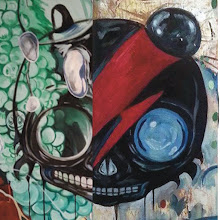


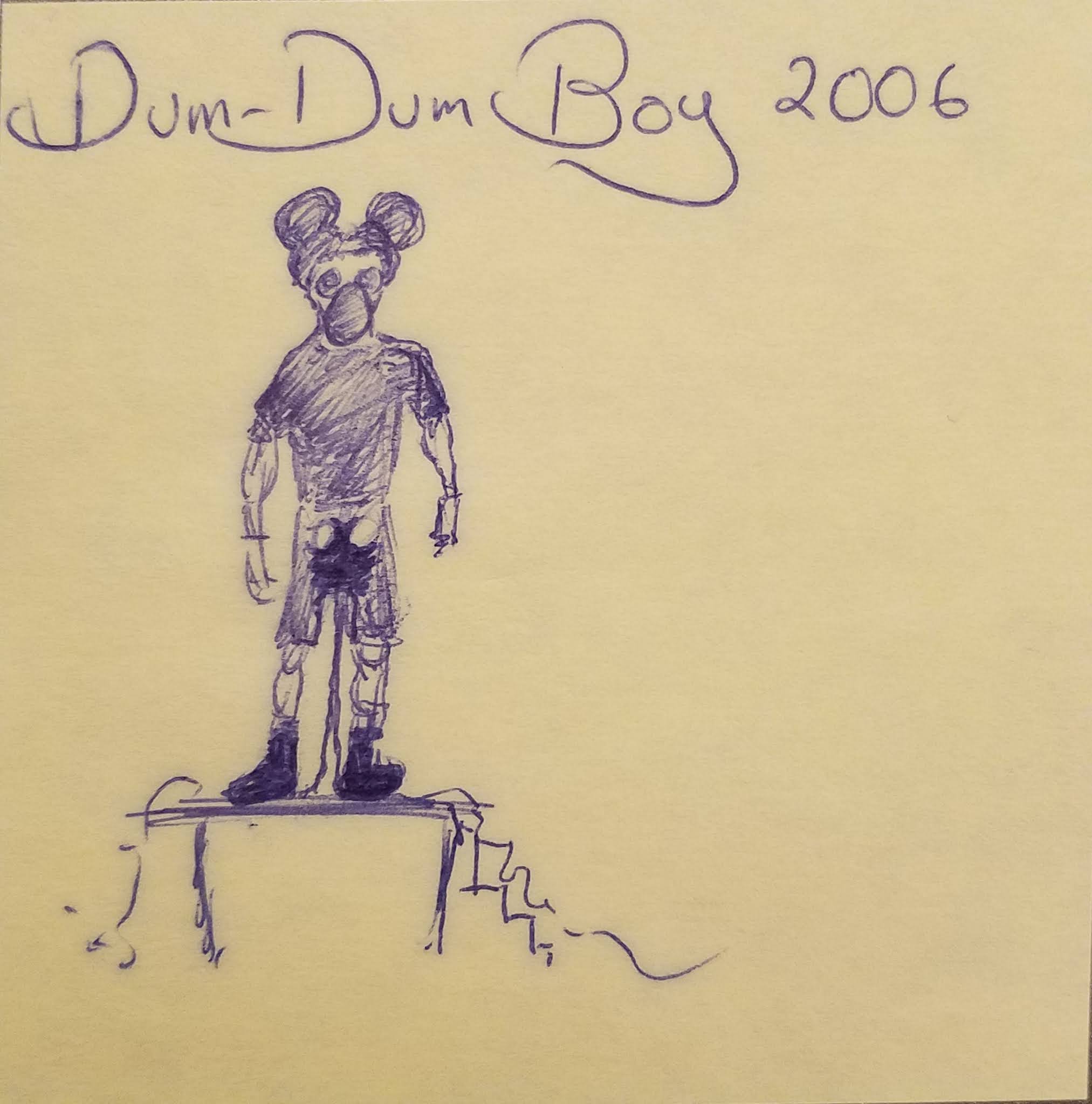

No comments:
Post a Comment